A deep burn leaves behind a thick, stiff layer of dead skin called eschar. When that layer wraps right around a limb or the chest, it can squeeze what lies beneath, and a planned release incision restores room for blood flow and breathing.
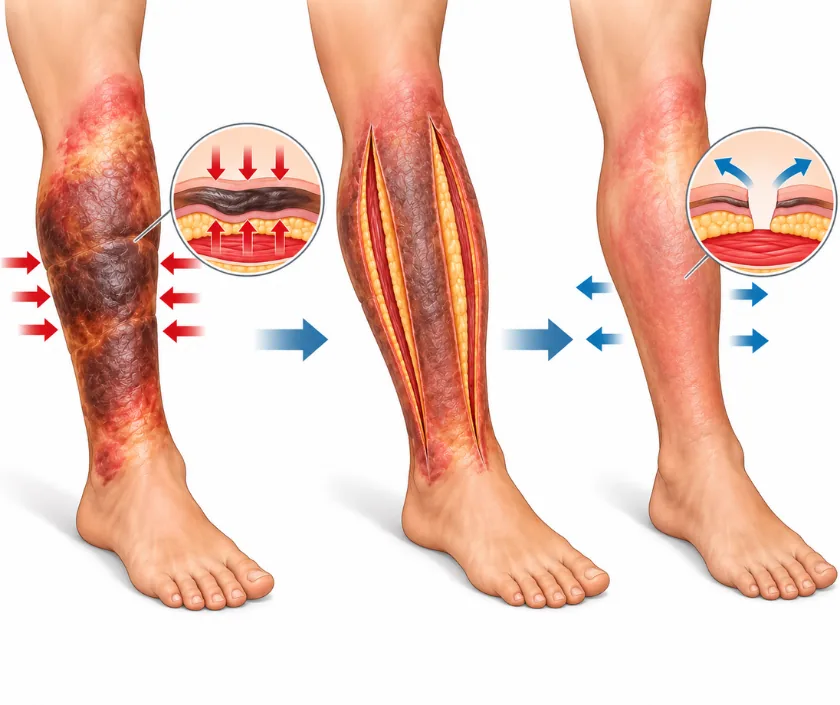
An escharotomy is an incision made through the thick dead skin of a deep burn to relieve pressure underneath. When a deep burn encircles an arm, leg, finger or the chest, the stiff eschar cannot stretch as swelling builds, so circulation or breathing is squeezed. Cutting through that layer immediately gives the tissue room, and the wound is dressed and later grafted.
Healthy skin is elastic. Deeply burned skin is not. After a deep burn, the surface turns into eschar, a rigid crust of dead tissue. Meanwhile the injury and the fluid given in treatment cause swelling in the tissues underneath. If the eschar runs all the way around an arm, a leg, a finger or the chest wall, that swelling is trapped, and the pressure inside keeps climbing.
Circulation suffers first. Pulses at the wrist or ankle weaken, the hand or foot feels cold, and sensation changes. On the chest, the problem shows up as difficulty expanding the ribs, so breathing becomes laboured and oxygen levels drift down. Left alone, tissue that could have survived may not.
The procedure itself is straightforward. Using a blade or diathermy, the surgeon makes a line through the full depth of the eschar along a planned path on the side of the limb or across the chest. The stiff crust springs apart, pressure falls, and blood flow returns. Bleeding points are controlled, the released wound is dressed, and the patient goes back to the burn unit for continued monitoring.
An escharotomy is not part of every burn admission. It is reserved for the specific situation where dead, stiff skin is physically restricting what is underneath.
The team checks pulses with a handheld Doppler, examines colour, warmth and sensation, and on the chest watches breathing effort and ventilator pressures. Findings are recorded repeatedly so a trend, not a single reading, drives the decision.
Pain relief and sedation are given, and consent is taken from the patient or family with the reason explained plainly. Clotting is checked, warmth is maintained, and equipment for controlling bleeding is made ready at the bedside.
An incision is carried through the full thickness of the dead eschar along planned lines on the sides of the limb, or in a grid pattern across the chest. The crust separates visibly and the tissue beneath expands.
Pulses, colour, warmth and capillary refill are reassessed straight away, and on the chest the anaesthetist looks for easier breathing. If release is incomplete, the incision is extended rather than repeated elsewhere.
Bleeding points are sealed, the open wound is dressed with an antimicrobial layer, and the limb is elevated. Circulation checks continue hourly, since swelling can keep rising for another day or so.
Circulation and breathing are checked repeatedly. Pain relief is adjusted, the limb is kept raised, and any oozing from the incision is managed with dressings.
Swelling usually peaks and then begins to settle. The release wound is inspected at each dressing change, and the wider burn plan continues alongside.
Dead tissue is removed in theatre and skin grafting is planned. The escharotomy line is generally grafted at the same time as the surrounding burn.
Attention turns to scar softening, pressure garments and joint movement. Some escharotomy scars need later release if they tighten across a joint.
Relief of pressure is usually immediate and obvious, with pulses and colour improving within minutes. What the procedure cannot do is reverse damage that has already occurred, or make the underlying burn any shallower. The area still needs grafting, and the release line becomes part of the final scar pattern. Function afterwards depends mostly on how deep the original burn was and how consistently therapy is followed.
This is a small procedure with a clear purpose, but it is performed on injured tissue in an unwell patient, so it carries real risks that the team plans for.
By discharge the release wound is usually grafted or healing. The habits that protect it are simple and matter for months.
The eschar being divided is dead tissue with no working nerve endings, and sedation with pain relief is given. Most patients describe pressure rather than sharp pain.
Quite the opposite. The release is done precisely to protect circulation and give the limb the best chance of surviving intact.
It only relieves pressure. Removal of dead tissue, dressings and skin grafting still follow as part of the wider treatment plan.
When a bandage is the cause, loosening it certainly helps. Here the constriction comes from the burned skin itself, which no amount of unwrapping will relieve.
Decisions like this are time sensitive, and Elegance Clinic in Surat aims to make them calmly, with the reasoning explained to the family before anything is done.

An escharotomy is rarely billed on its own, because it happens within an ongoing burn admission that already includes intensive monitoring, dressings and medication. Charges depend on how many sites are released, whether theatre and general anaesthesia are used, and the length of the overall stay.
You will be given a written estimate once the extent of the burn has been assessed, and an updated statement as treatment continues. Most policies treat this as covered emergency inpatient care, and our team will assist with preauthorisation.
These are the questions that come up most often in consultation. If yours is not here, send it on WhatsApp and the team will reply, usually the same day.
Ask your question →A written estimate is prepared after the burn has been assessed, since cost depends on how many sites need release, whether theatre time and anaesthesia are involved, and the length of the admission. The release is one line item within the wider burn treatment bill.
Emergency burn admission is usually treated as covered inpatient care, and a release procedure performed during that admission normally falls within it. Cover depends on your policy terms, sum insured and room category, so preauthorisation is started as early as possible.
It is time sensitive rather than frantic. Circulation and breathing are checked repeatedly, and once the signs show that pressure is restricting them, waiting risks losing tissue that could be saved. The team explains the reasoning before proceeding.
The dead layer being divided has no working nerve endings, so the cut itself causes little sharp pain. Sedation and pain relief are given regardless, because the surrounding burn is sore and the situation is stressful for anyone.
Pressure relief is felt within minutes, but the wound left behind heals on the same timetable as the rest of the burn. Removal of dead tissue and grafting usually follow within the next week or two, and scar care continues for months.
No. Only burns that encircle a limb, a digit or the chest tend to cause the trapped pressure this procedure relieves. Many deep burns are patchy or one sided and are managed with dressings and grafting alone.
The release line becomes part of the burn scar and is usually grafted along with the surrounding area. Scars can widen or tighten across a joint, which is why stretching, moisturising and pressure garments are part of the plan.
Each technique below has its own page explaining how it works and when it is chosen.
Seeing patients from across the city and beyond: read about the practice on the plastic surgeon in Surat page, or check what a written estimate covers on the costs and insurance page.
