When a burn is too large for the available donor skin, the wound can be covered for a time with skin from a human donor or from an animal source. This page explains what these covers do, why they are temporary and how the decision is made.
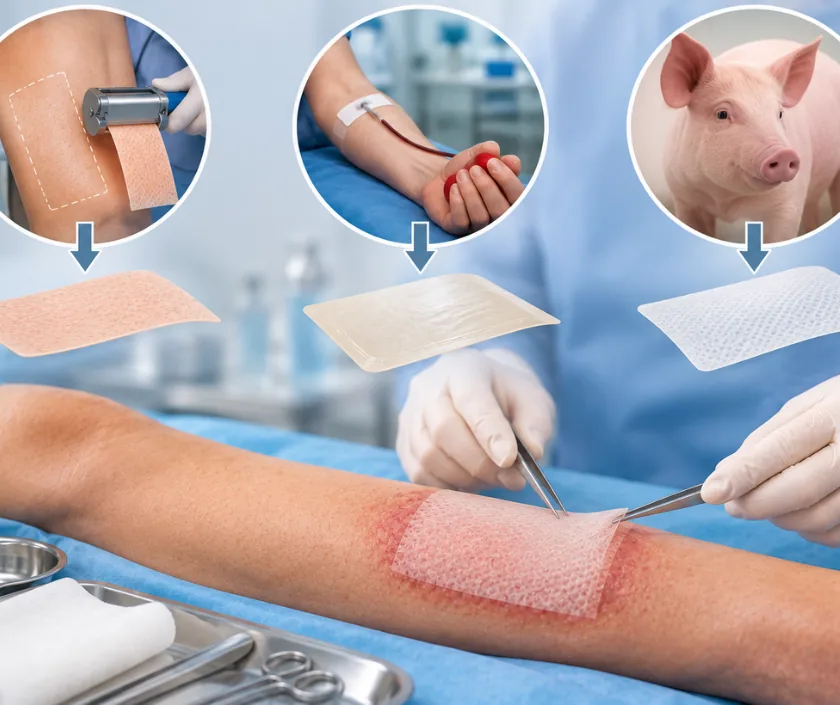
Allograft, also called homograft, is skin from a human donor. Xenograft is a processed layer from an animal source, most often pig. Both act as temporary covers rather than lasting replacements, because the body recognises them as foreign and sheds them over time. They protect the wound, reduce pain and fluid loss, and buy time until skin from the patient can be used.
Extensive burns create a simple problem: there may not be enough unburned skin left to cover everything at once. Leaving raw areas open is not safe, so the surgeon needs something to close the surface while donor sites heal and become available again.
Skin from a human donor answers that need well. It behaves like real skin, sticks to the bed, cuts down fluid and heat loss and makes the wound far less painful. Such tissue comes from a tissue bank, where donors are screened and the skin is processed and stored under regulated conditions. It is understood from the start that this cover will not last. Over a period of weeks the immune system recognises it as foreign, and it is removed or replaced with skin from the patient before that stage arrives.
A xenograft works on the same principle using a processed layer from an animal source, most often pig. Families sometimes find that idea startling, which is why it is discussed openly beforehand, along with what the alternatives are.
Temporary cover suits situations where the wound must be closed now although lasting cover is not yet possible. It is a bridge, chosen for specific reasons and for a limited time.
The surgeon explains what the material is, where it comes from, how long it is expected to stay and what happens next. Alternatives are set out, and the family decides with time to ask questions.
Dead tissue is removed and bleeding is controlled, exactly as it would be before grafting. A clean, healthy bed matters just as much for temporary cover as for a graft.
The sheet is laid on the prepared area, trimmed and fixed with staples, sutures or dressings. Edges are settled carefully so the material stays in contact with the bed everywhere.
Layered dressings hold everything in place. The team watches for adherence, fluid underneath and any sign of infection, checking at intervals rather than leaving it untouched for long.
Once donor areas are ready, the temporary layer is lifted and skin from the patient is applied. This may happen in one sitting or in stages across several visits to theatre.
Comfort usually improves once the raw surface is closed. Dressings are checked, temperature is watched and fluid balance is managed. The cover is expected to stick down to the bed.
Adherence is assessed at planned inspections. Some areas may need replacing. Donor sites are prepared or allowed to heal so that lasting cover can follow.
The temporary layer is exchanged for skin from the patient, usually in planned sittings. Physiotherapy continues throughout so joints do not stiffen while waiting.
Lasting appearance depends on the definitive graft rather than the temporary cover. Scar care, garments and reviews follow the same path as any grafted burn.
This cover is a stage, not an outcome. It should be judged by whether the wound stayed protected and the patient reached definitive grafting in better shape, rather than by how the skin looks. Final appearance comes from the graft that follows. Shedding of the temporary layer is expected rather than a complication, and the timing of exchange is planned around it.
Tissue used this way is screened and processed under regulated conditions, and it is placed with the same care as a graft. Even so, some risks belong to the method.
Most care in this phase happens in hospital, though families still have a real part to play.
It cannot. The body recognises it as foreign within weeks, so it is exchanged for skin taken from the patient.
Tissue comes from screened donors and is processed and stored under regulated conditions before use.
The material is a processed layer placed on the surface as a dressing. It does not become part of the body and is removed later.
It usually means the burn is large. Temporary cover is a planned step towards grafting rather than a sign that treatment has failed.
Decisions about donor material are made with the family at Elegance Clinic in Surat, unhurried and with alternatives laid out. Nothing is used without that conversation happening first.

Cost reflects the material used, the area covered, theatre and anaesthesia time, and the fact that a further operation for lasting cover will follow. Availability of banked tissue also affects planning and price. After assessment the office prepares a written estimate covering the whole sequence as far as it can be predicted, and checks what a policy or scheme will pay towards it.
These are the questions that come up most often in consultation. If yours is not here, send it on WhatsApp and the team will reply, usually the same day.
Ask your question →Price depends on the material, the area covered, theatre time and the further surgery that follows. Because this is a stage rather than the final operation, the estimate is prepared for the whole planned sequence after assessment, and scheme or insurance cover is checked in advance.
Donors are screened and the tissue is processed and stored under regulated conditions before it reaches theatre. Any transmission risk is remote, and it is weighed against the real danger of leaving a large burn open. The reasoning is explained before consent is taken.
In a large burn there may not be enough unburned skin to cover everything in one sitting. Donor areas also need time to heal before they can be used again. Temporary cover keeps the wound closed and comfortable while that process happens.
It stays for a matter of weeks rather than months, and the exact period varies with the individual and the material used. Planned inspections decide when it is exchanged. Waiting until the layer is visibly shedding is avoided, since exchange is easier while the bed is healthy.
Final appearance is decided mostly by the graft placed afterwards, not by the temporary layer. Keeping the bed protected in the meantime does help, because a dried or infected bed produces a worse result. Scar care after grafting follows the usual path.
Yes. The source of the material is explained beforehand and the decision belongs to the family. Where it is declined, the plan shifts to staged grafting, wider meshing or a synthetic substitute, and the trade offs of each are set out honestly.
The conversation covers what the material is, where it comes from, how it is screened, how long it is expected to stay and what operation follows. Alternatives are described with their advantages and drawbacks. Consent is taken only after those questions have been answered.
Each technique below has its own page explaining how it works and when it is chosen.
Seeing patients from across the city and beyond: read about the practice on the plastic surgeon in Surat page, or check what a written estimate covers on the costs and insurance page.
