A pressure garment is a tight elastic sleeve, vest or mask worn over a healing burn scar. This page covers how garments are measured and fitted in Surat, how long they are worn each day and what they can realistically achieve.
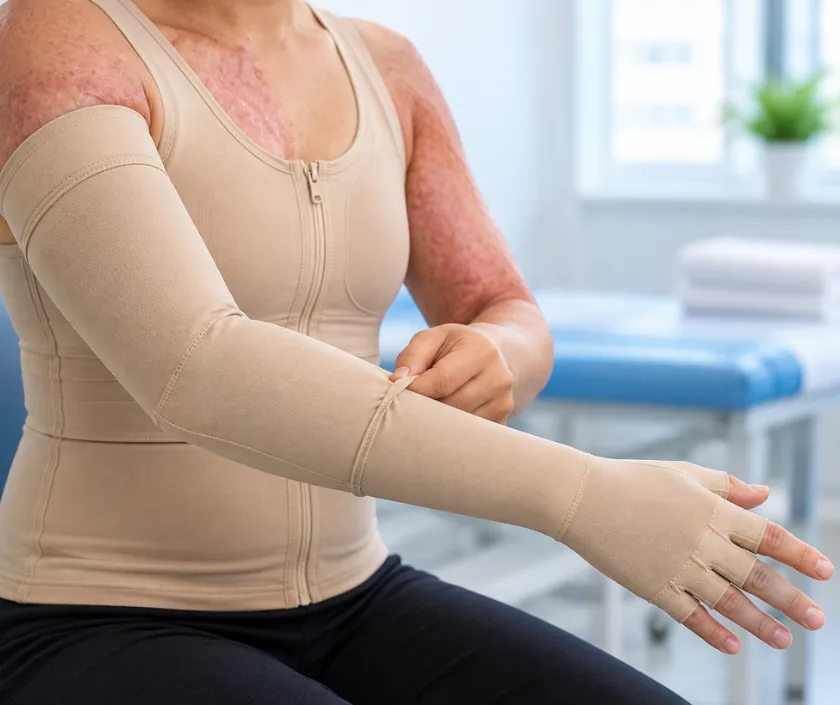
Pressure garments are custom made elastic sleeves, vests, gloves or masks that press evenly on a healing burn scar. Steady pressure appears to help a raised scar flatten and soften as it matures. Garments are usually worn for most of the day and night, and replaced as they stretch or as a child grows.
Deep burns often heal with a scar that rises above the skin, turns red and feels firm. Left alone, that scar can keep thickening for months before it slowly settles. Pressure therapy uses a close fitting elastic garment to apply steady, even load over the whole area, which many burn units have used for decades to encourage flattening and softening.
Every garment is made to measurement. Your limb or trunk is measured at several levels, and the fabric panels are cut smaller than those figures so the material stretches on. Sleeves, gloves, vests, leggings and face masks are all available, and zips or hooks are added where a garment would otherwise be impossible to pull on.
Wearing time is the part patients underestimate. Garments are generally worn through the day and night, coming off only for bathing, skin care and exercise. Because elastic tires, garments are checked at review and replaced when they no longer feel snug, and children need new ones as they grow.
Pressure therapy suits people whose burn has healed but whose scar is thickening, and who can commit to wearing a garment nearly all day.
Your scar is examined for thickness, colour and firmness, and the skin is checked to confirm it is fully closed. Areas that need extra padding, such as a hollow at the neck or armpit, are noted.
Measurements are taken at several levels along the limb or trunk, usually with the joint in a natural position. Numbers are recorded on a chart so the next garment can be ordered without repeating the whole process.
The garment is made to those measurements and then tried on with you present. Pressure is judged by feel and by how the fabric sits, and seams are moved away from bony points.
Getting a tight garment on takes practice, so you are shown the technique before leaving. Care of the skin underneath, washing routines and the daily wearing target are all written down for you.
At each review the scar and the fit are checked together. Elastic that has slackened is replaced, and children are remeasured because a garment outgrown quickly stops applying useful pressure.
Skin has to get used to constant pressure. Wearing time is built up gradually, and the skin underneath is inspected every time the garment comes off.
By now the garment is usually worn day and night apart from bathing and exercise. Itching often eases first, well before any change in scar height is visible.
Scars typically start to flatten and lose some redness during this period. Garments are replaced as the elastic tires, and measurements are repeated at each review.
Once the scar looks pale, flat and soft, wearing hours are reduced step by step. Stopping too early can let a scar thicken again, so the decision is made at review.
Pressure therapy changes how a scar matures. Many patients see a raised scar become flatter, paler and less itchy across several months, though the skin never returns to how it looked before the burn. Results depend heavily on wearing hours, and a garment left in a drawer does nothing at all. Where a scar is already mature and pale, little further change should be expected.
Garments are a low risk treatment, yet a poor fit or a long spell without checking the skin can cause real damage.
Small habits decide whether a garment is worn or abandoned, so the routine is worth setting up properly in the first week.
Benefit tracks closely with wearing hours, which is why the target is most of the day and night.
Excess pressure damages skin and cuts circulation, so garments are measured rather than pulled as tight as possible.
Elastic slackens with washing and wear, and growing children outgrow garments, so replacements are part of the plan.
It helps a scar flatten and soften, but healed burn skin keeps a different colour and texture.
Scar management at Elegance Clinic in Surat is planned alongside burn surgery, so garments are ordered as soon as the skin will tolerate them. Dr. Ashutosh Shah reviews the scar and the garment fit together at each visit.

Cost depends on the body area covered, whether a sleeve, glove, vest or face mask is needed, the type of fabric and how many replacements the year will require. Children usually need more garments than adults, simply because they grow. Following your assessment a written estimate lists the first set and the expected replacements, so the yearly cost is clear from the start.
These are the questions that come up most often in consultation. If yours is not here, send it on WhatsApp and the team will reply, usually the same day.
Ask your question →Price varies with the area covered, the fabric chosen and the number of replacements needed over a year. A written estimate is prepared once the scar has been assessed and measurements taken. Ask about insurance at that visit, since cover for garments differs between policies.
Yes, when they are measured properly and the skin is checked at every break. Problems come from garments that are too tight at one point or worn over skin that is not fully healed. Report blisters, numbness or colour change straight away.
Most people wear a garment until the scar looks pale, flat and soft, which commonly takes many months. Wearing hours are then reduced gradually rather than stopped at once, because an active scar can thicken again if pressure is removed too soon.
It will not. Pressure helps a raised scar settle flatter, paler and less itchy, and that difference is often noticeable. Healed burn skin still keeps its own colour and texture, so the aim is a softer, calmer scar rather than invisible skin.
Children wear garments routinely, and they often adapt faster than adults do. Growth means more frequent remeasurement, and parents check the skin at every break. Play and school continue as normal, with the garment worn under ordinary clothes.
Fitting waits until the wound is closed and the new skin can take gentle pressure without breaking down. That point often comes a few weeks after healing or grafting. Starting while the scar is still active gives the treatment the best chance.
The scar and skin are examined first, then measurements are taken along the affected area. You will discuss which style of garment suits your daily life. Once made, the garment is tried on with staff present, and you practise putting it on yourself.
Each technique below has its own page explaining how it works and when it is chosen.
Seeing patients from across the city and beyond: read about the practice on the plastic surgeon in Surat page, or check what a written estimate covers on the costs and insurance page.
