Tangential excision removes burned skin in thin shaves until living tissue appears underneath. This page explains why it is done early, how the raw surface is covered afterwards and what recovery in Surat usually looks like.
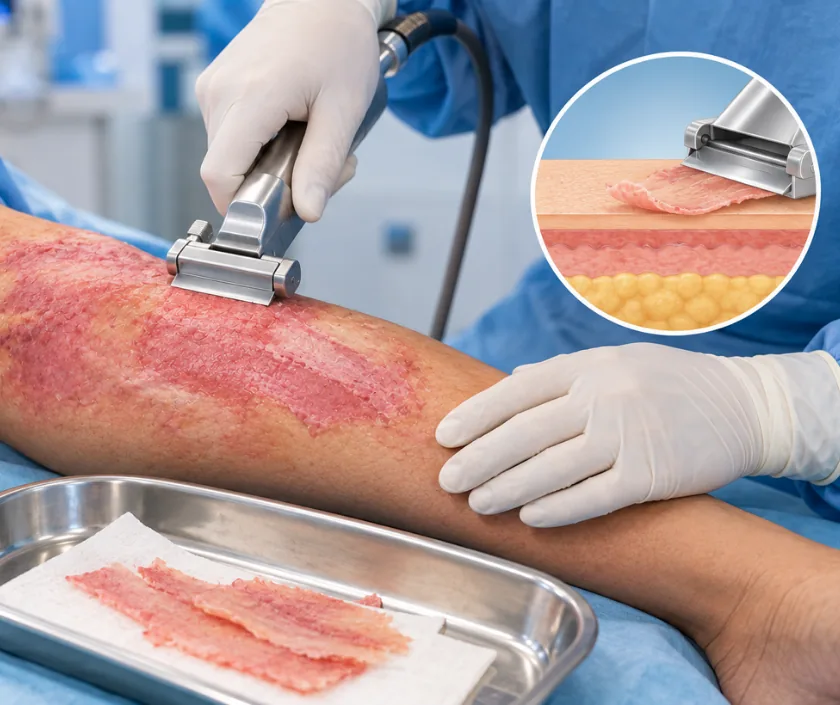
Tangential excision is the surgical removal of burned skin in thin horizontal layers until healthy, bleeding tissue is reached. Surgeons use it for deep burns that will not heal on their own. Because the healthy base is preserved, the raw area can be covered at the same sitting with a graft or a temporary dressing. Timing depends on how stable the patient is.
Deep burns leave behind a layer of dead skin called eschar. Eschar does not heal and it does not lift away by itself. While it stays on the body it feeds bacteria and holds the wound open, so surgeons remove it rather than wait.
In tangential excision the surgeon uses a guarded blade to shave the burn in thin passes. After each pass the surface is inspected. Dull or grey tissue means another shave is needed. Bright pinpoint bleeding from a white, firm bed means living tissue has been reached, and the surgeon stops there. Because only the dead layer is taken, healthy dermis underneath is preserved, and that spared dermis tends to give a softer scar later.
Bleeding is expected and is controlled with medicated gauze, tourniquets on limbs and careful diathermy. For that reason large areas are usually done in planned sittings rather than all at once, with blood arranged in advance. Cover follows straight away where the bed looks reliable.
Tangential excision suits deep burns that still have some healthy tissue underneath. Whether it is right for a particular patient depends on burn depth, overall stability and the plan for cover.
Burn depth, size and the general condition of the patient are assessed together. Blood is grouped and arranged, and the anaesthetic team confirms fitness. A plan for cover is agreed before the theatre date is fixed.
Surgery happens under general anaesthesia. The patient is warmed actively, since heat is lost quickly from open burn surfaces. Limbs may be raised or a tourniquet applied to reduce bleeding during the shave.
Using a guarded blade, the surgeon takes thin passes across the burn. Each pass is inspected. Shaving continues until the bed shows firm white dermis with fine pinpoint bleeding across the surface.
Warm medicated gauze, gentle pressure and targeted diathermy settle the bed. Only when bleeding is under control does the team decide whether the surface is ready for immediate cover.
A skin graft, a temporary biological cover or a dressing is applied to the raw bed. Layers of padding follow, and limbs are splinted where movement could disturb the surface.
Pain relief, fluids and warmth are the priorities. Dressings usually stay undisturbed unless there is a reason to look. Blood counts are checked and repeated if the excision was large.
A first dressing change tells the team how well the bed and the cover have taken. Physiotherapy starts early so joints near the burn do not stiffen.
Most grafted areas are closed by now, though some patients need a second sitting. Pressure garments, silicone and moisturiser are usually introduced around this time.
Scars soften and fade slowly. Colour and texture keep changing for a long while, and any release procedure for tightness is planned only once things settle.
Excision closes a wound, and it does not restore skin to the way it looked before the burn. Grafted areas usually stay a different colour and texture from surrounding skin, and the donor site leaves a mark of its own. Preserving dermis helps the area stay softer and move better. Some patients need more than one sitting, and scar treatment continues long after the wound has healed.
Burn surgery is done on patients who are already unwell, so risks are discussed openly before consent. Knowing what can happen makes early problems easier to spot.
Most of the work after discharge is steady and unglamorous. Following the plan closely protects what surgery achieved.
Dead skin does separate eventually, but slowly, and the wait invites infection and deeper scarring.
Depth becomes clearer with time, yet the wound also becomes more dangerous. Early removal is usually the safer trade.
Large or deep burns are often treated in planned sittings, and scar care carries on for many months afterwards.
Once the dermis is gone, a raw surface needs cover from a graft or a substitute rather than time alone.
Burn care at Elegance Clinic in Surat is planned as a pathway rather than a single operation, with the surgical, anaesthetic and physiotherapy plan explained to the family in plain language. Written estimates are shared before admission so families know what they are agreeing to.

Cost depends on the area excised, the number of sittings required, whether blood transfusion is needed, the type of cover used and the length of hospital stay. Anaesthesia, theatre time, dressings and physiotherapy are counted separately. After assessment the office prepares a written estimate, and where a policy or a government scheme applies the team helps with the paperwork.
These are the questions that come up most often in consultation. If yours is not here, send it on WhatsApp and the team will reply, usually the same day.
Ask your question →Cost varies with the size of the burn, the number of sittings, the type of cover used and how long the hospital stay turns out to be. A written estimate is prepared after assessment, and insurance or scheme cover is checked before admission.
Fitness is judged case by case. Resuscitation, warming and correction of blood counts come first, and surgery is timed for when the body can tolerate it. The anaesthetic team reviews every patient beforehand, and large burns are often treated in planned stages.
Early removal is generally preferred once the patient is stable, because dead tissue invites infection. Exact timing depends on the depth of the burn, the area involved and how resuscitation is going. The surgical team reassesses daily rather than fixing a date in advance.
Discomfort is expected, particularly at the donor site if a graft was taken. Pain relief is prescribed and adjusted, and dressing changes are timed around medication. Most people find the ache eases steadily over the first week rather than staying at the same level.
Grafted and healed burn skin stays different in colour and texture from skin nearby, and the difference is usually visible. Preserving healthy dermis helps the area stay softer and move more freely. Pressure garments, silicone and time all improve the appearance gradually.
Burns that extend into fat or muscle need a deeper form of excision. Patients who are still unstable, severely anaemic or not yet fully resuscitated wait until those problems are corrected. Superficial burns that are healing well need dressings rather than surgery.
The burn is examined, depth and area are estimated and photographs may be taken with consent. Blood tests and a fitness review follow. Removal and cover are explained, questions are answered and a written estimate is shared before anything is booked.
Each technique below has its own page explaining how it works and when it is chosen.
Seeing patients from across the city and beyond: read about the practice on the plastic surgeon in Surat page, or check what a written estimate covers on the costs and insurance page.
