Burn scar across the wrist and hand pulls the fingers out of position, so grip and pinch slowly disappear. Release surgery restores the missing skin, brings the joints back towards a working position and gives hand therapy something to build on.
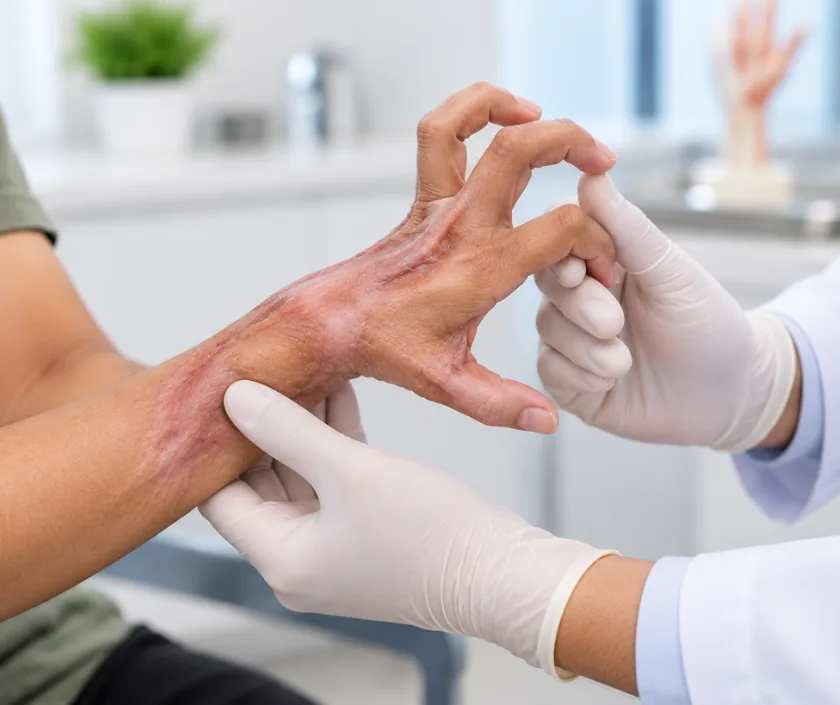
Wrist and hand contracture release divides the tight burn scar, brings the wrist and fingers back towards a working position and resurfaces the raw area with a graft or a flap. Fine wires sometimes steady small joints while the skin heals. Splinting in a safe position and daily hand therapy then decide how much grip and pinch return.
Skin over the hand is thin and mobile, and it has to fold and stretch constantly. After a burn, that skin heals into scar with no give, so the wrist and fingers are dragged towards whichever surface was injured. A burn on the back of the hand tips the knuckles backwards and lifts the fingers away from the palm. Scarring in the palm does the opposite and curls them inwards.
Function drains away quietly. Holding a glass, buttoning a shirt, writing, using a phone and cutting food all become clumsy, and people start using the other hand for everything. Joints that never move grow stiff on their own, while small muscles waste, which adds a second layer of difficulty on top of the tight skin.
Surgery therefore has two aims. One is to put back the skin the burn destroyed, and the other is to bring joints to a position from which the hand can work. Therapy afterwards carries the result, since a released hand that is not exercised simply tightens again.
Release helps when tight skin, rather than a destroyed joint or tendon, is the main thing keeping the hand out of position.
Grip, pinch, joint movement and sensation are recorded, and the therapist sees the hand before surgery. Which surface is tight, and how the fingers behave when the wrist moves, guides the whole plan.
Scar is divided across the lines of tension, so the wrist and fingers can be brought back towards a working position. Tendons, nerves and vessels lying close under the skin are identified and protected.
Thick skin grafts are usually taken from the groin or the inner arm, because they shrink less than thin grafts. Exposed tendon or joint may need a flap of tissue with its own blood supply instead.
Fine wires sometimes steady a small joint for a short period, and a splint holds the wrist slightly back with the knuckles bent. Both measures stop new skin from contracting into the old pattern.
Movement begins as soon as the graft is judged secure. Sessions cover swelling control, tendon glide, grip practice and scar work, with a home programme that continues long after the wound has healed.
Hand stays raised in a bulky dressing and splint. Fingertips are watched for colour, warmth and sensation, while pain relief is adjusted as needed.
First dressing change shows how the graft has taken. Gentle guided movement starts, and swelling control becomes a daily job at home.
Grip and pinch practice increases as the skin toughens. Splints are often adjusted, and scar massage with moisturiser is added once the surface is closed.
Grafted skin softens and its colour settles gradually. Night splinting frequently continues, and growing children are reviewed for fresh tightening between the fingers.
Hands usually gain a working position and a useful grip, although fine dexterity rarely returns to what it was before the burn. Grafted skin remains different in colour and texture, and stiff joints may keep some limitation even after the skin is corrected. Effort put into therapy shapes the outcome more than any other single factor. Repeat release is sometimes needed, particularly for children whose hands are still growing.
Hand surgery involves delicate structures, so the possible problems deserve a clear discussion beforehand.
A released hand keeps its position only when the daily routine is followed once you are back home.
Grafted skin heals well yet keeps a different colour and texture. What improves most is movement, not appearance.
Therapy timed with wound healing protects tendon glide and joint movement. Delay allows stiffness that is far harder to reverse.
Scar keeps pulling for months afterwards. Splints and daily exercise hold the position that surgery achieved.
Staged release through the growing years often restores useful grip, even when the hand has been tight for a long time.
Hand reconstruction at Elegance Clinic in Surat runs with a therapist involved before and after surgery, because splinting and exercise decide how much function the operation gives back.

Hand contracture release restores lost function, so mediclaim policies and government schemes usually accept it once photographs and a note on the limitation are submitted. Charges vary with the number of fingers released, the type of skin cover, the use of wires, anaesthesia and how much hand therapy is planned. An itemised written estimate is given before admission.
These are the questions that come up most often in consultation. If yours is not here, send it on WhatsApp and the team will reply, usually the same day.
Ask your question →Most cases fall within Rs 45,000 to Rs 1.6L. The number of fingers released, the type of skin cover, use of fine wires, anaesthesia and planned hand therapy all affect the total. You receive a written estimate before admission.
Cover is usually available, because the surgery restores grip and daily independence rather than changing appearance. Photographs, a note on the movement lost and a treatment plan are normally requested. Policy waiting periods and room rent limits continue to apply.
Release is a routine reconstructive operation, though tendons, nerves and small vessels sit close beneath the scar. Careful technique reduces the risk of injury to them. Graft loss, stiffness and infection remain possible and are easier to manage when reported early.
Guided movement often begins within the first weeks, and light everyday tasks follow as the graft toughens. Strong gripping waits longer. Splinting at night and a home exercise programme usually continue for many months to protect the position gained.
Useful grip and pinch often return, yet fine dexterity may stay reduced when joints have been stiff for years. Skin will look grafted. How much function returns depends heavily on therapy done at home between appointments.
Children are treated when tightness limits grip, school work or growth of the hand. Waiting can let joints stiffen and fingers deform. Because scar does not grow with the hand, more than one release is sometimes needed through childhood.
Movement of each joint, grip, pinch and sensation are recorded, and the scar is examined with the hand stretched. Photographs are taken for the file and for insurance. Skin cover options, splinting and therapy are then explained in detail.
Each technique below has its own page explaining how it works and when it is chosen.
Seeing patients from across the city and beyond: read about the practice on the plastic surgeon in Surat page, or check what a written estimate covers on the costs and insurance page.
