Tissue expansion grows new skin beside a burn scar so the scar can be replaced with tissue of matching colour. This page explains both operations, the weeks with a visible expander in place, and what the whole plan may cost.
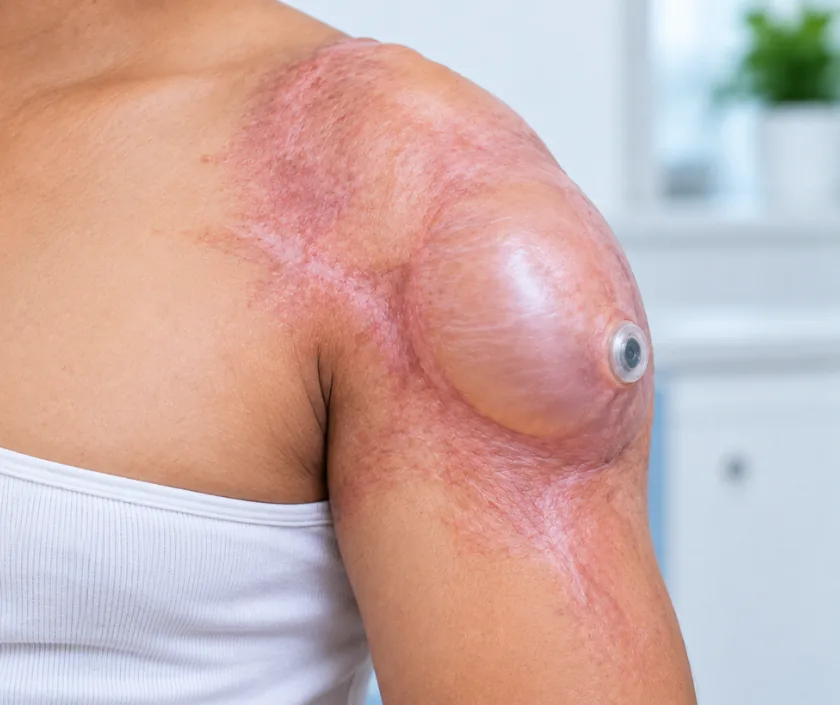
Tissue expansion grows extra skin next to a burn scar, so the scar can be removed and replaced with skin of matching colour and texture. A silicone balloon is placed under healthy skin and filled with saline over several weeks, then a second operation removes it and moves the new skin across. Living with a visible bulge is part of the deal.
Skin responds to steady stretch by making more of itself, which is the principle behind expansion. Surgeons use it when a burn scar is too wide to remove and close directly, and when colour match matters enough to justify a longer route. Scalp, forehead, cheek, neck, chest and limbs are the usual sites.
A pocket is made under healthy skin beside the scar, and a silicone expander is placed inside with a small filling port under the surface nearby. Every week or so, sterile saline is added through that port with a fine needle. Skin above stretches gradually, and the bulge grows steadily over the weeks.
Once enough new skin has formed, a second operation removes the expander, cuts out the scar and slides the expanded skin across. Because the moved skin comes from the same region, its colour, thickness and hair growth usually match well. Understanding the middle phase, with a visible swelling, matters before you agree to start.
Expansion asks for patience and a tolerance of looking different for a while. It rewards that with the closest colour match reconstruction can offer.
The scar is measured, donor areas are assessed and a size of expander is chosen. Photographs are taken. Time is then spent explaining the middle weeks honestly, because that is the part people find hardest.
Under general anaesthesia, a pocket is made beside the scar and the deflated expander is slipped in with its filling port. A little saline goes in immediately, and you usually go home within a day or two.
From about two weeks onward, saline is added through the port using a fine needle. Each session takes minutes. Tightness for a few hours afterwards is normal, and the amount is adjusted to your comfort.
Once enough skin has grown, the expander comes out, the scar is excised and expanded skin is advanced or rotated across the gap. Drains are often used, and stitches stay in longer than usual.
Moved skin settles over the following months. Any remaining scar can be treated in a further round of expansion, planned once the tissue has fully recovered.
Discomfort after placement is modest and settles with tablets. The wound stays dry, and the small amount of saline already inside causes little change in shape.
Stitches come out and filling begins. Ordinary work is usually possible, while heavy lifting and contact sports are avoided for as long as the device is in place.
The bulge is now obvious. Clothing, a hairstyle or a scarf helps, and most people have settled into the routine of filling visits by this stage.
After the second operation the new scar softens and fades slowly. Colour match becomes clearer, and a further stage can be planned when the area was large.
Colour and texture usually match far better than any graft, and the final scar is a line rather than a patch. Skin gained is limited, though, so very large scars may need two rounds or partial correction. Expect some widening of the scar over time, and a period of altered shape while the device is in place. Most people find the middle weeks harder than the recovery after either operation.
Expansion is a well established technique, and most courses run to plan. Problems tend to show themselves early, which is why regular review matters.
Daily life carries on during expansion with a few sensible adjustments.
It is a temporary device, removed at the second operation once enough skin has grown.
Cheek, neck, chest, abdomen and limbs are all expanded regularly where healthy skin lies nearby.
Most people describe pressure and tightness for a few hours, and the volume added each time can be reduced when needed.
Gain is limited by the size of the device and the skin around it, so large scars sometimes need a second round.
Expansion is offered at Elegance Clinic only after a frank discussion about the weeks in the middle, because consent given without that picture rarely holds up. Filling visits for families travelling into Surat are grouped to reduce trips.

Expansion is quoted after assessment rather than from a fixed band. Price reflects the number and size of expanders, two admissions, anaesthesia and the run of filling visits in between. Replacing one small scar costs far less than expanding several areas at once. A written estimate is shared before anything is booked, along with a clear note of what insurers usually consider and what they do not.
These are the questions that come up most often in consultation. If yours is not here, send it on WhatsApp and the team will reply, usually the same day.
Ask your question →A soft silicone balloon is placed under healthy skin next to the scar and filled slowly with sterile salt water. Steady stretch makes the skin grow in area. At a second operation the balloon comes out and new skin is moved across the scar.
Almost certainly, once filling is under way. A bulge develops under the skin and grows week by week. Clothes, a scarf, a cap or a change of hairstyle help, and many people choose to start treatment during a quieter season at work.
Two as a rule, one to place the expander and one to remove it and move the skin. Large scars occasionally need a further round afterwards. Filling visits happen in between and are done in the outpatient room.
A written estimate is prepared after assessment, since price depends on the size and number of expanders, both admissions and the length of the filling programme. Insurance cover varies with the reason for surgery, so that is discussed openly before booking.
It is well established and usually straightforward. Infection, leakage and thinning of the skin over the device are the main concerns, and each is normally managed by early review. Smoking raises the risk noticeably, so stopping beforehand is strongly advised.
Most people carry on with ordinary work. Heavy lifting, contact sports and pressure over the device are avoided. Travel is possible provided filling appointments are kept, and sessions can sometimes be grouped for those coming from far away.
That is a reasonable choice, and alternatives exist. Skin grafts, removal of the scar over several sittings, or simply continuing with scar therapy are all discussed at consultation, with their advantages and drawbacks set out plainly.
Each technique below has its own page explaining how it works and when it is chosen.
Seeing patients from across the city and beyond: read about the practice on the plastic surgeon in Surat page, or check what a written estimate covers on the costs and insurance page.
