Tumours of the abdominal wall often involve muscle and the tough layers that hold the belly together. Reconstruction restores that support after removal, so the abdomen stays strong and a bulge or hernia becomes far less likely.
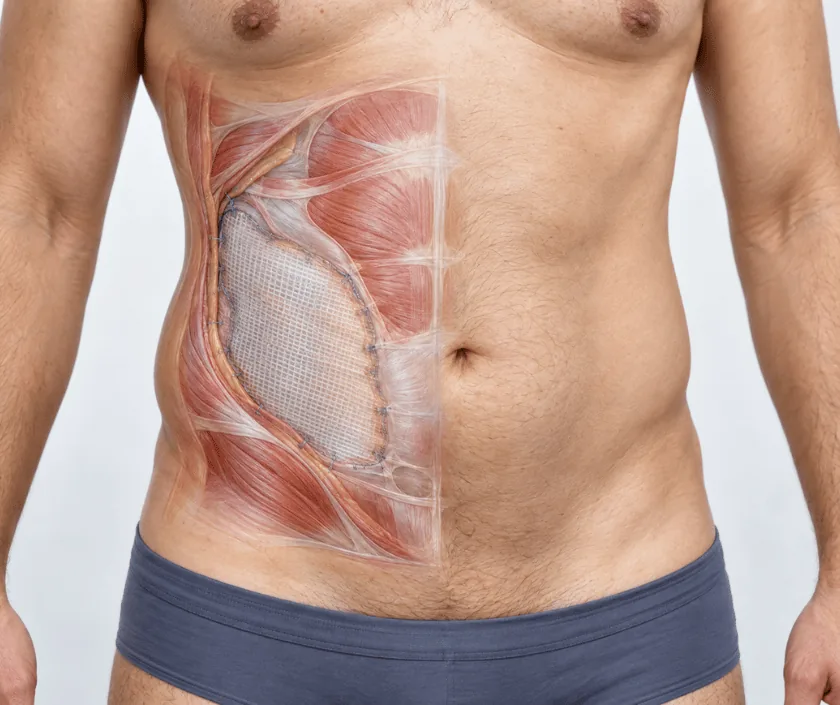
Abdominal wall tumour reconstruction rebuilds the layers of muscle and fascia after a tumour is removed from the belly wall. Mesh, a muscle flap or a free flap restores strength where the gap is large. The aim is a wall that holds pressure without bulging, with healthy skin cover on top.
The abdominal wall is built from layers of muscle wrapped in tough fascia. Tumours here may start in that tissue, as desmoid tumours and sarcomas do, or reach it from an organ inside. Because these growths sit within the layers that hold the abdomen together, removing them with a clear margin usually takes the full thickness of the wall.
Reconstruction then has two jobs. Strength comes first, since pressure inside the abdomen pushes constantly against any weak point. Mesh is fixed to healthy fascia around the gap, and a component separation technique can bring your own muscle layers back toward the midline. Where the defect is very large, tissue is borrowed from the thigh or back to bridge it.
Cover comes second. Skin and fat are advanced across the repair, or a flap is used when skin was removed alongside the tumour. Living tissue over mesh lowers the risk of infection, which is the complication that causes most trouble in this region.
Planning depends on how much of the wall must come out, and on whether your own tissue can be brought across to fill the gap.
Scans are studied with the oncology team to judge how much muscle and fascia must come out. Donor options and the likely position of any mesh are agreed before the day of surgery.
The tumour is taken with a margin of healthy tissue, often through the full thickness of the wall. Bowel and other structures are dealt with by the general surgeon when they are involved.
Mesh is fixed to sound fascia around the gap. Component separation can release your own muscle layers so they meet in the midline, giving a repair made largely of living tissue.
For very large gaps, tissue from the thigh or back is transferred, sometimes as a free flap joined to nearby vessels under a microscope. That adds both bulk and blood supply.
Skin and fat are closed over the repair with drains beneath. Pressure inside the abdomen is watched, since a tight closure can affect breathing and circulation.
Pain relief allows sitting up and gentle walking. Drains stay in place, and eating restarts slowly once the bowel wakes up.
Drains come out as the output settles. Walking increases each day, though lifting and straining remain firmly off the list.
Most people return to office work and light activity. An abdominal support belt may still be advised for comfort during longer days.
Strength continues to improve with guided exercise. The repair is checked at reviews, alongside scans arranged by the cancer team.
A repaired abdominal wall is usually strong enough for ordinary life, though it rarely feels identical to before. Numbness around the scar is common, and some people notice firmness or a slight difference in shape. Recovery can vary, and returning to heavy lifting takes months rather than weeks. Weight control protects the repair over the years.
Because the abdomen is under constant pressure, this repair carries risks that deserve careful attention.
Protecting the repair while it gains strength is the main task at home.
Most repairs settle without trouble. Infection and bulging are the real concerns, and both are reduced by living tissue cover and by avoiding strain early on.
Support garments ease symptoms, though they do not close a gap in the fascia. Only a repair restores the layer that actually carries the strength.
Skin heals long before the deep layers do. Loading the abdomen too soon is the commonest reason repairs stretch or give way.
Wide defects pulled together under tension tend to fail. Mesh, muscle release or a flap spreads the load instead of concentrating it.
At Elegance Clinic in Surat, abdominal wall removal and repair are planned with the general surgeon and the oncologist, so a single operation covers both halves of the problem.

Cost varies with the size of the defect, the type and amount of mesh, whether a flap is needed and the length of stay. Operations that involve the bowel or a free flap sit at the higher end. Cancer surgery is often covered by insurance, and a written estimate is shared before admission.
These are the questions that come up most often in consultation. If yours is not here, send it on WhatsApp and the team will reply, usually the same day.
Ask your question →Free flap reconstruction usually falls between Rs 1.8L and Rs 4.5L, and the total is case based. Mesh, theatre time, intensive care and the length of stay all affect it. A written estimate is prepared before admission.
A bulge can develop at the edge of any repair, and the risk is higher in smokers, in people carrying extra weight and after early heavy lifting. Mesh and living tissue cover are used to reduce that chance.
Light activity resumes within a couple of weeks. Lifting is generally avoided for around six weeks, and heavy manual work or gym loading waits until about three months, guided by how the repair feels.
Not always. Small defects close with your own tissue once the muscle layers are released. Mesh is added when the gap is wide, when tension would be high or when nearby fascia is weak.
Antibiotics and drainage settle many cases, especially where muscle covers the mesh. Occasionally the mesh has to be removed and the wall repaired again later, which is discussed openly before surgery.
Usually yes, once the wound has healed. Timing is set with the oncologist, and living tissue cover is chosen partly because it tolerates radiation better than a tight closure.
Bring scans, biopsy reports, notes from any earlier abdominal surgery and a list of medicines. Mention any hernia, previous mesh or wound infection, since each of those changes how the repair is planned.
Each technique below has its own page explaining how it works and when it is chosen.
Seeing patients from across the city and beyond: read about the practice on the plastic surgeon in Surat page, or check what a written estimate covers on the costs and insurance page.
