Basal cell carcinoma is the most common skin cancer and the slowest to cause serious trouble. It grows in one place, almost never spreads to other organs, and complete removal with a clear margin usually settles the problem.
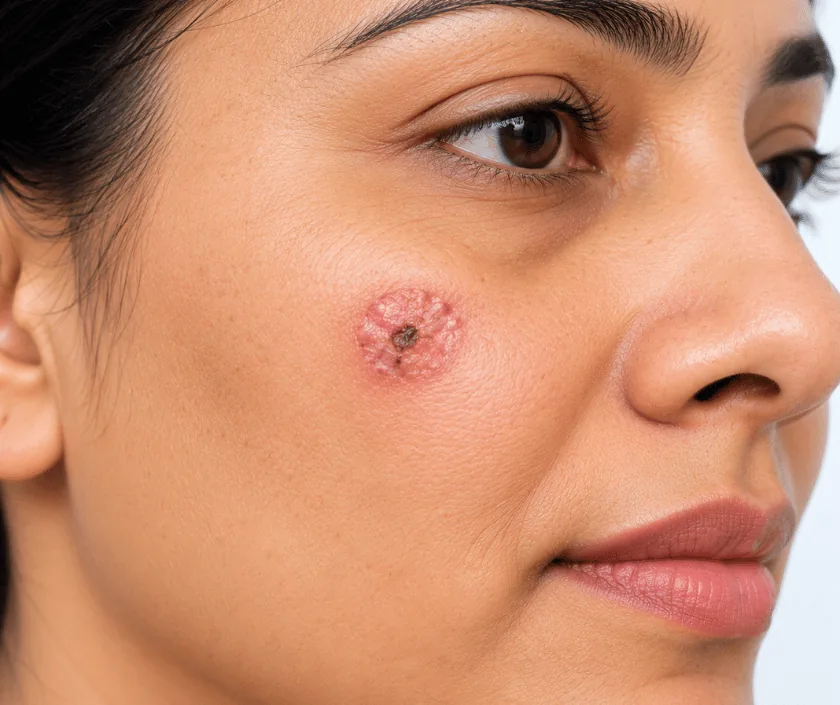
Basal cell carcinoma excision removes the lesion along with a small rim of normal skin around it. Because this cancer grows slowly and rarely spreads, complete removal with clear margins usually settles it for good. The gap is then closed directly, with a local flap or with a skin graft, depending on size and site.
Basal cell carcinoma usually appears as a pearly bump, a scaly patch or a small sore that keeps bleeding and scabbing without ever settling. Sun exposed skin on the face, ears, scalp and shoulders is the usual site. Growth is slow, measured in months and years rather than weeks, and spread to distant organs is very rare.
Treatment aims at removing the whole lesion in one piece. A rim of normal skin is taken around it, along with a little fat underneath, so that hidden extensions come out too. That specimen goes to the laboratory, where a pathologist checks every edge and reports whether the margins are clear.
Closing the gap is the second half of the job. Small defects come together in a line placed along a natural skin crease. Larger ones need a local flap, where nearby skin is moved across to fill the space, or a graft taken from behind the ear or near the collarbone. Choice of method depends on size, site and how freely the skin moves.
Excision suits nearly everyone with a confirmed basal cell carcinoma, and the main planning question is how the gap will be closed.
A punch or shave biopsy confirms the type of skin cancer. Lesion and planned margin are then marked while you sit upright, so that the final scar lines up with the natural creases of the face.
A fine needle numbs the area, and the sting lasts only a few seconds. Most people stay awake, chat through the procedure and go home within a couple of hours.
That marked disc of skin is lifted with a small amount of fat beneath it. Orientation stitches are placed so the laboratory can tell exactly which edge came from which side.
Small wounds close in a line. When skin is short, a local flap borrows tissue from beside the defect, or a graft is taken from behind the ear where colour and texture match well.
Pathology confirms the margins within a few days. Should one edge be involved, a small further excision is planned promptly rather than waiting to see what happens.
Mild soreness and some swelling are usual, especially around the eye when the lesion sat on the nose or cheek. Simple painkillers are enough for most people.
Stitches come out somewhere between five days and two weeks depending on the site. Scars look red and firm at this stage, which is entirely normal.
Redness begins to fade and the line softens. Makeup and sun protection can be used freely once the surface has healed fully.
Most scars settle into a pale line. Skin checks continue, since people who develop one basal cell carcinoma have a higher chance of developing another.
Complete removal with clear margins settles most basal cell carcinomas, and further treatment is rarely needed. A scar remains, and its final look depends on the site, the closure and your own healing. Faces tend to heal well because the blood supply is rich. Recovery can vary, and redness may take several months to fade, so patience helps more than any product.
This is a small operation, though it is still surgery on the skin, and a few things can go differently from the plan.
Wound care here is simple, and doing the basics consistently gives the scar its best chance.
It is a true skin cancer. Spread to other organs is very rare, yet it keeps growing locally and can damage cartilage, eyelids and bone when left alone.
Some thin lesions do respond to those methods, though surgery gives a specimen the laboratory can check, which is why it remains the usual choice.
Scars are placed in creases and settle over months. Most people find the line far less troubling than a sore that kept bleeding.
Damage builds up across a lifetime, so daily protection lowers the chance of new lesions appearing on other sun exposed skin.
Elegance Clinic in Surat treats skin cancer removal and the repair as one plan, so the closure is designed before the lesion is taken out.

Charges depend on the size of the lesion, its site, how the gap is closed and the laboratory work involved. A small excision closed in a line costs much less than a flap on the nose or a graft near the eyelid. Cover under insurance varies between policies, so a written estimate is prepared after assessment.
These are the questions that come up most often in consultation. If yours is not here, send it on WhatsApp and the team will reply, usually the same day.
Ask your question →A written estimate follows assessment, since size, site and the method of closure all change the figure. Laboratory charges for margin reporting are added separately. Bring your insurance details, because cover for skin cancer surgery differs between policies.
It is the least aggressive of the common skin cancers and almost never spreads to other organs. Left alone, though, it keeps growing into nearby tissue, so removal is still advised rather than simply watching it.
Usually not. Complete removal with clear margins handles most lesions on its own. Radiotherapy is kept for situations where surgery is unsuitable, or where the report shows features that call for extra treatment.
Most excisions take under an hour under local anaesthesia, and you go home the same day. Larger repairs using a flap or a graft take longer and may need a short period of rest before discharge.
A further excision is planned to take the remaining edge. Catching this on the report is exactly why the specimen goes for examination, and one more small procedure is usually all that is needed.
Fresh scars look red and raised, then fade over several months. Placement along a natural crease helps a great deal. Sun protection, gentle massage once healed and time do more for the final look than any cream alone.
Recurrence is uncommon after complete removal with clear margins, though it does happen, particularly on the nose and around the eye. Any new lump, scab or colour change in an old scar should be shown at a review.
Each technique below has its own page explaining how it works and when it is chosen.
Seeing patients from across the city and beyond: read about the practice on the plastic surgeon in Surat page, or check what a written estimate covers on the costs and insurance page.
