Many people put up with a discharging opening or a patch of exposed mesh for months before asking about it. Once mesh is infected, dressings rarely settle the problem, and removal with sound tissue cover is usually needed.
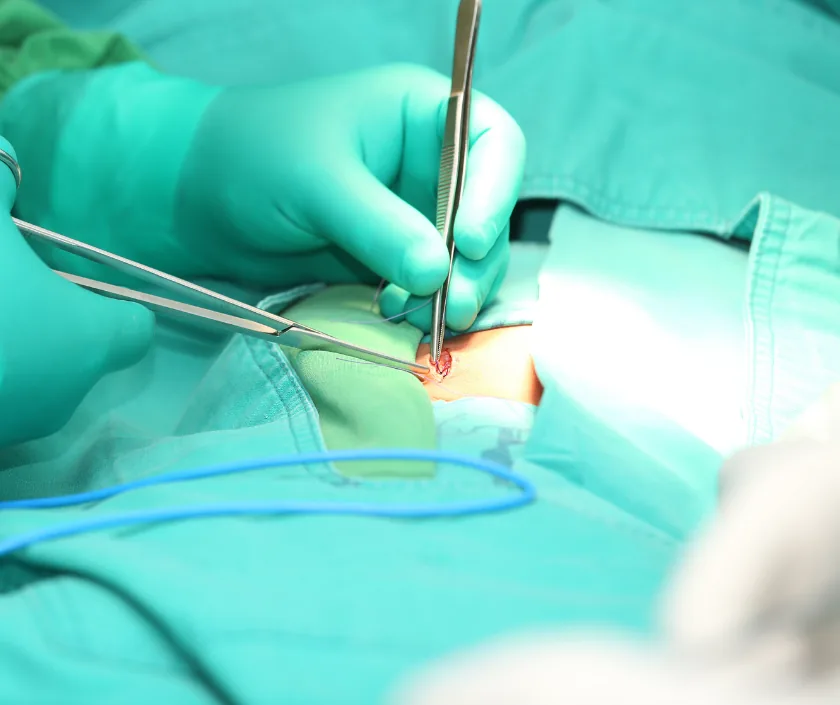
Mesh exposure means the mesh used in a hernia repair has become visible through the skin or is discharging through a small opening. When mesh becomes infected, bacteria shelter within its fibres where antibiotics cannot reach them. Treatment usually involves removing the affected mesh, repairing the abdominal wall and covering it with healthy tissue.
Mesh is used in most hernia repairs and usually causes no trouble at all. Occasionally bacteria settle on it, either during surgery or later through the bloodstream. Because mesh is a synthetic material with no blood supply of its own, immune cells and antibiotics struggle to reach the bacteria hiding within its fibres.
What patients notice is often subtle at first. A small opening appears in the old scar, fluid leaks, things settle for a while with tablets, then the discharge returns. Over months dressings become part of daily life. Sometimes mesh can be seen at the base of the opening, or felt as a firm plate beneath thin skin.
Assessment involves examining the area, sending swabs and arranging a scan to map how far the infection spreads and how much mesh is involved. Treatment then removes the infected mesh, cleans the cavity and repairs the abdominal wall. Cover comes from healthy tissue, since skin closed over an infected space simply breaks down again.
Treatment suits anyone whose mesh has become infected or exposed and whose symptoms have not settled with wound care and antibiotics.
You are examined, swabs are taken and a scan maps the infected area. Old operation notes help identify the type of mesh and where it was placed, which shapes the surgical plan.
Infected mesh is removed along with the surrounding inflamed tissue and any sinus track. Complete removal matters, because a small piece left behind can keep the infection going.
The space is washed thoroughly and unhealthy tissue is excised until healthy tissue is reached. Samples go for culture so antibiotics can be matched precisely to the organism found.
The abdominal wall is repaired using your own tissue, a component separation, or biological material where synthetic mesh would be unwise in an infected field.
Healthy skin or a flap covers the repair, and drains manage fluid. Antibiotics continue as advised while the wound and blood tests are monitored closely.
Pain relief, antibiotics and drain care are the focus. You are helped to sit and walk early, and the wound is inspected regularly for leak or redness.
Most people go home once the wound is dry and tablets control the pain. Dressing appointments continue, and you are shown what to watch for at home.
Comfort usually improves noticeably. Reviews check the repair and the wound, and light activity resumes while lifting stays restricted.
Strength returns gradually with guided exercise. Reviews carry on to check for any hernia coming back and to confirm the infection has settled.
Removing infected mesh usually settles the discharge and lets the wound close for good. The abdominal wall may be weaker than before, and a hernia can appear later, especially where synthetic mesh had to be avoided. Scars are longer than the original ones. Recovery can vary, and with extensive infection the repair is sometimes staged, with a further operation planned once things have settled.
Surgery in an infected field carries higher risk than a straightforward first hernia repair, and that is explained openly.
After surgery, protecting the repair and finishing the antibiotic course do most of the work.
A stitch problem settles quickly. Discharge carrying on for months usually means infected mesh underneath and needs proper assessment.
Bacteria live within the mesh fibres where medicines cannot reach them. Tablets calm the symptoms while they are taken and rarely solve the problem.
Long standing infection wears the body down and makes later surgery harder. Earlier assessment usually means a smaller, simpler operation.
Not always. Once infection has fully settled, a further reinforced repair can often be planned, and the options are discussed with you.
Long standing mesh problems deserve a proper plan rather than another course of tablets, so assessment here is thorough and a written estimate is provided before admission.

Pricing depends on how much mesh is involved, how far the infection has spread, the repair technique required and the length of stay, so an estimate follows assessment rather than a phone enquiry. The written estimate separates surgeon and anaesthesia fees, theatre charges, any biological material used, ward stay and review visits, with help offered for insurance claims.
These are the questions that come up most often in consultation. If yours is not here, send it on WhatsApp and the team will reply, usually the same day.
Ask your question →An estimate is written after assessment, since the amount of mesh, the spread of infection, the repair technique and the length of stay all differ. Every element appears in writing before admission so the figure is clear.
Rarely. Bacteria live within the fibres of the mesh, where medicines and immune cells cannot reach. Antibiotics may calm symptoms for a while, yet the discharge usually returns once the course ends.
It is not too late, and treatment still helps. Longer standing infection can mean more tissue is involved, so surgery may be larger. Assessment shows exactly what is needed in your case.
It can, particularly where synthetic mesh had to be avoided. The wall is repaired using your own tissue or biological material, and later reinforcement is discussed once the infection has fully cleared.
Many people stay for a few days, and longer when infection is deep or the repair is complex. Discharge follows once the wound is dry, pain is controlled and antibiotics are settled.
Sometimes. Where infection is widespread, cleaning may come first and definitive repair later. Staging protects the final result, and any such plan is explained clearly before you agree to surgery.
Bring the notes from your original hernia operation, details of the mesh if known, any swab results, recent scans and a list of medicines. A written estimate follows once the plan is agreed.
Seeing patients from across the city and beyond: read about the practice on the plastic surgeon in Surat page, or check what a written estimate covers on the costs and insurance page.
