Bioengineered dressings are built from living cells, collagen scaffolds or processed tissue rather than plain gauze. They give a stalled wound the building blocks it lacks, so the body can start laying down new tissue again.
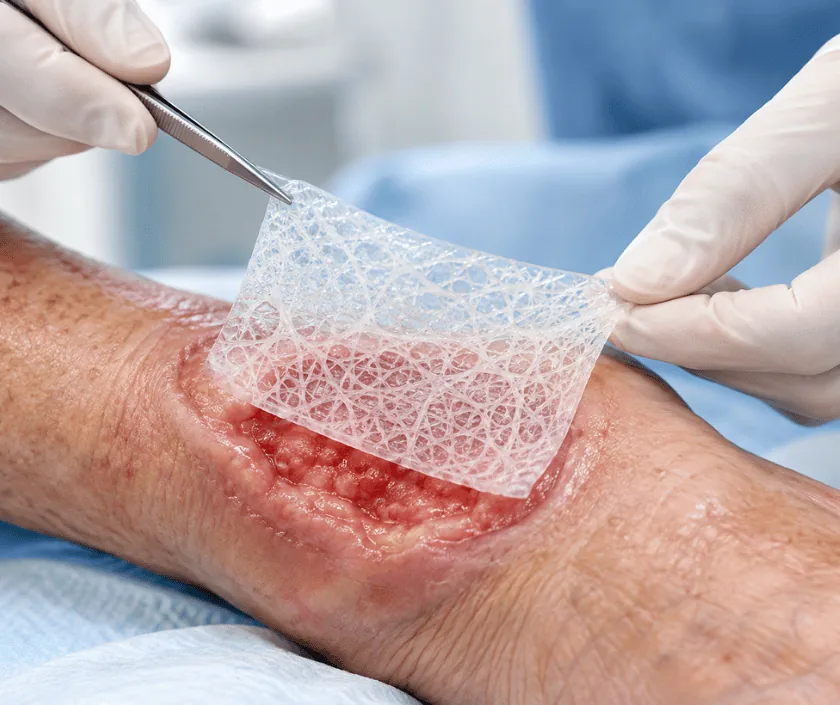
Bioengineered dressings are wound coverings built from collagen, growth factor carriers or living skin cells. Unlike gauze, they take part in healing by giving the wound a scaffold and signals to grow into. They are chosen for clean wounds that have stopped improving, and they work alongside pressure relief, infection control and blood flow treatment.
Ordinary dressings do an important but limited job. They keep a wound moist, absorb fluid and stop dirt getting in. A bioengineered dressing goes further, because it is built from materials the body recognises and can use.
Several types exist. Collagen sheets give the wound a ready framework, which saves the body the work of building one. Some products carry growth factors, the natural signals that tell cells to divide and move. Others contain living skin cells grown in a laboratory, which release those signals directly into the wound bed. Silver or honey may be combined with the scaffold where bacteria are a concern.
Choosing between them is a clinical decision rather than a shopping choice. It depends on how deep the wound is, how much fluid it produces, whether bone or tendon is visible and how good the blood supply is. In practice these dressings are applied in a clinic, covered with a simple outer dressing, then reviewed every few days so the plan can change quickly if nothing is moving.
They work best on a clean wound with a decent blood supply that simply needs a push. A wound that is dirty, deep or starved of blood needs something else first.
The wound is measured and photographed, the edges are examined and earlier notes are compared. Nothing is applied until the base is judged clean enough to accept it.
Any slough or dead tissue is removed and the wound is washed. Local anaesthetic is used if this part is likely to be uncomfortable.
The product is cut to shape, laid on the wound and held with a light outer dressing. Compression or offloading is reapplied over it where that is needed.
You return after a few days. Outer dressings come off, progress is measured against the photographs, and the next application is planned or the plan is changed.
The dressing stays undisturbed. Mild warmth or itching around the edge is common. Keep the area dry and continue any compression or footwear you were given.
Many wounds start to look smaller at the edges first. A further application may be made at each review, depending on how much of the previous one has been absorbed.
By now the direction of travel is clear. Some wounds have closed or nearly closed, while those that have not are reassessed for surgery.
Attention shifts to preventing a return, using compression stockings, footwear, sugar control or vein treatment as the case needs.
Many wounds respond, and some close entirely without surgery. Others improve only while the dressings continue. Response can vary a great deal, and it depends far more on blood supply, pressure relief and sugar control than on the product itself. If a wound has not moved after a fair trial, carrying on is rarely the right answer, and a surgical plan is discussed instead.
These dressings are gentle, although a few problems do occur and it is fair to know them beforehand.
The dressing works only if it stays where it was placed and the cause of the wound is treated at the same time.
The dressing helps only when the base is clean and blood is reaching it. Otherwise the money is wasted.
They can avoid surgery in shallow wounds. Deep wounds with exposed bone or tendon still need tissue moved over them.
Most plans involve several applications across a few weeks, with a review between each one.
A tidy surface can hide poor blood flow or continuing pressure, so the cause is checked at every visit.
Elegance Clinic in Surat treats these dressings as one tool within a plan that also covers blood supply, pressure relief and infection. You are told before starting how many applications are being planned and when the plan will be reviewed.

The price of a bioengineered dressing depends on the product chosen, the size of the wound and how many applications the plan needs. A written estimate is prepared after the wound is assessed, and it separates the dressing itself from clinic visits and from any procedure carried out at the same time. Insurance policies differ in what they allow for advanced dressings, so your policy is checked before treatment starts.
These are the questions that come up most often in consultation. If yours is not here, send it on WhatsApp and the team will reply, usually the same day.
Ask your question →The cost varies with the product, the size of the wound and the number of applications planned. A written estimate is prepared after the wound is measured, and it separates the dressing from clinic visits so you can see where the money goes.
Yes, provided the wound is clean and blood is reaching the foot. Dead tissue must be removed first and pressure must be taken off the area. Without those two steps the dressing simply sits on a wound that cannot respond.
Many wounds start to shrink at the edges within two or three weeks. Progress is judged by measurement and photographs rather than by how the wound feels, because a wound can look wetter for a while and still be improving.
Shallow, clean wounds often do close with these dressings alone. Deeper ones usually still need a graft or a flap. After a fair trial the wound is reassessed honestly and a surgical option is discussed if progress has stopped.
Generally no. A wound with bone or tendon visible needs tissue moved over it, because a dressing cannot bridge that gap. Bioengineered products suit shallow wounds with a healthy pink base far better.
Most plans involve an application every few days to a week, with a review each time. Timing depends on how quickly the product is absorbed and on how much fluid the wound produces during that period.
The wound is cleaned, measured and photographed, and circulation in the limb is checked. Earlier reports and medicines are reviewed. You then hear which options fit, what each involves and what the estimate looks like before anything is applied.
Each technique below has its own page explaining how it works and when it is chosen.
Seeing patients from across the city and beyond: read about the practice on the plastic surgeon in Surat page, or check what a written estimate covers on the costs and insurance page.
