A hand born without a usable thumb loses most of its grip, because nothing can meet the fingers. This page explains pollicisation, the operation that moves the index finger into the thumb position, and what it asks of your child.
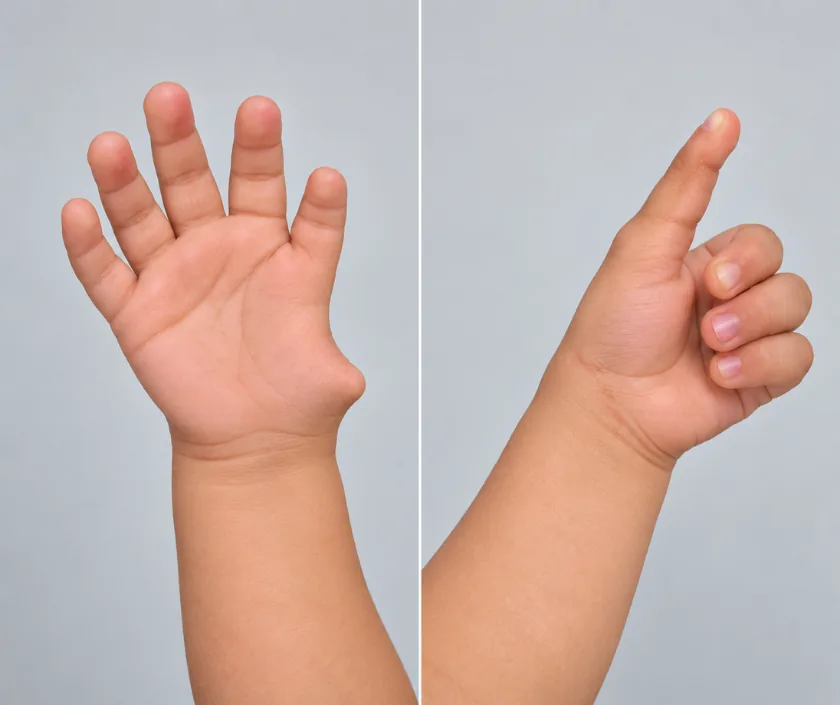
Pollicisation moves the index finger into the thumb position, along with its own nerves, blood vessels and tendons. The finger is shortened, turned and set at an angle so it can meet the other fingers. Surgeons use it when a child is born with no thumb, or with a thumb too unsteady to be worth keeping. Hand therapy afterwards teaches the new grip.
The thumb sits apart from the fingers and swings across the palm to meet them. That single movement is behind most of what a hand does, from holding a spoon to buttoning a shirt to gripping a cricket bat. A hand with no usable thumb loses much of its grip, because there is nothing to press against. Children then scoop objects between two fingers or against the palm, which works for large items but fails for small ones.
Pollicisation solves this by making a thumb from what is already there. The index finger is lifted on its own skin, nerves, arteries and tendons, shortened at the knuckle, rotated and moved to where a thumb belongs. Small muscles are rebalanced so the new thumb can pull across the palm and pinch.
Because the moved finger keeps its own nerve supply, sensation stays. Children usually accept the new thumb quickly, since the brain adapts far more easily in early life than later. Therapy then turns that new position into everyday habit.
Before anything is planned the whole child is checked, because a missing thumb is sometimes linked with heart, kidney or blood conditions. The hand is then assessed by the surgeon and the hand therapist together.
The whole arm is examined and X ray pictures are studied to see which bones and joints are present. How your child currently picks things up is watched, since that shows what the new thumb must achieve.
Skin flaps are raised and the index finger is freed on its own nerves, arteries and tendons. Keeping these attached is what allows the finger to survive and to keep normal feeling.
The knuckle bone is shortened so the new thumb is not too long. The finger is then rotated and tilted, so its pulp faces the other fingers the way a thumb does.
Small hand muscles are reattached so the new thumb can move away from the palm and pinch. Tendons are adjusted in length, since a moved finger needs a different pull to work well.
Skin is closed to shape a web space, and a well padded cast protects the hand. Your child stays in hospital while circulation to the new thumb is watched closely.
Your child is in hospital while the hand is kept raised and the blood supply checked. Pain relief is given regularly. The cast covers the hand and part of the arm.
The cast comes off at review and the wounds are checked. Hand therapy begins with gentle movement, scar care and games that ask the new thumb to touch each finger.
Pinch and grip usually feel more natural. Many children use the new thumb without thinking. A night splint is sometimes advised while strength continues to build.
The new thumb grows with your child. Reviews check movement, strength and skin. Small adjustments are occasionally useful, and therapy is repeated around any further stage.
Most children gain a useful pinch and use the new thumb without stopping to think about it. The hand still looks different, because there are three fingers beside the new thumb rather than four. Movement is usually good but rarely the same as a hand that was never affected. Strength builds slowly over the first year with therapy. Some children need a small later procedure to improve position or release tightness.
Pollicisation is a demanding operation with a long record of good function in children. Even so, you should know what can go wrong before agreeing to it.
The arm is protected for the first few weeks and then the real work begins with therapy and play.
A moved finger has its own feeling and movement, which no device worn on the outside can give.
Children adapt quickly and use the remaining fingers well. A working pinch matters far more than a fourth finger.
The hand learns best in early childhood, so waiting often makes the new thumb harder to use well.
Therapy after surgery is what turns a new thumb into a thumb the child actually uses.
Parents tell us they value being shown exactly what their child can and cannot do now, and what the plan is meant to change.

Pollicisation is a long operation that needs an experienced team, careful anaesthesia and close monitoring afterwards, so no single price fits every child. The estimate reflects theatre time, the nights in hospital, whether other differences in the same arm are treated at the same sitting, and the months of hand therapy that follow. Cover under a government scheme or a mediclaim policy depends on the diagnosis and the hospital. A written estimate is prepared once your child has been examined and the plan agreed.
These are the questions that come up most often in consultation. If yours is not here, send it on WhatsApp and the team will reply, usually the same day.
Ask your question →No fixed band is published for this operation, since theatre time, hospital stay and any extra work on the same hand all vary. Hand therapy afterwards also forms part of the plan. You are given a written estimate after assessment, with a note on likely scheme or insurance cover.
It is carried out routinely in specialist units and children tolerate it well when they are fit for anaesthesia. Weight, blood tests and heart and kidney checks come first, since related differences are common. Monitoring after surgery is close for the first days.
A cast is worn for about three to four weeks, then therapy starts. Comfort returns within days. Confident use of the new thumb builds over months, and therapy visits usually continue for a while after the cast comes off.
It works as a thumb for most everyday tasks, with feeling preserved, though it stays a little shorter and moves less than a thumb that formed normally. Many children write, dress and eat without help. Function matters more here than appearance.
The hand has one fewer finger and a thumb built from that finger, so it does look different. Most children mind far less than parents expect, because the hand suddenly does what they want. Shape can be refined later if it troubles them.
Many teams prefer the early years, while the brain adapts most readily and grip habits are still forming. Timing also depends on size, general health and other treatment the arm may need. Older children and adults can still benefit.
The arm is examined, grip is watched during play and X ray pictures are reviewed. Photographs may be taken for records. You will hear whether pollicisation suits your child, what the stages involve, what therapy is needed and what the estimate covers.
Seeing patients from across the city and beyond: read about the practice on the plastic surgeon in Surat page, or check what a written estimate covers on the costs and insurance page.
