Amniotic band syndrome happens when strands of tissue wrap around a baby in the womb and leave a tight ring on a limb or digit. This page explains which rings need urgent attention and how the rest are treated in stages.
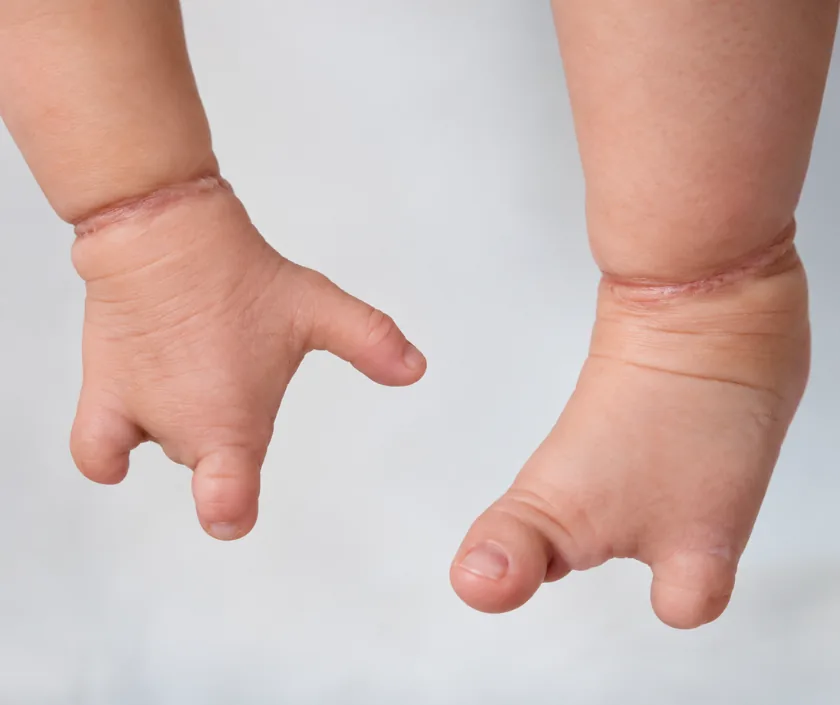
Amniotic band syndrome, also called constriction ring syndrome, happens when strands of tissue in the womb wrap around a limb or a finger. They leave a groove in the skin, and the part beyond can be swollen, fused or missing. A tight band can squeeze the blood supply in a newborn, so urgency depends on how tight it is.
Early in pregnancy, strands of the inner sac can come loose and wind around a developing arm, leg, finger or toe. The band acts like a tight thread. Where it presses, the skin forms a groove that can be shallow or deep. Beyond the groove, fluid struggles to drain, so the finger or limb may look puffy. A tight band can also press on the nerves or the blood vessels.
The effects vary a great deal. Some children have only a faint ring that never causes trouble. Others have fingertips joined together, a part that stopped growing, or a digit that is absent because the band cut through before birth. Feet, legs and rarely the face can be involved as well. The condition is not inherited and is not caused by anything the mother did.
How soon treatment is needed depends on how tight the band is. A deep ring that threatens circulation in a newborn is released early, while a mild ring can be watched and dealt with when your baby is bigger.
Treatment depends on how deep the ring is and whether the part beyond it is swollen or short of blood supply. Some rings need urgent attention and others are simply watched.
The limb is examined for colour, warmth and swelling, and the depth of the ring is judged. X ray pictures show the bones. A deep ring in a newborn is treated as urgent rather than planned.
If circulation or drainage is threatened, the band is released without waiting. The tight ring of scar is cut out and the skin is closed so pressure on the vessels and nerves is relieved.
Rather than a straight closure, the skin is closed with interlocking flaps, often called Z plasty. Breaking the line of the ring stops the scar tightening into a fresh band as your child grows.
When fingertips are fused, they are divided and the sides are resurfaced with local flaps and small grafts. Nail folds are rebuilt so the separated fingers have neat, durable edges.
A very deep ring around a limb is sometimes released in two sittings, half the circumference at a time, so the blood supply to the skin stays reliable throughout.
A dressing or cast protects the repair and is kept dry and raised. Swelling beyond the ring often begins to settle within days once the pressure is relieved.
Dressings come off at review, and scar care and gentle movement start. Silicone or massage may be advised. Most children are back to school and ordinary play by this stage.
The scar softens and flattens. Movement and grip are assessed. Where fingers were separated, therapy continues so the new web spaces are used properly.
The limb is checked as it grows, since a scar can tighten with growth spurts. A further release or a small revision is occasionally needed in later childhood.
Releasing a ring usually settles the swelling and leaves a far smoother contour, though a fine scar line remains where the groove was. Deep rings are sometimes released in two stages, treating half the circle at a time, so the blood supply to the skin stays safe. If a nerve or muscle below the ring was already affected before birth, surgery cannot undo that. Separated fingers work and look better but may stay short or narrow.
Band release is usually straightforward and children heal quickly. These are the problems to be aware of before surgery.
Position, dressings and watching the fingers or toes beyond the dressing are the main things at home.
It follows a chance tear in the inner sac. It is not linked to what a mother ate, did or took.
Rings do not release themselves, and they can feel tighter as the limb grows against them.
It is not inherited and the chance of it happening again is very low. Your team can talk this through with you.
That swelling is usually trapped fluid held back by the ring, and it often improves once the ring is released.
Parents often arrive frightened and blaming themselves, so the first visit is spent explaining what happened and what can safely be done.

Costs here depend on what the band has done. A single shallow ring released in one sitting is a smaller undertaking than a deep limb ring treated in stages, or a hand with several fused fingertips. Theatre time, the number of sittings, whether grafts are used, the hospital stay and the therapy afterwards all shape the figure. Urgent newborn surgery is arranged on need rather than on cost. A written estimate is shared after your child is examined and the plan is agreed.
These are the questions that come up most often in consultation. If yours is not here, send it on WhatsApp and the team will reply, usually the same day.
Ask your question →No fixed band is published, because one shallow ring and a deep ring treated in stages are very different operations. Theatre time, grafts, hospital stay and follow up therapy all count. A written estimate is given after assessment, with a note on scheme or insurance cover.
Sometimes. A ring tight enough to affect the blood supply or drainage of a newborn limb needs release quickly, and that decision is made on examination. Many rings are shallow and can be planned at a comfortable age instead, so urgency varies.
Release can be done safely in small babies when the anaesthetic team is satisfied with weight and general health. Urgent cases are done in a unit set up for infants. Where there is no urgency, waiting a few months often makes anaesthesia simpler.
Dressings or a cast stay on for a few weeks, then scar care begins. Children are usually comfortable within days. Swelling beyond the ring settles gradually, and the scar keeps softening over several months.
The groove becomes much less obvious and the swelling usually improves once pressure is relieved, though a mark remains and some puffiness may persist. Results are better when release is done before the tissues have been squeezed for years.
A digit lost before birth cannot be brought back, but options exist. Separating fused tips, deepening web spaces, or in selected children a toe transfer, can improve grip. What suits your child depends on what remains and on how the hand is used.
The limb is examined for colour, swelling and the depth of the ring, and X ray pictures are reviewed. You will hear whether treatment is urgent or can be planned, how many sittings are likely, and what a written estimate covers.
Each technique below has its own page explaining how it works and when it is chosen.
Seeing patients from across the city and beyond: read about the practice on the plastic surgeon in Surat page, or check what a written estimate covers on the costs and insurance page.
