A buried penis looks small or hidden because the shaft sits behind skin or a fat pad, even though it is a normal size. This page explains why that happens, when surgery helps and what recovery involves.
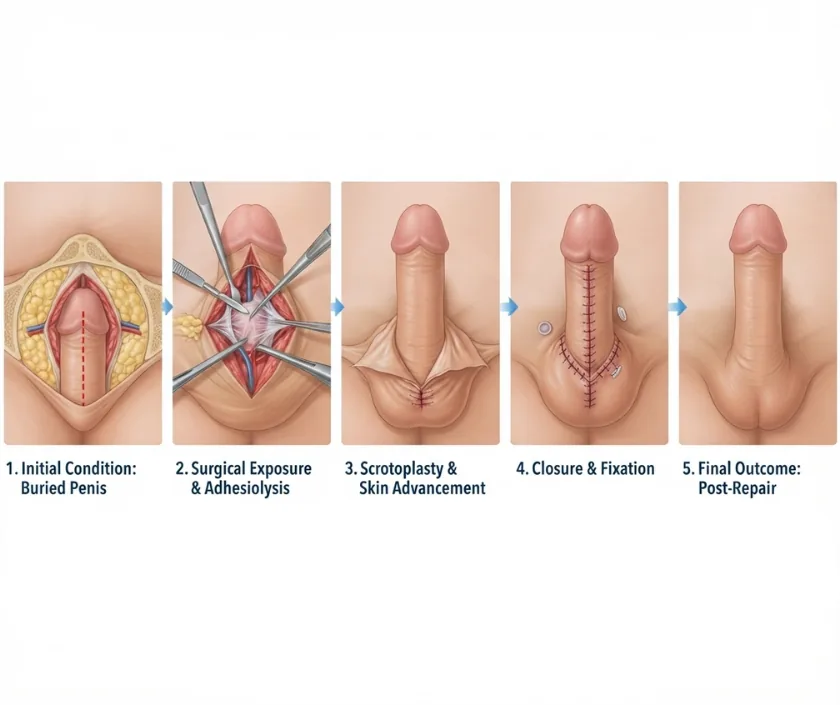
In a buried penis the shaft is a normal size but lies hidden behind the surrounding skin or fat, so it appears small. It can be present from birth, or follow a circumcision that left too little skin. Surgery uncovers the shaft by releasing tethering, anchoring the base and rearranging skin, which usually improves hygiene and the stream.
A buried penis is a concealed one, not a small one. The shaft itself is usually of normal length, but it sits behind the pubic fat pad or inside skin that is poorly attached at the base, so only a small part is visible. Parents often notice it in infancy, or when a child gains weight.
There are a few different reasons. Some children are born with weak attachments between the skin and the layer underneath, so the shaft slides back. Others have a trapped foreskin that balloons when they pass urine. In others the appearance follows a circumcision that removed too much skin or left a scar ring. Each of these needs a different repair, which is why the cause is worked out first.
The reasons to treat are practical. A hidden shaft makes the area hard to keep clean, can lead to repeated soreness or infection, and makes the stream spray, so toilet training becomes difficult. Older children may also feel self conscious. Surgery is not urgent in most cases, and in some infants the appearance improves on its own as the child grows and the fat pad reduces.
The child is examined gently and privately, and the plan depends on whether the cause is tethering, a tight scarred ring after circumcision, an overhanging fat pad or a mix of these.
The area is examined briefly with a parent present, and the history of any earlier circumcision is taken. Weight and toilet training are discussed. The cause decides which repair is planned.
Under general anaesthesia the skin is lifted off the shaft, and any tight scar ring or tethering band is released, so the shaft can come forward to its full length.
Fine stitches fix the skin at the base to the layer beneath, so the shaft stays uncovered rather than sliding back once healing is complete.
Skin is moved from where there is plenty to where there is a shortage, using flaps. A small graft is occasionally needed when too much skin was removed previously.
A light dressing supports the repair for several days. Most children go home the same day or after one night, with pain relief and clear advice on keeping the area clean.
Swelling is expected and can be marked in the first days. Loose clothing and regular pain relief help. Nappies are changed often, and older children rest at home.
The dressing is removed at review and swelling begins to settle. Bathing is usually allowed once the wound is dry. Many children return to school around this time.
The shape is clearer as swelling goes down. Cycling, straddle toys and rough play are usually allowed again, and stitches have dissolved in most children.
The final appearance settles over months as scars soften. Weight gain during growth can hide the shaft again, so reviews and simple advice continue.
Most boys pass urine much more easily afterwards and the skin problems settle. The penis is not made larger by this surgery, it is simply uncovered, so what is seen afterwards is what was always there. Swelling of the shaft skin is normal for a few weeks and can look alarming before it settles. If weight over the lower abdomen increases again, some burying can return, so the fat pad is discussed as part of the plan.
This is a reconstructive operation on skin that is often already scarred, so a realistic view of the outcome matters as much as the technique.
Keep the area clean and dry, expect swelling, and stick to the toilet and bathing routine you are given.
In almost all cases the penis is normally formed and simply hidden. Measuring it during examination usually reassures parents.
More skin removal often makes a buried penis worse, because the skin that is needed to cover the shaft is lost.
Many toddlers do as the fat pad settles, but tethering and scarred rings do not resolve on their own.
The usual reasons to operate are the urine stream, hygiene and repeated skin infection.
This is a private subject for a child and a worried one for parents, so consultations are unhurried and examination is kept brief and respectful.

The estimate depends on the cause, on how much scar tissue is present from an earlier circumcision, on whether flaps alone will do or a graft is needed, and on the anaesthetic and hospital time. Dressings and review visits are included. Because a repair on skin that has already been operated on takes longer than a first repair, the written estimate is prepared only after the area has been examined.
These are the questions that come up most often in consultation. If yours is not here, send it on WhatsApp and the team will reply, usually the same day.
Ask your question →No fixed band is published. A first repair costs less than a correction on skin that has already been operated on, and a graft adds to the figure. Written estimates follow the examination, with insurance or scheme cover checked at the same visit.
Not always. In some infants the appearance improves as they grow and the fat pad reduces. Surgery is advised when hygiene is difficult, when there are repeated infections, when the stream sprays badly, or when a scar ring is tightening.
In most cases the shaft is a normal size and simply lies hidden behind skin or fat, and an examination usually settles the question quickly. Where there is genuine doubt about growth, a paediatric opinion and hormone tests can be arranged.
It is planned with a paediatric anaesthetic team once your child is generally well. The operation is usually short and most children go home the same day. Swelling afterwards is expected and is checked at the first review.
Swelling settles over two to three weeks, with the dressing removed at review. School usually restarts within two weeks and active play by around six weeks. The final shape becomes clearer after a few months.
It can, most often when a child gains a lot of weight, since the fat pad hides the shaft once more. Anchoring the skin at the base reduces that risk. Reviews during growth pick up any change early.
The area is examined briefly with a parent present, and any earlier circumcision is discussed. You will hear the likely cause, whether waiting is reasonable, what a repair would involve, and the cost in writing before a date is offered.
Each technique below has its own page explaining how it works and when it is chosen.
This condition sits between reconstructive surgery and mens health. The wider assessment, including function and follow up into adult life, is covered on the sister site.
Seeing patients from across the city and beyond: read about the practice on the plastic surgeon in Surat page, or check what a written estimate covers on the costs and insurance page.
