Chordee is a bend that is present from birth, most often downwards. This page explains how curvature is assessed in children, the ways it can be straightened, and what parents can expect afterwards.
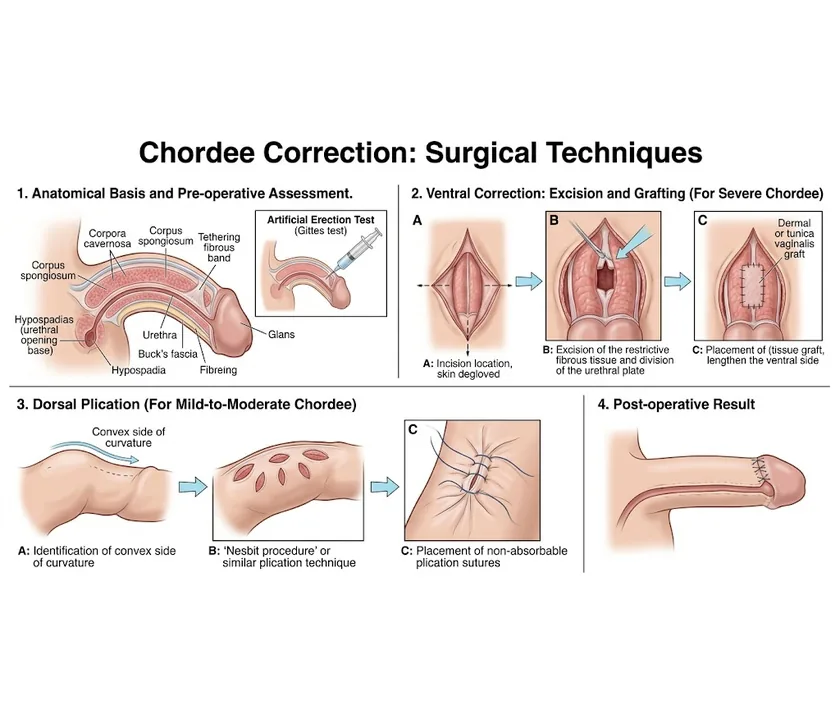
Chordee means a curve that is present from birth. It can occur on its own or alongside a difference in where the urinary passage opens. Mild curves often need no treatment. When a curve is marked, it is straightened during a planned operation, either by releasing tethered tissue, by adjusting the covering layer, or by adding a small graft.
Chordee is a bend that shows itself as a child grows. It happens because tissue is tighter or shorter on one side than the other, most often on the underside, so the shaft curves in that direction. The cause lies in how the tissue formed before birth, not in anything that happened afterwards.
A curve can be present alone or together with a difference in where the urinary passage opens, which is why assessment covers the whole area rather than the bend alone. Curves vary a great deal. A slight bend that causes no trouble is common and often needs nothing more than reassurance and a review as your child grows.
When correction is advised, the surgeon decides how to straighten the shaft only after measuring the curve during the operation, because the true degree cannot be judged from the outside. Releasing tethered skin and tissue is the first step and is often enough. If a bend remains, the covering layer on the longer side can be adjusted, or a patch of tissue can be added to the shorter side. Both options are explained to families in advance.
The examination is brief and private, and the degree of curve is confirmed at the start of the operation itself. Mild curves that cause no problem are often simply reviewed.
The history is taken in detail and the area is examined briefly, with a parent present. Notes from any earlier operation are reviewed. The plan is explained before a date is offered.
Under general anaesthesia the surgeon measures the true curve, because it cannot be judged reliably from the outside. That measurement decides which straightening method is used.
The skin and the tight layer beneath it are lifted and released. In many children this step alone straightens the shaft, and nothing further is needed.
If a bend remains, the covering layer on the longer side is shortened with fine stitches, or a small graft is added to the shorter side. The curve is checked again before closing.
A light supportive dressing is applied. Where the urinary passage was opened during the same operation, a fine catheter may be used for a short time.
Swelling and bruising are expected and look worse before they look better. Loose clothing, regular pain relief and rest at home are the main needs. Most children go home the same day or after one night.
The dressing is removed at review. Bruising fades and stitches begin to dissolve. Bathing is usually allowed once the wound is dry, and school often restarts around this time.
Healing is reviewed and the shape is checked. Cycling, straddle toys and rough play are usually allowed again by now, and swelling has largely settled.
The result is judged once the tissue has fully softened. Reviews continue during growth, because a curve can become noticeable again as a child gets older.
Most boys end up with a straight or near straight shaft. A small residual curve can remain, particularly where the curve was severe, and it is sometimes accepted rather than pushed further at the cost of extra risk. Swelling and bruising look worse than they are and settle over some weeks. A curve occasionally becomes visible again during the growth of puberty, so a review at that stage is sensible. Further surgery is uncommon but possible.
Correction is a careful operation on delicate tissue. Most children heal without trouble, though the possible problems should be clear before you agree to surgery.
The main tasks are keeping the dressing and any catheter as instructed, and keeping your child comfortable.
A true chordee is caused by tight tissue along the shaft and it does not straighten with growth.
It can affect the urine stream in childhood, and correcting it early avoids surgery at an age when a boy is more aware of it.
Circumcision does not release the tethering that causes the curve, and the foreskin is often useful in the repair.
Very mild curves that cause no difficulty can simply be reviewed as a boy grows.
Parents value a private, unhurried consultation and a straight answer about whether a curve genuinely needs treating.

The estimate depends on how the curve is straightened, on whether the urinary passage is treated in the same sitting, on the anaesthetic time and on whether an overnight stay is planned. Dressings, any catheter care and review visits are included in the written figure. Because the method is settled only once the curve is measured during surgery, the estimate explains what may change on the day and why.
These are the questions that come up most often in consultation. If yours is not here, send it on WhatsApp and the team will reply, usually the same day.
Ask your question →No fixed band is published, because the method is chosen during surgery once the curve is measured. A written estimate is given after assessment and explains what could change on the day, along with any scheme or insurance cover that applies.
Not always. Slight curves are common and often need nothing more than review as your child grows. Correction is advised when the bend is marked, when it affects the urinary stream, or when it is likely to cause difficulty in adult life.
It is planned with a paediatric anaesthetic team once your child is generally fit. The operation is usually short, and many children go home the same day. Swelling is watched closely in the first hours after waking.
Swelling and bruising settle over two to three weeks, and the dressing comes off at review. Most children are back at school within a couple of weeks and back to cycling and rough play by around six weeks.
It can. A bend sometimes becomes noticeable again as a child grows, particularly when the original curve was marked. That is why reviews continue during growth, and why some children need a further procedure in later childhood.
Many surgeons prefer early childhood, before school age, once the child is growing well. Where the curve is mild, waiting and reviewing is reasonable. Older children and young adults are also treated, and the same principles apply.
The history is taken, the area is examined briefly with a parent present, and any earlier operation notes are reviewed. You will hear which straightening methods may be used, what recovery involves, and the cost in writing before a date is fixed.
Seeing patients from across the city and beyond: read about the practice on the plastic surgeon in Surat page, or check what a written estimate covers on the costs and insurance page.
