Camptodactyly is a finger that stays bent at the middle joint. This page explains how the finger is assessed in Surat, why splinting comes first for most children, when surgery helps and what it may cost.
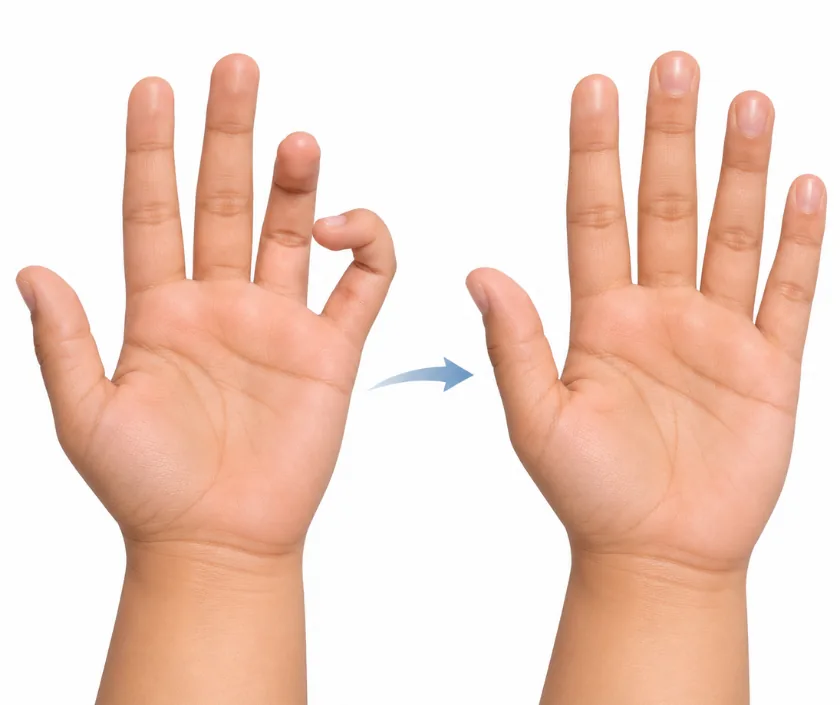
Camptodactyly is a finger held bent at the middle joint that will not fully straighten, most often the little finger. Stretching and splinting guided by a hand therapist help many children, and an operation is kept for fingers that stay very bent or keep worsening. Treatment is measured in months rather than weeks, and reviews continue while the child grows.
Camptodactyly means a finger is held bent at the middle joint, known as the proximal interphalangeal joint. It is usually the little finger, and both hands are often affected. The bend may be noticed in a baby, or it may appear for the first time during the growth spurt of the early teenage years.
The cause is a tight or misplaced structure across the front of the joint. A small muscle or a tendon slip may pull the finger down, the skin at the front may be short, or the joint surfaces may have adapted to the bent position over time. Because several things can be involved, the finger is assessed carefully before any operation is offered.
Most children are treated without surgery. A hand therapist fits a splint that holds the finger straighter for long stretches, usually overnight, along with a daily stretching routine. This works best when it starts early and is kept up for months. Surgery is considered when the bend is severe, keeps increasing, or stops the child from writing or gripping comfortably.
The finger is assessed for how far it bends, whether it can be straightened passively and how much it affects daily tasks. Most children start with therapy rather than surgery.
Movement is measured with the wrist and knuckle in different positions, which shows whether a tight tendon is pulling the finger down. X rays show the shape of the joint surfaces.
A hand therapist fits a splint and teaches a stretching routine. Progress is measured over several months, because many fingers improve enough with splinting alone and avoid an operation.
When surgery is agreed, your child sleeps under general anaesthesia. A zigzag cut on the front of the finger gives a view of skin, tendon and joint without leaving a straight scar.
Tight tissue in front of the joint is released, an abnormal muscle or tendon slip is divided or moved, and skin is added as a graft or flap when the front of the finger is short.
The finger is held straighter in a splint. Hand therapy restarts within a few weeks and carries on for months, because holding the gain matters as much as the release itself.
The finger rests in a splint or light plaster and the hand is kept raised. Discomfort is usually mild. Most children go home on the day of surgery.
Stitches are checked and a therapy splint is made. Gentle active movement begins, balanced against the need to hold the finger in its new straighter position.
Splinting mostly moves to night use, with exercises during the day. Grip and writing improve gradually, and progress is measured at each review rather than judged by feel.
Night splinting often continues while the child is growing, because the bend can return. Reviews carry on until growth is finished.
Splinting often holds the bend steady or improves it while the finger is still supple, but it takes months of daily wear and the bend can return if splinting stops too soon. Surgery can improve the position, though a finger that was tight for years rarely straightens fully, and there is a risk of losing some bending movement in exchange for gaining extension. Because of that trade off, surgery is offered selectively rather than routinely.
Camptodactyly is one of the harder hand differences to correct, so honest expectations matter. The aim is a more useful finger rather than a straight one.
Whether the plan is splints or surgery, the daily routine at home is what decides the result.
It usually stays the same or slowly tightens, and some children notice it worsening during growth spurts.
Splinting and stretching come first for most children, because surgery can trade bending movement for straightening.
Camptodactyly does not usually hurt. It is the position of the finger rather than any pain that causes difficulty.
It is a difference in how the tendons and soft tissues around the joint formed, not the result of a knock or a fall.
Families value being told honestly when a finger is better left alone, and being given a therapy plan they can actually keep up at home.

Many children need splinting and therapy rather than an operation, so cost varies widely. When surgery is planned, the estimate depends on how many fingers are treated, whether a skin graft or a tendon transfer is needed, the anaesthetic time, and the splints and therapy sessions that follow. A written estimate is prepared after assessment, with the therapy plan priced alongside it.
These are the questions that come up most often in consultation. If yours is not here, send it on WhatsApp and the team will reply, usually the same day.
Ask your question →A written estimate is given after assessment, because many children need only splints and therapy sessions while others need an operation. The surgical estimate covers surgeon, anaesthesia, theatre and any graft, with splinting and therapy listed separately so nothing comes as a surprise.
The operation is short and is done under general anaesthesia after an anaesthetic check. Nerves and vessels lie close to the front of the joint, so the release is carried out slowly and carefully. Most children go home the same day with simple pain relief.
The wound settles within two to three weeks, but the real work runs for months. Night splinting and daily exercises usually continue for at least half a year, and reviews carry on while the child is still growing.
Usually not. Treatment aims to reduce the bend enough for comfortable grip and writing rather than to make the finger straight. Many children gain useful movement, some gain a little, and part of the bend can return during growth.
No. Splinting and stretching guided by a hand therapist are the first choice for most children, and many do well without surgery. An operation is reserved for a severe bend, one that keeps increasing, or a finger that blocks daily tasks.
Earlier is better for splinting, because a young finger responds more readily and the routine becomes part of daily life. A bend that appears during the teenage growth spurt is watched closely, since it can worsen quickly over a few months.
Finger movement is measured in different wrist positions, X rays are taken and the effect on writing and grip is discussed. A therapy plan usually starts that day. You will hear when surgery might be considered and what a written estimate would cover.
Each technique below has its own page explaining how it works and when it is chosen.
Seeing patients from across the city and beyond: read about the practice on the plastic surgeon in Surat page, or check what a written estimate covers on the costs and insurance page.
