Some boys and young men have a bend that has been present since birth and becomes obvious around puberty. This page explains how the curvature is assessed, how it can be straightened and what recovery involves.
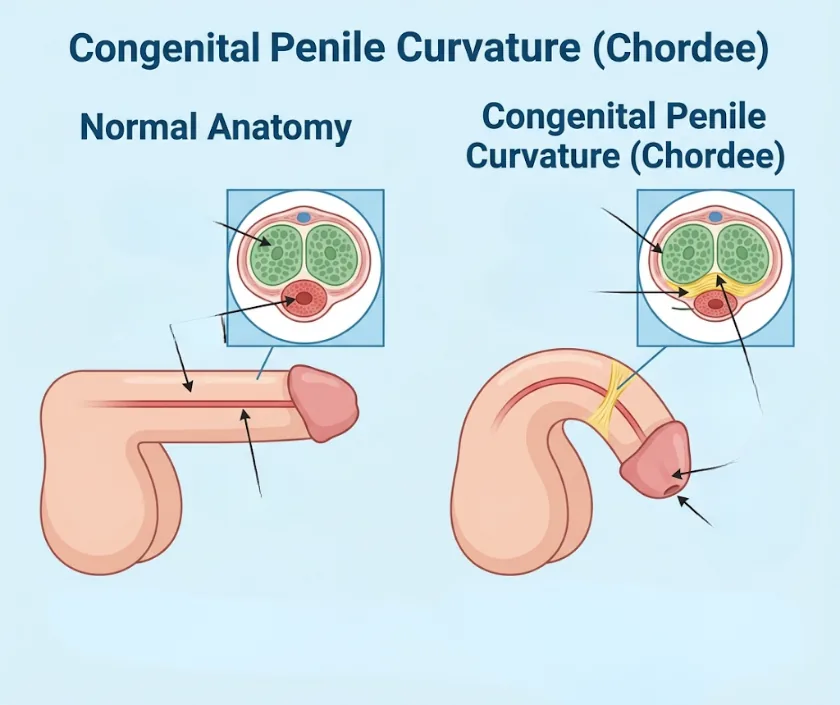
Congenital penile curvature is a bend that has been present since birth, because one side of the covering layer is shorter than the other. It is usually noticed in the teenage years. Mild curves need no treatment. A marked bend can be straightened by shortening the longer side, or by adding a graft to the shorter side.
The shaft is covered by a firm layer that is normally even on all sides. When one side is slightly shorter from birth, the shaft bends towards that side as it grows. The bend is usually downwards, though it can be to one side or upwards. There is no injury, no scarring and no underlying disease.
Most young men notice the curve during the teenage years, when growth makes it more obvious. Many curves are slight, cause no difficulty at all, and need nothing more than reassurance. Treatment is considered when the bend is marked, when it causes discomfort, or when it is likely to make adult life difficult.
This condition is not the same as a bend that develops later in adult life from scarring, and it is not the same as the curvature seen in young children alongside a difference in the urinary passage. Because treatment differs, the first task at consultation is to work out which of these is present. Assessment relies on a careful history and examination, and the true angle is confirmed during surgery.
Assessment is about how much the shaft bends and whether the bend causes a practical problem. Many boys are simply reviewed rather than operated on.
The history is taken, including when the bend was first noticed and whether it has changed. A brief examination follows. Blood tests or a scan are arranged only when another cause is suspected.
The true angle can only be judged during the operation, so it is measured under anaesthesia. This decides which straightening method suits, and both options are discussed with you beforehand.
For most bends, fine stitches or small tucks shorten the covering layer on the longer side until the shaft is straight. This is the simpler method and it heals quickly.
For a severe bend, the covering layer on the short side is opened and a patch of tissue is stitched in to lengthen it. This is a longer operation with a slower recovery.
The skin is closed with dissolving stitches and a light supportive dressing is applied. Most patients go home the same day or after one night.
Swelling and bruising are expected and can look alarming before they settle. Rest, loose clothing and regular pain relief are advised, along with time away from school, college or work.
The dressing is removed at review and bruising fades. Light activity and desk work are usually fine. Cycling, gym work and contact sport are still avoided.
Healing is reviewed and the result is assessed. Most normal activity is allowed again, and advice on resuming adult activity is given at this visit.
The tissue softens and the final shape settles. A small residual bend sometimes becomes apparent, and is reviewed rather than treated straight away.
Most boys end up with a shaft straight enough for comfortable passing of urine and ordinary daily life. A slight residual bend is common and usually of no practical importance. Swelling and bruising make the early appearance misleading, so the result is judged once healing has settled rather than in the first weeks. A small number of boys need a further procedure, particularly when the original bend was severe or hypospadias was repaired at the same time.
Straightening surgery is generally well tolerated, though it involves delicate tissue, and the trade offs should be clear before you consent.
Most of the care at home is about keeping the area clean and letting the dressing do its work.
A mild bend can look less obvious with growth, but tissue that is genuinely shorter on one side does not lengthen on its own.
The aim is to correct the direction of the shaft. Surgery is not carried out to alter size.
A bend present from birth is a matter of shape. Any concern about fertility is separate and would be assessed on its own.
Timing is chosen with the child in mind, and repair is often done in the early years rather than in the newborn period.
Families come to us for a private and matter of fact discussion of something many parents find awkward to raise, and for a clear view of whether surgery is needed at all.

The estimate depends on which method is needed, since shortening the longer side is quicker than grafting, and on the anaesthetic time, the hospital stay and the review visits that follow. Because the method is confirmed only once the angle is measured under anaesthesia, the written estimate covers both possibilities, so there is no surprise afterwards. Insurance cover is checked before admission.
These are the questions that come up most often in consultation. If yours is not here, send it on WhatsApp and the team will reply, usually the same day.
Ask your question →No fixed band is published, because the method is confirmed only once the angle is measured under anaesthesia. The written estimate covers both the simpler shortening technique and the longer grafting operation, so the figure is clear either way.
Usually not. Many bends are slight, cause no difficulty and need nothing more than reassurance. Treatment is considered when the curve is marked, when it causes discomfort, or when it is likely to make adult life difficult.
It is a routine reconstructive operation carried out under general anaesthesia, and most patients go home the same day or the next. Risks are explained fully in writing beforehand, including the loss of some length with the shortening method.
Swelling and bruising settle over two to three weeks, and most people return to study or desk work within one to two weeks. Sport and gym work wait until around six weeks. Recovery after grafting takes longer.
The aim is a shaft straight enough for comfortable function rather than a result measured to the degree. Many patients are left with a small residual curve that causes no difficulty. What counts as a good outcome is agreed before surgery.
Most surgeons wait until growth is complete, usually in later adolescence, because a curve can change while the body is still developing. Earlier surgery is considered when the bend is severe. Adults are treated at any age.
The history is taken in a private room and a brief examination follows, with a chaperone offered. Working out the cause matters, since treatment differs from bends that develop later in life. You leave with the options and a written estimate.
This condition sits between reconstructive surgery and mens health. The wider assessment, including function and follow up into adult life, is covered on the sister site.
Seeing patients from across the city and beyond: read about the practice on the plastic surgeon in Surat page, or check what a written estimate covers on the costs and insurance page.
