Some babies are born with a nose that is uneven, flat, twisted or small. This page explains how a congenital nasal deformity is assessed in Surat, when surgery is usually planned and what parents can expect.
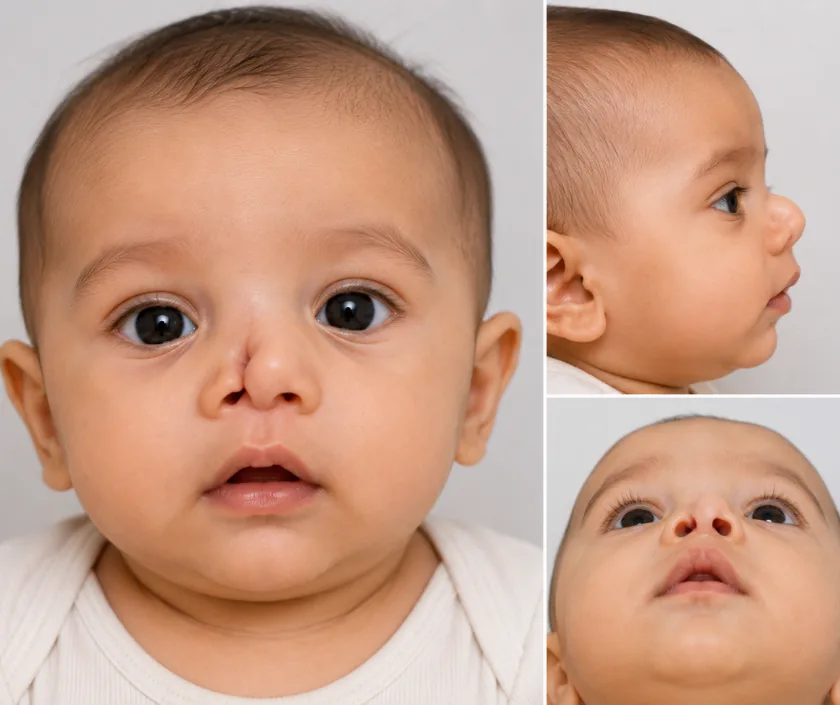
A congenital nasal deformity is a difference in the shape or structure of the nose that a child is born with. Treatment depends on whether breathing is affected and on how the face is growing. Minor shaping may be done early, while fuller correction of bone and cartilage is often planned once growth has settled.
The nose is built from bone at the top, cartilage in the middle and lower part, and a lining inside. When any of these parts do not form fully before birth, the nose may look flat, twisted, short or uneven, and one nostril may sit lower or narrower than the other. Some children also have a bent partition inside, called the septum, which can make one side harder to breathe through.
Not every difference needs an operation. The first job is to work out whether the child breathes comfortably, whether feeding and sleep are affected, and how much the shape bothers the child as they grow older. Photographs, a gentle examination inside the nostril and sometimes a scan help to build that picture.
Because the nose keeps growing through childhood, timing matters. Surgery that releases a tight airway may be done early, while shaping the bone and cartilage is often better once facial growth has slowed. Many children are reviewed over several years before a final plan is agreed.
Treatment is matched to what is actually causing trouble, whether that is the airway, the shape of the nose, or both together.
The nose is examined outside and inside, breathing on each side is checked and clinical photographs are taken. Growth, general health and any linked conditions are noted before anything is planned.
Surgery that opens a blocked airway may be advised early. Shaping work is often planned later, once the face has grown, so the result is not lost as the child develops.
The child sleeps under general anaesthesia. Cuts are placed inside the nostrils where possible, and a small cut across the columella is added when wider access is needed.
Bent cartilage is released and repositioned. Support may be added using cartilage taken from the septum or the ear, so the tip and bridge sit in a better line.
Soft splints may be placed inside the nostrils and a light tape or plaster outside. Your child wakes in a monitored area and is offered fluids once settled.
Swelling and blocked breathing are usual at first. Pain relief is given, the head is kept raised and saline drops help keep the lining moist. Most children go home quickly.
Splints and any outside dressing are removed at a review. Rough play, swimming and contact games are avoided. Many children return to school in this period.
Bruising has settled and breathing is easier for most children. Sport can usually restart once the surgeon confirms the framework has healed well.
The shape keeps refining as swelling fades. Growth is watched at yearly reviews, and a further stage is sometimes planned in the teenage years.
Breathing usually improves more reliably and sooner than appearance does. The outside shape settles over many months, and swelling at the tip is the last to go. Because the nose keeps growing through childhood and puberty, an early result can change, and a further procedure in the teenage years is common when the deformity was marked. Matched nostrils are not the aim; a balanced nose that works well is.
Nasal surgery in children is usually straightforward, and serious problems are uncommon. Knowing what can happen makes it easier to spot trouble early.
The nose is swollen and tender at first, and gentle care matters far more than anything active.
Small procedures for breathing can be done early. It is the fuller reshaping that usually waits for growth.
Surgery is planned around growth, which is exactly why the larger work is often left until later.
The inside and the outside can differ. A straight looking nose can still be blocked on one side.
Many children need staged treatment as the face grows, and this is planned from the start rather than being a setback.
Families come to us for an assessment that treats breathing and appearance as one problem, and for a plan that respects how a child grows.

The price depends on how much of the nose is being treated, whether cartilage has to be taken from the septum or the ear, the anaesthetic time needed, whether a night in hospital is planned and whether breathing work is done at the same sitting. Children who need staged treatment are quoted stage by stage rather than as one figure. A written estimate is shared after your child is examined, so the family knows the cost before a date is booked.
These are the questions that come up most often in consultation. If yours is not here, send it on WhatsApp and the team will reply, usually the same day.
Ask your question →There is no single published band, because the work ranges from a small shaping procedure to a full rebuild of the framework. Cost is driven by anaesthetic time, grafts and hospital stay. You receive a written estimate after the examination, before any date is fixed.
Surgery is planned only when a child is well and an anaesthetist is satisfied. Bleeding, infection and swelling are the main risks, and they are usually managed easily. Careful timing also protects the growing framework, which is why some work is deliberately delayed.
Most children go home the same day or after one night. Swelling and a blocked nose are common for a week or two, and school often restarts in that time. Contact sport waits until healing is confirmed at around six weeks.
The aim is a nose that works well and sits in balance with the face. Improvement is usually clear, though the two sides rarely match exactly. Swelling hides the final shape for months, so results are judged over a year rather than weeks.
Suitability depends on the type of deformity, the state of breathing and how the face is growing. Children with a blocked airway are considered earlier. Those who mainly want a shape change are often reviewed until growth settles.
Timing is judged case by case. Work that frees breathing may be done in infancy, while reshaping bone and cartilage often waits until the teenage years. Waiting is a clinical decision, not a delay, and reviews continue in the meantime.
The nose is examined inside and out, breathing is tested on each side and photographs are taken for the record. You hear what can realistically change, how many stages may be needed, and what the treatment would cost in writing.
Seeing patients from across the city and beyond: read about the practice on the plastic surgeon in Surat page, or check what a written estimate covers on the costs and insurance page.
