Columellar notching is a small step or dip in the strip of skin between the nostrils. It can be present from birth or appear after earlier nose surgery. This page explains how it is assessed and corrected.
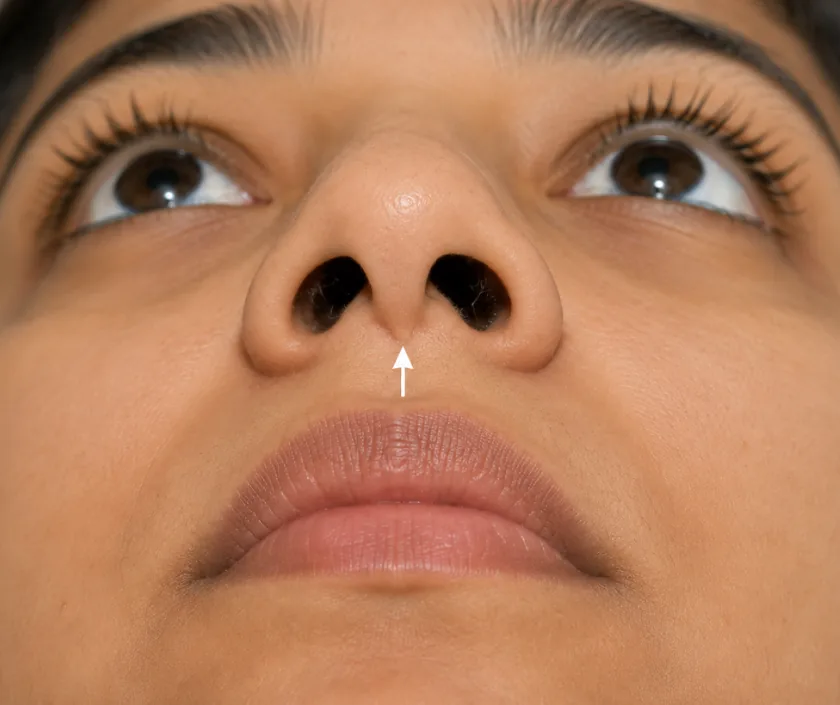
Columellar notching is a visible step, dip or retraction along the strip between the nostrils. It draws the eye to the base of the nose and can make the nostrils look uneven. Correction releases the tethered tissue, adds cartilage support where the strip is weak and reshapes the scar so the outline runs smoothly again.
The columella should form a smooth line from the tip of the nose down to the lip. A notch is a small break in that line. It may look like a step at one side, a dip in the middle or a strip that seems pulled up towards the tip, leaving the nostril rims sitting low on either side.
Some children are born with the problem, often alongside a cleft or another difference in how the nose formed. In other children it appears after earlier surgery, when a scar tightens as it heals and pulls the tissue upwards. Weak or missing cartilage underneath makes the notch more obvious, because there is nothing holding the strip forward.
Assessment looks at the outline from the front, the side and from below, and checks whether breathing is affected. A small notch that only shows in certain light may need nothing at all. When the notch is clear in normal conversation, or the child is troubled by it, correction is discussed.
This is a refinement rather than a major operation. It is usually offered when the notch shows in ordinary conversation and bothers the child or the family.
The outline is checked from the front, side and below, and breathing is tested. Photographs record the starting point so change can be judged fairly at later reviews.
Under general anaesthesia, the tight scar or band pulling on the strip is released through a small cut, which lets the tissue drop back into its natural line.
A slim piece of cartilage from the septum or ear is placed inside the columella when the strip is weak, so the corrected shape is held rather than slipping back.
The skin is rearranged, often with a small zig zag pattern, so the new scar sits along a natural line and does not pull the tissue upwards as it heals.
Fine stitches and a light tape are applied over the repair. Most children go home the same day, once they are awake, comfortable and drinking normally, with a review booked for the following week.
Mild swelling and tenderness at the base of the nose are usual. Pain relief is given, and the area is kept clean and dry as advised by the nursing team.
Stitches are checked or removed at review. Nose blowing and rough play are avoided. Most children are back at school within this period.
The scar looks pink and slightly firm, which settles with time. Scar massage and sun protection are usually advised once healing is confirmed.
The outline reads more smoothly as swelling fades and the scar softens. Yearly review continues if further nose work is planned in the teenage years.
The notch becomes much less noticeable rather than disappearing altogether. Swelling here settles slowly, so the final shape is judged many months later and not in the first few weeks. Small differences between the two nostrils usually remain and are quite normal. If your child has had a cleft repair, the tissue is scarred and less predictable, so a further small adjustment is sometimes needed as the face grows.
This is a small procedure, so recovery is usually quick. Even so, the base of the nose is a delicate area and a few problems are worth knowing about.
The nose is tender for a short while, and the main job at home is keeping the area clean and free from knocks.
Massage softens scar tissue but cannot rebuild missing support, so a visible notch needs a small procedure.
Waiting until scars have settled usually gives a better and steadier result than operating early.
Faces are never symmetrical. The aim is a nose that looks even in conversation, not a mirror image.
Parents come to us for careful attention to a small feature, and for an honest answer about whether it is worth an operation at this stage.

Cost depends on whether the notch is treated on its own or as part of wider nose surgery, whether cartilage support is needed, how long the anaesthetic takes and whether the child stays overnight. Repair after previous surgery often takes longer, because scar tissue has to be released carefully. A written estimate is shared once your child has been examined and the plan is agreed.
These are the questions that come up most often in consultation. If yours is not here, send it on WhatsApp and the team will reply, usually the same day.
Ask your question →No standard band applies, because the work ranges from a small scar release to a graded repair with cartilage support. Anaesthetic time and whether other nose work is done together also change the figure. A written estimate follows the examination.
It is a short operation on a small area, and most children recover quickly. Bleeding, infection and scar problems are the usual concerns, and they are uncommon. General anaesthesia is used, with the standard checks before the day of surgery.
Most children go home the same day. Swelling settles within a week or two and school usually restarts in that time. Scar softening continues for several months, so the final outline takes a while to show.
Scar tissue can tighten again, and a small degree of notching sometimes returns. Adding cartilage support and reshaping the scar line both reduce that chance. A minor touch up is occasionally advised at a later review.
Children whose notch is visible in normal conversation, or who are troubled by how the nose looks, are usually suitable. A faint notch seen only in certain light may be left alone, with review as the child grows.
Small corrections can be done in childhood when the notch bothers the child. When wider nose surgery is already planned for the teenage years, it is often sensible to treat everything in one sitting instead.
The outline is examined from several angles, breathing is checked and photographs are taken. You hear whether treatment is worthwhile now or later, what the operation involves, and what it would cost in writing.
Seeing patients from across the city and beyond: read about the practice on the plastic surgeon in Surat page, or check what a written estimate covers on the costs and insurance page.
