An infantile hemangioma is a common growth of small blood vessels that appears in the first weeks of life. This page explains why many need only watching, when medicine or surgery helps, and what treatment may cost.
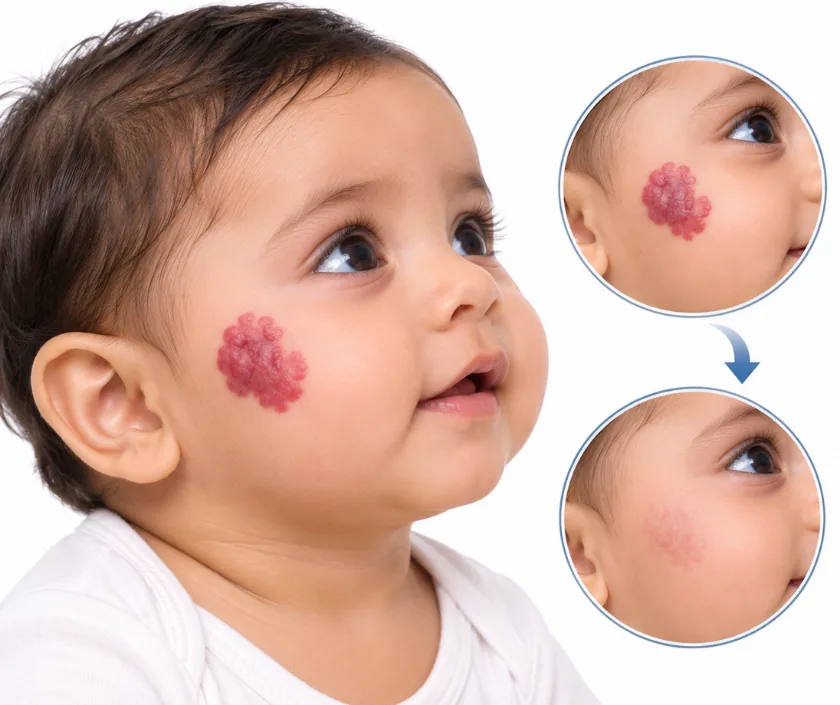
An infantile hemangioma is a benign growth of small blood vessels that appears soon after birth. It grows for several months, then shrinks slowly over years, so many need no treatment at all. Where treatment is needed, medicine is usually the first step. Surgery is kept for lesions that threaten sight or breathing, break down, or leave loose tissue behind.
An infantile hemangioma is not a cancer. It is an overgrowth of small blood vessels that usually shows up in the first few weeks of life as a red mark or a soft raised lump. Growth is quick for the first months, then it settles, and after that the lesion slowly fades and flattens over several years.
Because so many shrink on their own, watching carefully is a proper plan and not a way of doing nothing. Photographs at each visit show whether growth has stopped. Treatment is advised when the lesion sits near the eye, nose, lip or airway, when it breaks down and forms a sore, when it bleeds repeatedly, or when there are many lesions and internal ones are suspected.
Where treatment is needed, a beta blocker medicine given by mouth is usually the first choice, started and monitored by a specialist. Small surface lesions may be treated with a gel or with laser. Surgery has a place, but it is rarely the first answer. More often it is used later, for loose skin, a scar or leftover tissue once the lesion has settled.
Most of these birthmarks are watched rather than treated. Treatment is chosen when the site or the speed of growth makes it a problem.
Most hemangiomas are recognised by their appearance and by the story of how they appeared and grew. An ultrasound scan is added when the diagnosis is unclear or when a deeper lesion is suspected.
Site, size, speed of growth and the age of the baby are weighed together. Many lesions are simply watched with photographs at each visit, because they are already on the way to settling.
When treatment is needed, a beta blocker medicine by mouth is usually chosen. Heart rate, blood sugar and feeding are checked when it is started, and the dose is reviewed as the baby grows.
Flat surface lesions, sores that will not heal and leftover redness may respond to laser. A gel form of the medicine is sometimes used for small superficial marks.
An operation is considered for a lesion that keeps bleeding, blocks sight or breathing, or for loose skin and scarring left behind. It is usually done once the lesion has stopped growing.
Growth is fastest early on, which can be alarming. Regular photographs and reviews show whether treatment is needed. If medicine is started, checks are done at the beginning and repeated as the dose changes.
Growth usually slows and the colour begins to soften. Sores heal with dressings and careful cleaning. Feeding, sight and breathing are checked at each visit.
Shrinking happens gradually over years. Many lesions fade a great deal without any operation, and medicine is often stopped once growth has clearly ended.
Whatever remains is reviewed. Loose skin, a pale patch or leftover tissue can be treated with laser or surgery at this stage if it bothers the child.
Many haemangiomas fade a great deal without any treatment, though fading takes years and often leaves faint discolouration, a fine scar or loose skin. Medicine started early usually shrinks a growing lesion, but it does not always clear every trace and some regrowth can follow when it is stopped. Surgery exchanges a bulky mark for a scar. Watching is often the wiser first step, and reviews with photographs show whether the plan is working.
Watching, medicine, laser and surgery each carry their own risks. These are explained so that families can weigh them against the benefit.
Whether your child is on medicine or recovering from surgery, the daily skin routine makes the biggest difference.
Most of these birthmarks shrink on their own over years, so watching or medicine is usually the better first step.
When the site is risky, treatment started in the first months of life makes the greatest difference.
Laser has a role for certain lesions and for leftover redness, but it is not the first choice for a thick growing haemangioma.
Colour and softness change over weeks, and the full effect takes months of steady treatment.
Parents often arrive expecting an operation and leave with a plan that suits the natural behaviour of the birthmark instead.

Cost depends on which treatment is used. Watching with regular photographs costs very little. Medicine adds a monthly cost along with the checks done when it is started, and laser is priced by session, so the number of sessions matters. An operation brings theatre and anaesthetic time and a possible overnight stay. A written estimate is given after the child is assessed.
These are the questions that come up most often in consultation. If yours is not here, send it on WhatsApp and the team will reply, usually the same day.
Ask your question →It varies with the plan. Watching with photographs costs very little, medicine adds a monthly cost with checks, and laser is charged per session. An operation adds theatre and anaesthetic time. A written estimate is given after assessment, and insurance cover is checked when treatment is medical.
The beta blocker used is well known in children and is started with checks on heart rate, blood sugar and feeding. Doses are matched to weight and reviewed as the baby grows. Parents are told which signs need a call and which are expected.
Many do fade a great deal. Growth stops within the first year for most, then shrinking continues slowly over several years. Fading is often incomplete, so some children are left with a pale patch, loose skin or a little extra tissue.
Medicine is usually continued for months rather than weeks, and it is stopped gradually once growth has ended. Laser needs several sessions spaced apart. An operation, where it is used, is a single day in most cases, with review over the following weeks.
No. Most need nothing more than review and photographs. Treatment is advised when the lesion is near the eye, nose, lip or airway, when it breaks down or bleeds, when growth is very fast, or when many lesions suggest internal ones.
It is rarely the first step. An operation suits a lesion that keeps bleeding or blocks sight or breathing, and more often it is used later, once the lesion has settled, to remove loose skin or leftover tissue. Timing is planned around school where possible.
The story of when the mark appeared and how it changed is taken, and the child is examined. Photographs are recorded for comparison, and a scan may be arranged. You will hear whether watching, medicine, laser or an operation fits, with an estimate in writing.
Seeing patients from across the city and beyond: read about the practice on the plastic surgeon in Surat page, or check what a written estimate covers on the costs and insurance page.
