A lymphatic malformation is a collection of abnormal lymph channels and cysts that forms before birth. This page explains how it is told apart from lesions that fade, which treatments help and what care may cost in Surat.
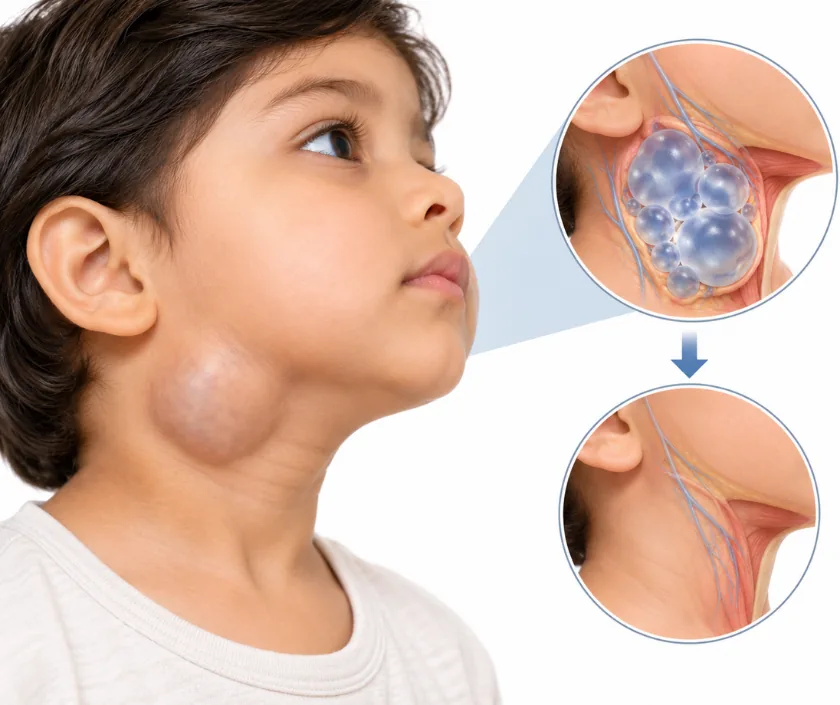
A lymphatic malformation is a group of abnormal lymph channels that form cysts under the skin or deeper in the body. It is present from birth and does not disappear on its own, unlike an infantile hemangioma. Large cysts often respond well to injection treatment, while fine spongy lesions may need surgery or medicine, and sometimes a combination.
Lymph is the clear fluid that drains from tissues. When the channels carrying it form abnormally before birth, fluid collects into cysts. The result is a soft swelling, most often in the neck, cheek, armpit, chest or a limb. Some are seen at birth or on a pregnancy scan, while others become obvious in the first years of life.
This is a malformation, not a tumour, and the distinction matters. An infantile hemangioma appears after birth and slowly fades over years. A lymphatic malformation is present from the start and stays, growing with the child. It can swell suddenly during a cold or throat infection, or if bleeding occurs inside a cyst, which alarms families.
Ultrasound and MRI scans show whether the cysts are large, which doctors call macrocystic, or fine and spongy, called microcystic. Large cysts usually respond well to sclerotherapy, an injection that makes the cyst lining stick together. Fine lesions respond less well and may need surgery. For very extensive disease, a medicine that slows abnormal channel growth is sometimes used under specialist care.
Treatment is chosen for what the swelling is doing rather than for its size alone, and the type of cysts decides which method is used.
Examination and an ultrasound scan usually give the answer, and an MRI shows depth and the relation to the airway and major vessels. Cyst size on the scan guides which treatment is likely to help.
For large neck or mouth lesions, breathing and swallowing come first. In babies this may mean planning delivery and early care in a centre able to protect the airway if that becomes necessary.
Fluid is drained from the cysts with a fine needle under scan guidance, and a medicine is injected so the lining sticks together. Swelling increases for a few days before the lesion shrinks.
Fine spongy lesions, and cysts that keep refilling, may be removed surgically. Nerves in the neck and face are identified and protected, and staged operations are safer than one large removal for extensive disease.
Where disease is widespread, a medicine that slows the growth of abnormal channels can be used. It is prescribed and monitored by a specialist, with regular blood tests and reviews.
Swelling increases before it improves after an injection, and a mild fever for a day or two can occur. Pain relief is given, and breathing and swallowing are watched closely for neck lesions.
Swelling settles and the lesion feels smaller and firmer. Feeding and speech return to normal for most children, and school restarts once comfort allows.
A review with a scan compares the result. Further sessions are planned where cysts remain, since one session is often not the whole treatment.
Lesions can refill or flare with infections, so review continues for years. Prompt treatment of colds and throat infections helps limit sudden swellings.
Large single cysts often shrink well with injection treatment, though more than one session is usual. Small cyst types improve less and tend to come back, so treatment is about control rather than removal. Swelling and a mild fever for a day or two after injection are expected. Surgery can leave a scar, numbness or, rarely, weakness of a nearby nerve. Many children stay under review for years, with treatment repeated when the swelling becomes troublesome again.
Injection treatment and surgery both carry risks, and these depend heavily on where the lesion sits. Everything is discussed before a plan is agreed.
Most families are managing a swelling at home between sessions, so knowing what is normal makes it far less frightening.
It is a malformation of lymph channels present from birth. It is not a cancer and it does not spread elsewhere in the body.
These malformations often return in part, so treatment is usually planned in stages over years.
Swelling often follows a cold or a throat infection and usually settles once that has been treated.
Treatment is offered at any age when symptoms call for it, and airway problems are dealt with early.
Families want to know which treatment fits their child's type of malformation, and what the realistic plan looks like over the years ahead.

Cost is shaped by the size and site of the lesion, the scans required, whether treatment is by injection, surgery or medicine, and how many sessions are planned. Lesions near the airway need closer monitoring and sometimes a longer stay, which raises the total. Medicines used for extensive disease add an ongoing cost. A written estimate is prepared after assessment.
These are the questions that come up most often in consultation. If yours is not here, send it on WhatsApp and the team will reply, usually the same day.
Ask your question →No fixed band applies. The figure depends on scans, the number of injection sessions, whether an operation is needed and how long the child stays in hospital. A written estimate is prepared after assessment. Insurance often contributes, since the treatment is done for medical reasons.
It will not. Lymphatic malformations are present from birth and grow along with the child, which separates them from infantile hemangiomas that fade over years. They can shrink a great deal after treatment, but they need active care rather than time alone.
It is done under scan guidance with anaesthesia, by a team used to these lesions. Swelling increases for a few days, which needs careful watching when the lesion is near the airway. Infection and skin changes are less common but possible.
After an injection, swelling peaks in the first days and settles over two to three weeks. Most children return to school within a week or two. Following an operation, drains and dressings may be needed and review continues for several weeks.
That depends on the cysts. Large cysts usually respond well to injections and often need no operation. Fine spongy lesions respond less well and may be better removed, although complete removal is not always safe near nerves. Many children need both.
Swelling that affects breathing or swallowing needs urgent care on the same day. Otherwise treatment is planned, and timing depends on symptoms, size and site rather than a fixed age. A quiet lesion can be watched with regular review.
The history of the swelling is taken and the child is examined, including how feeding and breathing are affected. An ultrasound scan is often done at the visit, and an MRI arranged. You will hear the options and receive a written estimate.
Seeing patients from across the city and beyond: read about the practice on the plastic surgeon in Surat page, or check what a written estimate covers on the costs and insurance page.
