A capillary malformation, often called a port wine stain, is a flat coloured patch present from birth. This page explains why it is not a mark that fades, how laser treatment lightens it, and which checks are advised.
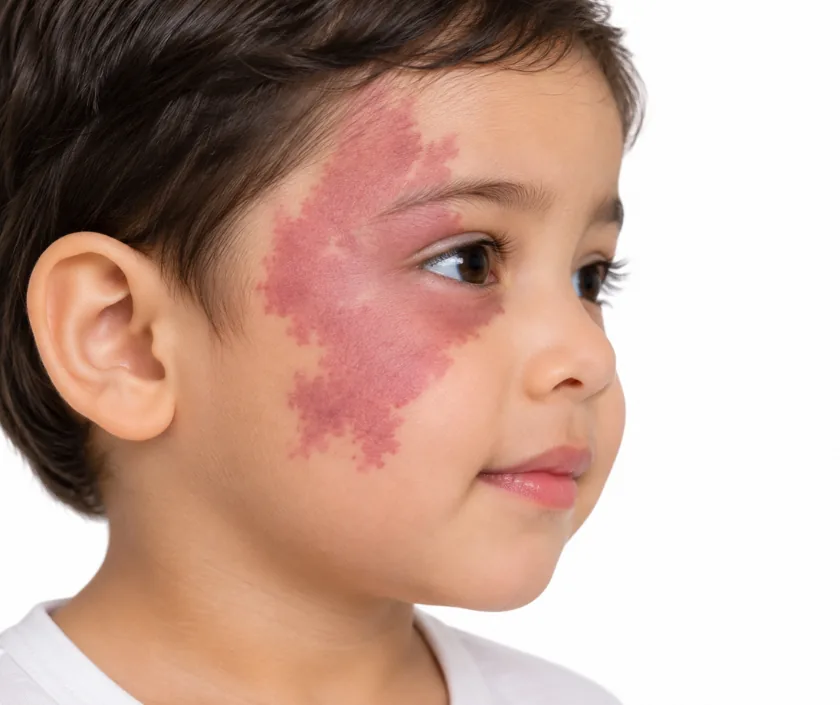
A capillary malformation, commonly called a port wine stain, is a flat pink or red patch caused by widened small blood vessels in the skin. It is present at birth and does not fade away, unlike the faint marks many newborns have. Laser treatment can lighten it over several sessions, and some patients need checks of the eyes or brain.
A capillary malformation is a patch of skin where the smallest blood vessels are wider than they should be. The colour is flat at first, pink or red, and does not rise above the skin. It is present at birth and grows in proportion with the child, so it covers roughly the same share of the body over the years.
Many babies have faint pink marks on the eyelids or the back of the neck that fade in the early months. A capillary malformation is different. Rather than fading, the colour usually deepens over decades, and in adulthood the surface may thicken, develop small bumps or bleed. Tissue and bone can also overgrow beneath a facial patch.
Pulsed dye laser is the main treatment. It targets the widened vessels while sparing the surrounding skin, and a course is spread over several sessions. Starting early often helps, and young children usually need brief anaesthesia so they stay still. Lightening rather than complete clearance is the honest aim, and top up sessions are often needed as the years pass.
The colour, thickness and site of the stain guide the plan. Treatment is often started young, when the skin is thin and the patch is small.
The patch is examined and photographed. Where it covers the forehead and upper eyelid, eye pressure checks and a brain scan are arranged, because a small number of children need that monitoring.
A test patch may be done first. The number of sessions, the spacing between them and how much lightening is realistic are explained before starting, since expectations matter more here than in most treatments.
A cooled pulsed dye laser is passed over the patch. Older children and adults often manage with cream that numbs the skin, while young children usually need a short general anaesthetic to stay still.
The area looks bruised for a week to ten days. Sun protection, gentle washing and prescribed creams are advised, and the next session is usually booked several weeks later.
When the surface has thickened, or the lip and cheek have overgrown, an operation can reduce and reshape the area. This is usually done later in life and may be combined with continuing laser.
Treated skin looks bruised and purple, which is expected and settles. Sun protection and gentle care are important, and school usually continues as normal.
Colour is compared with the photographs taken before. Some lightening is often visible, and the next session is planned at this stage.
Improvement builds gradually across the course. Some areas respond better than others, and patches on the limbs often respond less well than those on the face.
Colour can slowly return, so occasional maintenance sessions are common. Thickening or overgrowth appearing later is reviewed and may be treated surgically.
Most stains lighten considerably over a course of sessions, but complete clearance is uncommon and some colour usually stays. Response varies with the site, with the face often doing better than the hand or foot. Colour can slowly return over the years, so top up sessions are sometimes needed later. Each session leaves the area bruised and dark for a week or two before the lightening shows. Progress is judged from photographs rather than from memory.
Laser is well established for this condition, but results vary between people and between sites. Knowing the limits beforehand prevents disappointment.
The days right after each laser session need gentle care, and sun protection matters all year round.
A faint mark on the eyelid or nape often fades. A true port wine stain is a malformation and it stays for life without treatment.
Waiting is a choice families can make, but stains tend to darken and thicken with age and early skin often responds better.
Laser works over a course of sessions, and the aim is lightening rather than removal.
It arises from a chance change in the developing blood vessels and is not caused by anything a parent did.
Parents want a plain answer about what laser can and cannot do, and a plan that fits around school and family life.

Laser is charged by session, so the size of the patch and the number of sessions decide most of the cost. Treating a young child adds anaesthetic and day care charges, since they need to stay still. Eye and brain checks, where they are advised, are separate. An operation for thickened areas is priced on its own. A written estimate is prepared after assessment.
These are the questions that come up most often in consultation. If yours is not here, send it on WhatsApp and the team will reply, usually the same day.
Ask your question →Charges are per session, so the size of the patch and the number of sessions decide the total. Anaesthetic and day care are added for young children. Eye or brain checks are billed separately where advised. A written estimate is given after assessment.
It will not. Faint newborn marks on the eyelids or neck often fade, but a capillary malformation is different. The colour usually deepens over the years and the surface can thicken in adulthood, so treatment is offered rather than simply waiting.
Pulsed dye laser has been used in children for many years, and it targets the vessels while cooling the surface. Young children need a short anaesthetic to stay still, and fitness is checked beforehand. Bruising is expected, while blistering and scarring are uncommon.
Most patches lighten noticeably across a course, and some become hard to see, though complete clearance is uncommon. Facial patches usually respond better than those on the arms and legs. Photographs at each visit make the change easier to judge honestly.
Treated skin looks bruised and purple for about a week to ten days, then settles. Gentle washing, prescribed cream and sun protection are advised. Children usually go to school as normal, and the next session is booked several weeks later.
Starting in infancy or early childhood is often advised, because the patch is smaller and the skin responds well. Even so, treatment helps at older ages too, and adults with thickened patches can be offered laser and surgery together.
The patch is examined and photographed, and its history is discussed. If the forehead and upper eyelid are involved, eye pressure checks and a brain scan are arranged. You will hear how many sessions are likely, what lightening is realistic, and the cost in writing.
Seeing patients from across the city and beyond: read about the practice on the plastic surgeon in Surat page, or check what a written estimate covers on the costs and insurance page.
