A venous malformation is a tangle of abnormal veins present from birth, though it may not be visible at first. This page explains how it differs from a lesion that fades, how it is treated, and what treatment may cost.
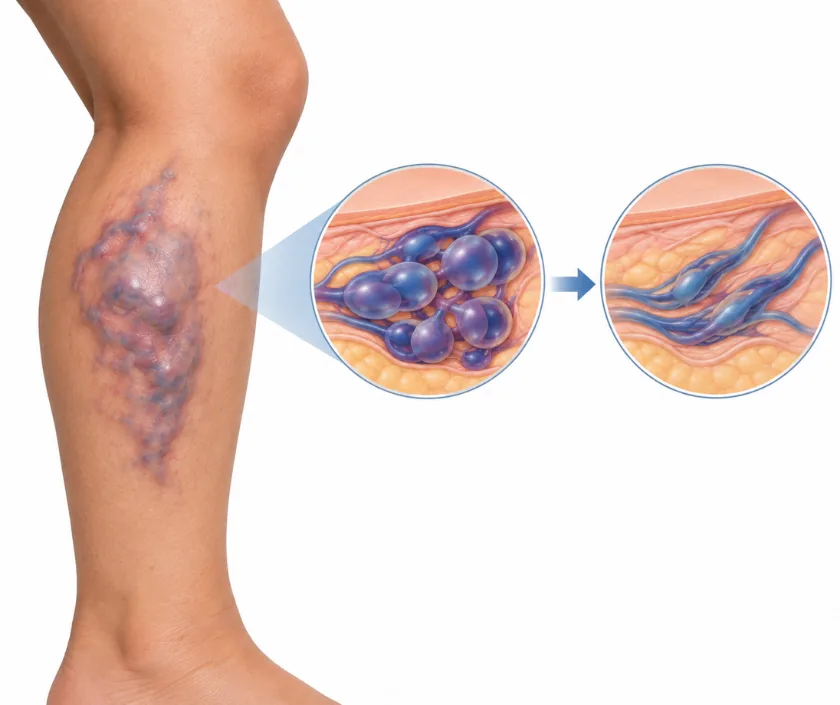
A venous malformation is a group of abnormal veins that forms before birth. Unlike an infantile hemangioma, it does not shrink away by itself. It grows steadily with the child and often becomes more noticeable at puberty. Treatment usually starts with compression and sclerotherapy, an injection that shrinks the abnormal veins. Surgery is used for selected lesions.
A venous malformation is a fault in the way veins formed before birth. It shows as a soft, bluish, compressible swelling that is usually not warm to touch. Swelling often increases when the part hangs down, when the child cries or strains, or first thing in the morning. Pain can come from small clots that form inside the abnormal veins.
Families often confuse this with an infantile hemangioma, and the difference matters. A hemangioma appears after birth, grows quickly, then fades over years. Malformations are present at birth even when hidden, grow in step with the child and do not disappear on their own. Scans, usually ultrasound and MRI, confirm which one it is and show how deep it goes.
Treatment aims to control the lesion, ease pain and protect nearby structures. Compression garments help many patients. Sclerotherapy, where a medicine is injected to shrink the abnormal veins, is the main treatment and is often repeated over several sessions. Surgery removes selected lesions, or what remains after injections. Blood clotting tests are checked for large lesions.
Not every venous malformation needs treating. Small quiet ones are often watched, while painful, growing or awkwardly placed ones are treated.
Examination gives a strong clue, and an ultrasound scan with an MRI confirms the type and shows the extent. Blood clotting tests are added for large lesions, since these can affect clotting.
Compression garments, raising the limb and simple pain relief help many patients, especially with limb lesions. Such measures are often continued alongside any procedure rather than replaced by it.
A medicine is injected into the abnormal veins under scan guidance, which makes them close and shrink. Several sessions spaced weeks apart are usually needed, and swelling for a few days afterwards is normal.
A well defined lesion, or what remains after injections, can be removed surgically. Careful planning protects nerves and other structures nearby, and larger removals may be staged over more than one operation.
Because these lesions can refill over time, review continues for years. Repeat sessions are arranged when symptoms return, and the plan is adjusted as the child grows.
After sclerotherapy the area is swollen, firm and tender for several days. Compression, raising the part and simple pain relief help. After an operation there is a dressing and a wound to keep dry.
Swelling settles and the lesion feels firmer than before. School and light activity restart. Contact sport waits, and compression garments are usually continued as advised.
A review compares size and symptoms with before. Another session may be planned at this point, since one treatment is rarely the whole course.
Scans may be repeated to check the result. Lesions can slowly refill, so ongoing review matters, and repeat treatment is normal rather than a sign of failure.
These malformations are rarely removed completely. Most children need several sclerotherapy sessions spaced over months, and swelling and soreness for a week or two after each is normal. The lesion usually shrinks and hurts less, then may slowly refill over years, especially during growth spurts and puberty, so further treatment later is common. Surgery is sometimes added for a well defined area. The realistic aim is good long term control rather than removal.
Both injection treatment and surgery carry risks. They are explained fully so that the plan can be weighed against the symptoms being treated.
Swelling after an injection session is expected and usually peaks in the first days. Comfort and elevation do most of the work.
Unlike some birthmarks, a venous malformation does not fade. It stays and grows gradually with the child.
It is a malformation of veins, not a growth. It does not spread to other parts of the body.
Several sessions spaced over months are usual, and the aim is to shrink and control it rather than remove it.
These veins have no clear border and bleed readily. Injection treatment is usually safer and is tried first.
Venous malformations are managed over years rather than fixed in one visit, so we plan the sessions and the reviews with families from the start.

Cost depends on the size and depth of the lesion, the scans needed, whether treatment is by injection, surgery or both, and how many sessions are planned. Injection courses are priced per session, so a large lesion costs more overall than a small one. Anaesthetic time, day care or an overnight stay and compression garments also count. A written estimate follows assessment.
These are the questions that come up most often in consultation. If yours is not here, send it on WhatsApp and the team will reply, usually the same day.
Ask your question →There is no fixed band, because the plan varies from a single injection session to staged surgery. Scans, anaesthetic time and the number of sessions drive the figure. A written estimate follows assessment, and insurance cover is checked, since treatment is done for medical reasons.
No. A venous malformation is not the same as an infantile hemangioma. Hemangiomas appear after birth and fade over years, while malformations are present from birth and grow with the child. Treatment aims to shrink and control the lesion rather than remove every trace.
It is done under scan guidance, usually with anaesthesia in children, by a team used to these lesions. Swelling and soreness for several days are expected. Skin blistering and nerve irritation are less common, and the risks depend on the site being treated.
After an injection session, swelling and tenderness last several days and settle over two to three weeks. School restarts sooner than sport. After an operation, wound care continues for a couple of weeks and a review is arranged at about six weeks.
Not always. Injections suit lesions that are spread out or wrapped around nerves, while an operation suits well defined ones, or leftover tissue after injections. Many patients need both. The choice comes from the scans and the symptoms, not from size alone.
Treatment is guided by symptoms rather than by age. Pain, bleeding, difficulty using a limb, or interference with eating and speech all move it forward. A lesion causing no trouble can be watched, with review as the child grows.
The history and the pattern of swelling are discussed and the area is examined. An ultrasound scan is often done at the visit, with an MRI arranged if needed. You will hear which treatments fit, how many sessions are likely, and the estimated cost in writing.
Seeing patients from across the city and beyond: read about the practice on the plastic surgeon in Surat page, or check what a written estimate covers on the costs and insurance page.
