Prominent ears stand further away from the head than usual and are often noticed in early childhood. This page explains what otoplasty does, when moulding in infancy may avoid surgery, how recovery goes and what shapes the cost.
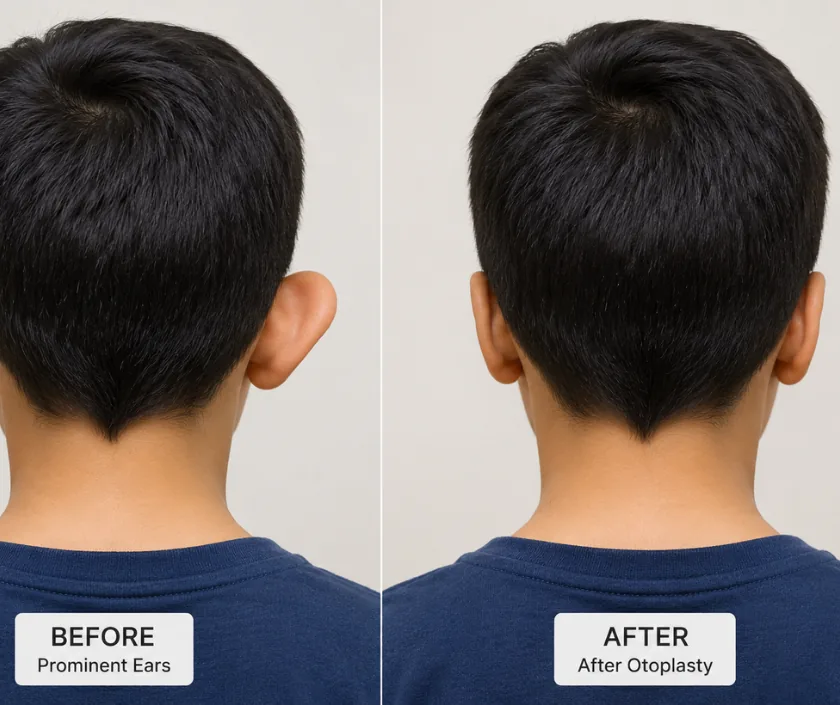
Otoplasty reshapes the cartilage of the outer ear so that it sits closer to the head. It is usually offered from about school age, once the ear has reached most of its adult size and the child wants the change. In the first weeks of life, moulding with a soft splint can sometimes reshape an ear without surgery.
Ears look prominent for two common reasons. The natural fold along the upper ear, which normally curves the rim back towards the head, may not have formed properly. Or the bowl of the ear may be deep, pushing the whole ear outwards. Many children have a mix of the two, and one ear often stands out more than the other.
Prominent ears do not affect hearing and are not a medical problem. Families usually ask about surgery because a child is unhappy with photographs, hairstyles or comments at school. That is a fair reason to seek advice, and it is also fair to decide against surgery. Where a baby is only a few weeks old, moulding with a soft splint worn for some weeks can reshape soft cartilage and may make an operation unnecessary.
When surgery is chosen, it is done through a cut hidden in the crease behind the ear. Fine stitches create the missing fold, the cartilage may be softened by gentle scoring, and a deep bowl can be trimmed or stitched closer to the head.
Age and willingness matter as much as ear shape, because the result depends on weeks of cooperation afterwards.
The ears are measured and photographed and the fold and bowl are examined. In children, being ready and wanting the change matter as much as age does, so the child is included in the discussion.
Adults and older teenagers usually have local anaesthesia, with sedation if they prefer it. Younger children sleep under a general anaesthetic. Either way this is nearly always a day case.
A cut is made in the crease behind the ear so that the scar is hidden. Skin is lifted carefully to expose the cartilage that has to be reshaped.
Fine stitches form the missing curve along the upper ear. The cartilage may be gently scored to soften it, and a deep bowl can be trimmed or stitched closer to the head.
The skin is closed and a supportive dressing is applied. A soft headband is then worn at night for some weeks so the ears are not pulled forwards during sleep.
A bulky dressing stays on and the head is kept raised. Aching and throbbing are common and settle with simple pain relief. Sudden severe pain on one side should be reported at once.
The dressing comes off in clinic and the ears look swollen and bruised at first. Most children go back to school in about a week, and adults to desk work sooner.
Swelling has largely settled and the new shape is much clearer. Sport and swimming usually restart around now, once the surgeon has checked healing.
The scar behind the ear fades slowly. The settled position is judged at this stage, and a small revision is occasionally discussed if one ear has drifted.
Ears usually sit noticeably closer to the head and look more balanced. Small differences between the two sides are normal and are far more obvious to the family than to anyone else. Ears can drift out a little during the first year, and a stitch occasionally loosens or becomes noticeable and needs a small revision. Numbness behind the ear settles over months. Wearing the headband as instructed is the single biggest thing a family controls.
Otoplasty is a common and generally well tolerated operation, yet no surgery is without risk. These are the problems worth knowing about before you decide.
The headband weeks are not a formality. They are what holds the new shape while healing finishes.
Moulding works only in the first weeks of life, and surgery waits until the ear is close to adult size.
Ears can drift out slightly during the first year, which is exactly why the headband period matters.
For a child being teased, the change in confidence at school is often the biggest result of all.
Ears are never identical, even in people who have never had surgery, so the aim is balance rather than a match.
Families appreciate being told when a baby could be moulded instead, and being encouraged to wait until an older child wants the change.

The price depends on whether one ear or both are treated, the type of anaesthesia, how much cartilage work is needed and whether the operation is a first correction or a revision. Cosmetic correction of prominent ears is often not covered by insurance, while some cases in children are assessed differently. A written estimate is given after examination, so you know the figure before booking a date.
These are the questions that come up most often in consultation. If yours is not here, send it on WhatsApp and the team will reply, usually the same day.
Ask your question →A written estimate is prepared after the ears are examined. Price varies with one ear or two, the anaesthetic used, the amount of cartilage work and whether it is a revision. Insurance cover is checked at the same visit, since correction is often treated as cosmetic.
Surgery is usually planned from about school age, once the ear has reached most of its adult size. Waiting also lets the child take part in the decision. In babies only a few weeks old, moulding with a soft splint may reshape the ear instead.
In the first weeks of life the cartilage is soft and holds a new shape well. A splint worn steadily for some weeks can improve many mild shapes. It works less well once the cartilage stiffens, so early advice matters if you want to try it.
Otoplasty is a widely performed procedure with a good safety record, though bleeding, infection and stitches loosening are all possible. Working through a hidden cut behind the ear, careful haemostasis and a supportive dressing all reduce risk. Any concern in the first days should be reported.
A dressing stays on for a few days, then a soft headband is worn at night for some weeks. Children usually return to school in about a week. Sport and swimming wait roughly six weeks, and the scar keeps fading for months.
For most people the corrected shape holds well over the years. Cartilage has memory, so an ear can drift partly outwards, more often when stitches loosen early or a headband is not used. A small revision can be discussed if that happens.
Both ears are examined and measured and photographs are taken for the record. You will hear what can realistically change, what the operation involves for your age group, the recovery to expect and the written cost estimate before any date is fixed.
Seeing patients from across the city and beyond: read about the practice on the plastic surgeon in Surat page, or check what a written estimate covers on the costs and insurance page.
