In Stahl's ear an extra fold crosses the upper ear, giving the rim a pointed look. This page explains what causes the shape, why moulding works so well in young babies, what surgery involves and what it may cost.
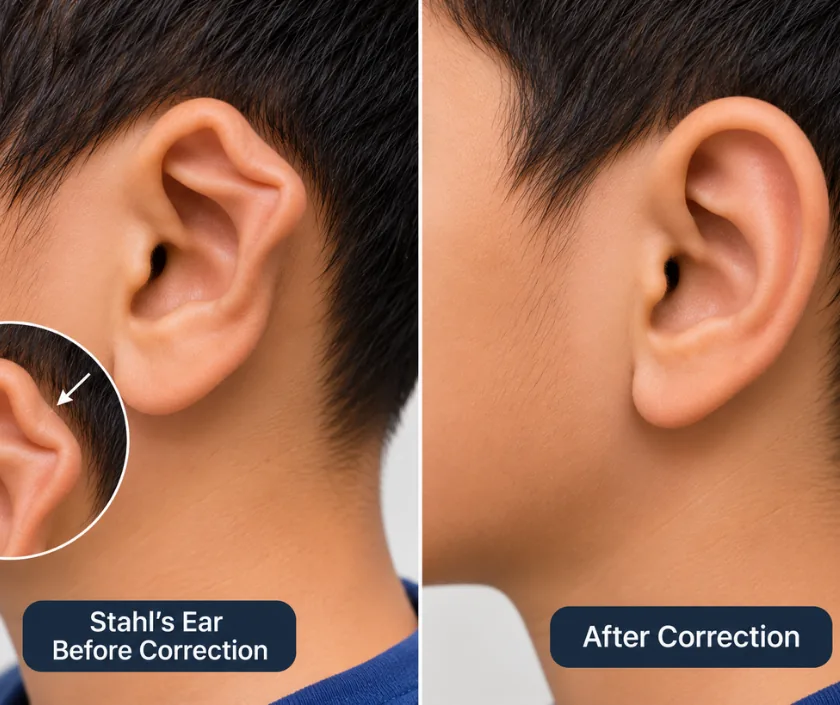
Stahl's ear is a shape difference in which an extra ridge of cartilage crosses the hollow of the upper ear. It flattens the normal curve and pulls the rim into a point. Hearing is not affected. In the first weeks of life a moulding splint often reshapes the ear completely, while an older child needs surgery to reduce or reshape the extra fold.
The upper ear normally has one ridge running along it, which curves the rim smoothly backwards. In Stahl's ear a second ridge crosses that hollow at an angle. It acts like a strut, flattens the natural curve and pushes the rim outwards, so the top of the ear comes to a point. Some people know it as a pointed ear or by nicknames from television.
The difference is present at birth and may affect one ear or both. It is a shape difference only. The canal, the eardrum and the inner ear develop separately, so hearing is normal and there is no medical need to treat it. Families come for advice because of appearance, or because an older child has started to notice comments.
Timing changes what is possible. In the first weeks of life the cartilage is soft and holds a new shape, so a splint can flatten the extra ridge with no operation at all. Once the cartilage has stiffened, that window has closed and surgery becomes the way to change the shape.
The right treatment depends almost entirely on age. Newborns are usually offered moulding, while older children and adults are offered surgery.
Both ears are examined and photographed and the extra ridge is traced. The surgeon checks whether the ear also stands away from the head, since the two are often corrected together.
A soft splint fitted in the first weeks presses the extra ridge flat while the cartilage is still soft. It is worn steadily for some weeks with regular skin checks and often works very well.
Children sleep under a general anaesthetic. Older teenagers and adults usually have local anaesthesia. The procedure is a day case in almost every case, with no overnight stay.
Through a cut behind the ear, the extra cartilage is thinned, weakened by fine scoring or partly removed so that it no longer holds the rim out in a point.
Fine stitches restore the natural curve along the upper ear. A supportive dressing is applied, followed by a soft headband at night for some weeks.
A dressing supports the reshaped rim and the head is kept raised. Aching is normal and settles with simple pain relief. Severe pain on one side should be reported the same day.
The dressing comes off in clinic and the ear is swollen and bruised at first. School restarts in about a week for most children, and a headband is worn at night.
Swelling has largely gone and the curve of the rim is clearer. Sport and swimming usually restart now, once the surgeon has checked that healing is complete.
The scar behind the ear fades and the cartilage settles. If a slight point remains, a small adjustment can be discussed once everything has softened.
Moulding works well when it is started early and worn as instructed, though some ears keep a faint fold. Started late, it does much less. Surgery reduces the extra fold and rounds the rim, but cartilage has memory and a mild pointing can return over the years. Scars are placed behind the ear or along a natural line where they are hard to see. The two ears usually look alike from the front rather than exactly matched.
This is delicate work on cartilage that remembers its old shape. Most people are pleased with the result, and the following problems are still possible.
Whether your child has a splint or a dressing, the job at home is the same. Keep it in place, keep it clean and watch the skin.
The extra fold is built into the cartilage and does not settle with time. Early moulding is what changes it.
The opposite is true. The easiest treatment is in the first weeks of life, and the option fades quickly.
It is a difference in the outer cartilage only. The hearing parts of the ear are separate and unaffected.
Home taping can damage newborn skin and rarely holds the shape. A fitted splint is designed for the task.
The value here is honest timing advice, because the same ear needs very different treatment at three weeks and at three years.

Price depends on whether one ear or both are treated, the anaesthetic used, how much cartilage work the fold needs and whether prominence is corrected at the same sitting. Correction is often regarded as cosmetic, so insurance cover is checked openly at the first visit. A written estimate is given after examination, well before any date is booked, so there is no surprise later.
These are the questions that come up most often in consultation. If yours is not here, send it on WhatsApp and the team will reply, usually the same day.
Ask your question →A written estimate is prepared after the ears are examined. The figure depends on one ear or two, the anaesthetic used, how much cartilage work is needed and whether prominence is treated at the same time. Insurance cover is discussed at the same visit.
In the first weeks of life the cartilage is soft and a moulding splint often flattens the extra ridge completely. It is worn steadily for some weeks with regular skin checks. Started later, moulding rarely changes a stiffened cartilage.
Surgery is generally planned from about school age, once the ear has reached most of its adult size and the child wants the change. There is no medical urgency, so timing follows growth and how much the shape bothers your child.
It is day case surgery with a good safety record. Bleeding, infection and partial return of the point are the recognised risks, and an irregular edge can occasionally be felt. Health is checked before the date and any concern afterwards is reviewed quickly.
A dressing stays on for a few days, then a soft headband is worn at night for some weeks. School usually restarts in about a week. Sport and swimming wait roughly six weeks while the reshaped cartilage settles.
Most ears hold the new curve well over the years. Cartilage has memory, so a slight point can return, more often when the fold was firm or the headband was not used. A small adjustment can be considered if that happens.
Both ears are examined and photographed and the extra fold is assessed. You will hear whether moulding is still an option at your child's age, what surgery could realistically change, the recovery involved and the written cost estimate.
Seeing patients from across the city and beyond: read about the practice on the plastic surgeon in Surat page, or check what a written estimate covers on the costs and insurance page.
