A cleft hand has a gap running into the middle of the palm, usually where the middle finger would sit. This page explains what that means for your child, when an operation helps and when a hand is better left alone.
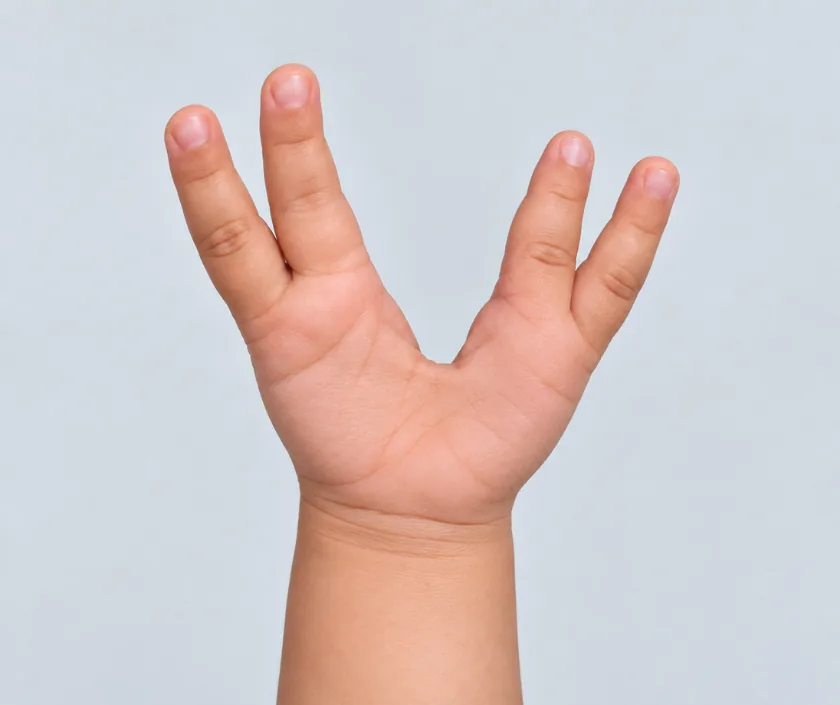
Cleft hand, also called split hand, is a difference where the central part of the hand does not form, leaving a V shaped gap in the palm. One or more middle fingers may be missing, and the remaining fingers can be joined or angled. Many cleft hands grip and pinch well, so surgery is offered only where it adds function or comfort.
In a cleft hand the middle of the hand does not form completely. A gap runs from between the fingers down into the palm, and the middle finger is often absent. The thumb and the border fingers are usually present, which is why so many of these hands work far better than they look. Both hands and sometimes the feet can be involved, and the difference can run in families.
Every cleft hand is different. The gap may be narrow or wide, the fingers on either side may be joined by skin or share a bone, and the web between thumb and index finger is sometimes tight. Some children have an extra bone sitting inside the cleft that pushes the two sides further apart as they grow.
The first job is to work out what the hand can already do. Grip, pinch and how objects are picked up are all watched. Where a child grasps well, appearance alone is rarely a good reason to operate, and honest advice sometimes means advising against surgery.
Not every split hand needs surgery. We operate when the gap is widening, when the thumb cannot meet the other fingers, or when joined fingers pull the hand out of shape.
The hand is examined and X ray pictures show which bones are present inside the palm. Grip and pinch are watched during play, and photographs are taken so change over the years can be compared.
Not every cleft needs closing. Surgery is planned where a tight thumb web, joined fingers or a widening bone limits use. When the hand already works well, watchful review may be the wiser choice.
Fingers held together by skin or bone are separated, and the new sides are covered with local flaps and sometimes a small graft. Nail folds are rebuilt so the edges are neat and durable.
The gap in the palm is narrowed by moving the bones of the hand closer and joining soft tissue across the space. Any bone sitting inside the cleft is removed at the same sitting.
A tight first web space is opened using skin flaps taken from the closed cleft. A wider web lets the thumb move away from the palm so larger objects can be held.
A cast keeps the hand still while healing starts. Keep it dry and raised. Simple pain relief is usually enough, and most children are comfortable within a few days.
The cast is removed at review, wounds are checked and therapy begins. Gentle movement, scar massage and pinch games help the fingers settle into their new spacing.
Grip and pinch are measured and compared with before surgery. Splints may be used at night. Ordinary school activity and play have usually resumed by this point.
The hand is reviewed as it grows, since bones can shift with growth. A further small operation is sometimes advised in later childhood, with therapy repeated afterwards.
The hand will still have fewer fingers than usual and will not look typical. What surgery aims at is a narrower, steadier hand that pinches and grips more easily. Movement in the remaining fingers improves only as far as their joints and tendons allow. The gap can widen again during growth spurts, and a further operation is sometimes needed. Many children with a well used split hand manage school and sport with very little help.
Surgery on a cleft hand is planned carefully because the hand often works well already. These are the problems to weigh before deciding.
The cast protects the repair, and the therapy that follows decides how much of the new shape becomes useful movement.
Missing fingers cannot be created. Surgery narrows the palm, frees the fingers that are there and improves pinch.
Timing is chosen around how the child uses the hand and how the tissues have grown. Early is not always better.
Most children find their own ways to eat, write and dress, often faster than adults expect.
The same pattern can affect the feet, and it sometimes runs in families, which is why genetics advice is offered.
We start by watching what your child already does with the hand, because that is the honest measure of whether an operation will add anything.

Cleft hand surgery is planned around one particular hand, so there is no set price. The estimate depends on how many fingers are separated, whether the cleft is closed and the thumb web widened at the same sitting, the anaesthetic time, the use of skin grafts and the therapy that follows. Some children need more than one stage across childhood, each with its own estimate. Cover under a government scheme or a mediclaim policy varies, and a written estimate is shared after examination.
These are the questions that come up most often in consultation. If yours is not here, send it on WhatsApp and the team will reply, usually the same day.
Ask your question →No fixed band is published, since the work needed differs so widely. Separating joined fingers, closing the cleft and widening the thumb web all add theatre time, and some children need more than one stage. A written estimate follows assessment.
Hand surgery is routine in children who are fit for anaesthesia. General health, weight and any related differences are checked beforehand by a paediatrician. Most operations take a couple of hours, and many children go home the same day or after one night.
A cast is usually worn for a few weeks, then therapy starts. Children are comfortable within days but avoid rough play and swimming until wounds are healed. Movement and strength keep improving for several months afterwards.
The hand will look tidier and the gap narrower, but a cleft hand keeps its own shape and often has fewer fingers. Setting expectations early matters. Improving grip and comfort is a more realistic aim than a typical appearance.
No, and this is worth saying plainly. Many cleft hands pinch and grip well, and operating on such a hand can take away as much as it gives. Surgery is advised mainly for tight webs, joined fingers or a cleft that keeps widening.
Assessment can start in infancy, while operations are usually timed to growth and to what your child needs to do. Joined fingers are often separated in the early years. Cleft closure may be planned later, once the pattern of growth is clearer.
The hand is examined, X ray pictures are reviewed and grip is watched during play. Photographs are taken for the record. You will hear which parts might benefit from surgery, which are better left alone, and what an estimate would include.
Each technique below has its own page explaining how it works and when it is chosen.
Seeing patients from across the city and beyond: read about the practice on the plastic surgeon in Surat page, or check what a written estimate covers on the costs and insurance page.
