Thumb hypoplasia means the thumb is smaller or weaker than it should be, and sometimes it is barely attached. This page explains how the thumb is assessed in Surat, which operations help and what recovery asks of your family.
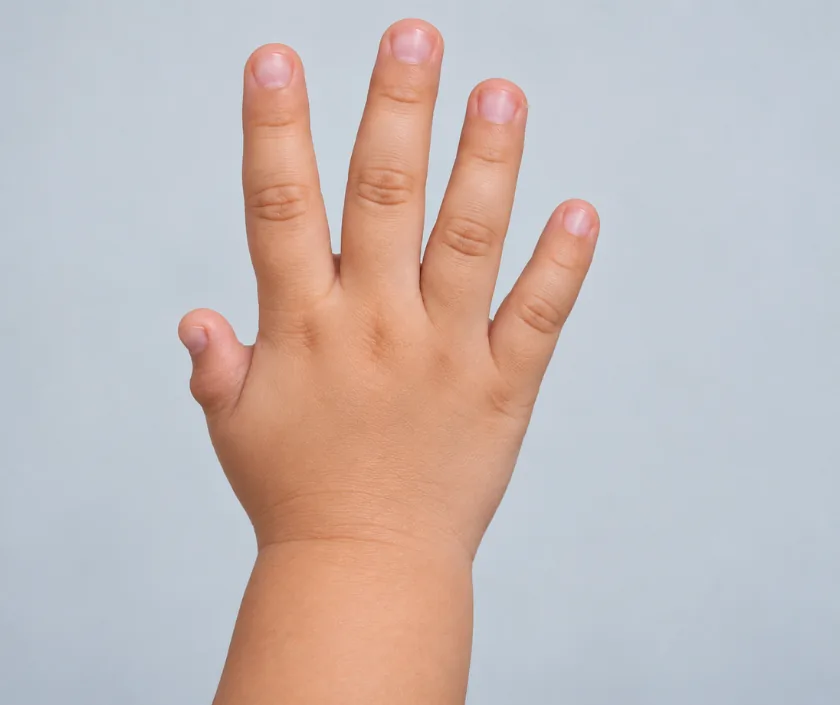
Thumb hypoplasia is a thumb that has not formed fully. It ranges from a slightly small thumb to one that hangs on a narrow bridge of skin. Treatment depends on how steady the joint at the base of the thumb is. A steady thumb can be rebuilt, while an unsteady or floating thumb is usually treated by moving the index finger into the thumb position.
The thumb does a great deal of the work of the hand. It swings across the palm to meet the other fingers, which is what allows pinching, holding a pencil and gripping a bottle. When the thumb is small, weak or wobbly, that meeting is hard to make, so a child often grips between the sides of two fingers instead.
Doctors group thumb hypoplasia by what is missing. A mildly small thumb may have all its parts and only need watching. Others lack the muscles that pull the thumb across the palm, have a tight first web space, or have a loose joint where the thumb meets the wrist. At the far end, the thumb is joined by skin alone or is not there at all.
That grouping guides treatment. When the joint at the base is steady, the thumb can be kept and rebuilt with a web release, a tendon transfer and stitching to steady the side ligaments. When the joint is not steady, keeping the thumb tends to leave a part that is not used, so moving the index finger is usually advised.
Surgery suits a child whose thumb cannot hold anything, or who pinches sideways between the index and middle fingers instead. Assessment is about grip, not about size alone.
The thumb is examined for size, muscle power and how steady the base joint feels. X ray pictures show which bones are present. Play is watched to see how your child is already picking things up.
A tight web between the thumb and index finger is opened with skin flaps, sometimes with a small graft. A wider web lets the thumb swing away from the palm and hold larger objects.
Loose ligaments at the base of the thumb are tightened using a strip of nearby tendon. A steadier joint means pinch can be firm rather than folding under load.
When the muscles that swing the thumb are weak, a tendon from a finger is rerouted to do that job. This transfer gives the thumb a working pull towards the other fingers.
A cast protects the repair while it heals. Hand therapy then teaches your child to use the new movement, since the brain has to learn the rebuilt pattern of grip.
The cast stays on and the hand is kept dry and raised. Simple pain relief is usually enough. Most children return to nursery or school once they feel comfortable.
The cast is removed at review and therapy starts. Gentle exercises, scar massage and games that ask for pinch help the thumb take its new role.
Grip and pinch are measured again. Many children are using the thumb without being reminded by now, though a night splint may still be advised for a while.
The thumb grows with your child but often stays smaller than the other one. Reviews continue through childhood, and a further small procedure is sometimes useful later.
A rebuilt or moved thumb usually gives a good pinch, but it stays shorter and less mobile than a natural thumb, and strength stays below the other side. After pollicisation the hand has four digits, which most children accept easily but which parents often need time to get used to. Progress depends heavily on therapy in the first year. Some children need a small further operation as they grow. Most manage school and daily tasks without help.
Thumb reconstruction is a well established operation and children usually do well. It still helps to know what can go wrong so problems are picked up early.
The arm is protected in a cast at first. Once that is off, the real work is teaching the hand to use its new thumb every day.
Length is only useful if the base joint is stable. Without a stable base, a longer thumb still cannot hold anything.
The hand gains a working thumb and keeps its grip. Children adapt to four digits far faster than adults expect.
The brain has to learn the new pattern. Hand therapy in the months afterwards decides how much of the surgery becomes useful.
A small thumb is often linked with heart, kidney and blood conditions, so screening tests are part of the first visit.
The decision here turns on one question about the base joint, and we make sure parents understand that question before any date is set.

Thumb hypoplasia is treated in many different ways, so a single price would be misleading. What you pay depends on which steps are needed, whether a web release, a tendon transfer and joint work are all done together, the anaesthetic time, the length of stay and the hand therapy that follows. Cover under a government scheme or a mediclaim policy varies with the diagnosis and the hospital. You are given a written estimate after your child has been examined and the plan is settled.
These are the questions that come up most often in consultation. If yours is not here, send it on WhatsApp and the team will reply, usually the same day.
Ask your question →No fixed band is published, because the operation is tailored to the thumb in front of us. Web release, tendon transfer and joint tightening can be done alone or together, and each changes the theatre time. A written estimate follows the assessment visit.
Hand surgery in children is routine when the child is fit for anaesthesia. Weight, general health and any related conditions are checked first by a paediatrician. Operations are short, monitoring afterwards is close, and many children go home the same day.
A cast is usually worn for a few weeks, then hand therapy begins. Comfort returns within days, while strength and skill build over months. Rough play and swimming wait until the wounds are healed and the therapist agrees.
It will work better than before, though it usually stays smaller and a little weaker than the thumb on the other side. Most children pinch, write and dress themselves well. Function is the goal rather than a matching appearance.
No. When the joint at the base of the thumb is missing or very loose, a rebuilt thumb tends to be ignored by the child. In that situation moving the index finger into the thumb position gives far better use of the hand.
Many surgeons prefer to operate in the first years of life, before habits of grip are fixed. Exact timing depends on the size of the hand, general health and what your child is trying to do. Later surgery is still worthwhile.
The hand is examined, the base joint is tested for stability and X ray pictures are reviewed. You will hear which options suit your child, how many stages are likely, what therapy involves and what the written estimate covers.
Each technique below has its own page explaining how it works and when it is chosen.
Seeing patients from across the city and beyond: read about the practice on the plastic surgeon in Surat page, or check what a written estimate covers on the costs and insurance page.
