Ulnar club hand is a rare difference in which the forearm bone on the little finger side does not form fully. This page explains what it means for your child, how it is assessed in Surat and which treatments help.
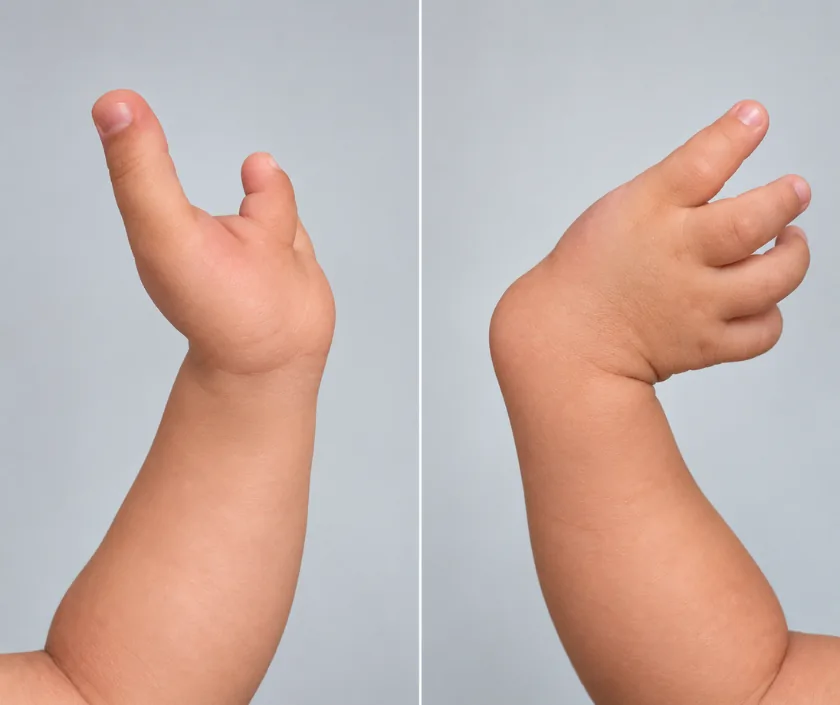
Ulnar club hand is a rare difference where the ulna, the forearm bone on the little finger side, is small or missing. The wrist may sit at an angle and some fingers can be absent. Many children use the hand well with therapy and splinting. Surgery is considered for the thumb, the web spaces or a stiff elbow.
The forearm has two bones. The ulna runs on the little finger side and the radius runs on the thumb side. In ulnar club hand the ulna does not form fully, so it may be short or missing altogether. The wrist then tends to lean towards the little finger side, and the forearm is usually shorter than the other one.
More than the wrist is affected. Fingers on the little finger side are often small or absent, the thumb may be poorly formed, and two fingers can be joined by skin. Many children also have an elbow that is stiff or unstable, which changes how the arm reaches and lifts.
Assessment looks at what your child can do, not only at what an X ray shows. Grip, pinch, reach and the way the two hands work together are all recorded. Because babies adapt early, treatment starts with hand therapy and splinting, and an operation is offered only where it will add real function.
The plan depends more on the elbow and the hand than on the look of the forearm. We ask what your child cannot reach and what they cannot hold.
The arm is examined, and grip, pinch and reach are recorded. X ray pictures of the hand, forearm and elbow show which bones are present. Other systems are checked, since some children have related differences.
Hand therapy builds strength and teaches your child to use both hands together. A light splint may hold the wrist in a better position. Progress is reviewed as growth continues and new tasks are attempted.
Where fingers are joined, the skin bridge is separated and the new sides are resurfaced, often with a small skin graft. Separation widens grasp and makes washing and nail care easier for everyone.
If the thumb is small or the first web space is tight, the web can be deepened and the thumb steadied. Where no usable thumb exists, moving a finger into the thumb position is discussed.
Some children need work on the forearm or elbow to improve position or stability. Such surgery is planned case by case, often later in childhood, and only when it will help daily function.
A cast or dressing protects the hand. Pain is usually mild and settles with simple medicine. Keep the dressing dry and rest the hand on a pillow so swelling eases.
The cast comes off at review and hand therapy begins. Gentle movement, scar care and play based exercises help your child trust the hand again.
Grip and pinch are measured and compared with the first visit. Splints are adjusted where needed. Most children are back to school routines and ordinary play by now.
Reviews continue as the arm grows. Some children need a further stage in later childhood. Therapy is repeated around each stage so the gains are kept.
The affected forearm stays shorter and the elbow often stays stiffer than the other side, and surgery does not change that. What can improve is grip, pinch and how easily the hand reaches useful positions. Strength usually stays below the unaffected side. Some children need more than one operation across childhood as the arm grows. Most manage school, sport and self care using the arm in their own way, often better than parents expected at the first visit.
Hand surgery in children is usually well tolerated and most recover quickly. Knowing the possible problems helps you spot them early and get advice.
After any hand or arm operation the limb is protected first and then moved early, because stiffness is the main enemy.
Length and elbow stiffness cannot be corrected to match the other side. Treatment focuses on what the hand can do.
Many children use the arm well without any operation. Surgery is offered when a specific task is blocked.
Timing is judged on how the child uses the limb. Waiting sometimes gives a better and safer result.
Therapy is where most of the daily function is built. Without it the gains from surgery fade.
We assess the elbow, the wrist and the hand together, because in this condition the elbow often decides what the hand is able to reach.

There is no fixed price for ulnar club hand surgery, because no two hands are alike. An estimate depends on which parts of the arm are treated, whether more than one stage is planned, the anaesthetic time needed, the use of skin grafts and how much hand therapy is likely afterwards. Scheme and insurance cover varies with the diagnosis and the hospital involved. A written estimate is given once your child has been examined and the plan is agreed, so nothing comes as a surprise on admission.
These are the questions that come up most often in consultation. If yours is not here, send it on WhatsApp and the team will reply, usually the same day.
Ask your question →No fixed band is published for this surgery, because the plan differs for every child. Cost depends on which structures are treated, the number of stages, anaesthetic time and any grafts used. A written estimate follows assessment, along with what scheme or insurance cover may apply.
Children handle hand surgery well once they are fit for anaesthesia. Blood tests and a paediatric review come first, and the anaesthetic team checks weight and general health. Most operations are short, and many children go home the same day or after one night.
A cast or dressing usually stays on for a few weeks, then therapy starts. Play returns quickly, while grip and pinch improve over months. Swimming and rough games wait until the wound has healed fully and the therapist is happy.
Function comes before appearance, so the aim is a hand that works. Surgery can improve the position of the wrist and the spacing of the fingers, though the hand will still look different. Many children are untroubled by this once they can use it.
No. Plenty of children with this difference use the arm well and need only therapy, splinting and regular review. An operation is suggested when a tight web space, joined fingers, an unstable wrist or a missing thumb is holding function back.
Assessment is best soon after birth, even when nothing needs doing straight away. Therapy and splinting can begin in infancy. Operations are timed to growth and to what your child is trying to do, so one fixed age does not suit everybody.
The arm is examined from shoulder to fingertip, and grip, pinch and reach are recorded. X ray pictures are usually taken. You will hear which options may help, how stages are spaced, what therapy is needed and what the written estimate covers.
Each technique below has its own page explaining how it works and when it is chosen.
Seeing patients from across the city and beyond: read about the practice on the plastic surgeon in Surat page, or check what a written estimate covers on the costs and insurance page.
