Each finger is fed by two small arteries running along its sides, and a deep cut can divide one or both of them. Repairing these vessels under a microscope keeps the finger alive, or at the very least warmer and better nourished than it would otherwise be.
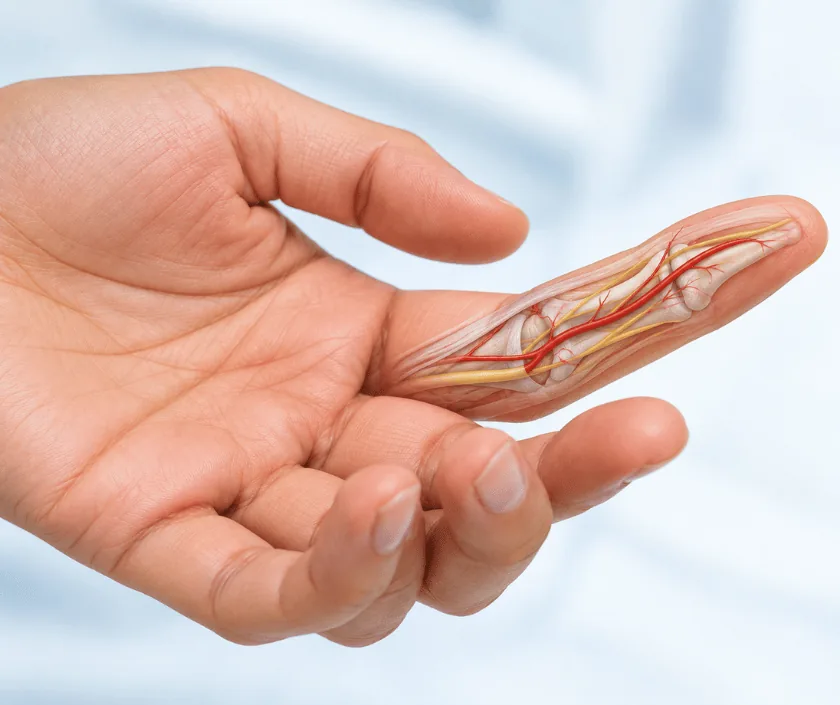
Digital artery repair joins the tiny vessels along the side of a finger after a cut has divided them. Losing both arteries leaves the finger without blood supply, which makes repair urgent. Where only one is cut the finger usually survives, yet repair is still preferred because it improves warmth, healing and comfort. The digital nerve alongside is repaired at the same time.
Along each side of a finger run a small artery and a nerve, tucked just under the skin and easily reached by a blade. A cut across the base or middle of the finger can divide one pair or both. What follows depends on how many vessels have gone: with one artery intact the finger usually stays pink, while losing both leaves it pale, cold and in immediate danger.
Surgery begins by exploring the wound under tourniquet so the cut ends can be found beyond the bruised zone. Vessel ends are trimmed back to healthy wall, then joined under the microscope with sutures so fine they are hard to see without magnification. Where a length of artery has been lost, a vein graft taken from the forearm bridges the gap.
Digital nerve repair is carried out at the same sitting, because feeling in the pulp matters enormously for everyday use. Tendon repair and skin cover follow as required, and a splint then holds the finger in a position where all the repairs are protected.
Repair is judged on how many vessels are cut, how the finger looks and what else has been injured. Some situations are urgent, others are a considered choice made with you.
Colour, warmth, refill and sensation are checked on both sides of the finger, and tendon movement is tested. Circulation findings decide whether the case goes to theatre immediately or can be planned.
A regional block numbs the arm and a tourniquet gives a clear field. The wound is extended along a planned zigzag so vessels and nerves can be traced past the injured segment.
Bruised vessel wall is trimmed until the lining looks healthy under magnification. If the ends will not meet without tension, a vein graft from the forearm bridges the gap.
Very fine sutures are placed around the circumference of the vessel under the microscope. Clamps are released and the surgeon watches for the finger to flush pink and stay that way.
Digital nerves are joined with the same magnification. Skin is closed without tension and a splint holds the finger in a protected position for the weeks that follow.
The finger is watched closely for colour and warmth, and the room is kept warm. Elevation is moderate rather than extreme, since the repaired vessel still has to push blood out to the tip.
Dressings are changed and the wound reviewed. Protected movement starts according to what else was repaired, with the splint worn between therapy sessions.
The splint usually comes off and strengthening begins. Sensation is tested on both sides of the finger so that nerve recovery can be followed over time.
Feeling keeps returning and the finger tolerates cold better. Tightness of scar or joint is addressed with therapy, and a secondary procedure is occasionally planned.
Most repaired fingers survive and settle into everyday use. Sensation returns slowly as the digital nerve regenerates, and it may never match the opposite side. Cold intolerance is common and improves gradually across the year that follows. Some stiffness at the nearest joint is usual, and the scar stays visible along the side of the finger. Not every repair remains open, which is discussed beforehand.
Working on vessels this small carries a genuine failure rate, so it helps to know what can go wrong before you consent.
Small vessels respond to warmth and calm, so home routines carry real weight through the first few weeks.
One artery can keep the finger pink while the other is divided. Exploring the wound settles the question, not colour alone.
Partial amputations are often repaired successfully when circulation is restored quickly, so the finger should never be written off at the scene.
Microsurgery routinely joins vessels far finer than a matchstick, using a microscope and sutures thinner than a hair.
Nerve recovery, stiffness and cold intolerance all continue long afterwards, and therapy matters throughout that whole period.
Elegance Clinic in Surat is set up for microsurgical work on the hand, with the magnification, instruments and monitoring that small vessel repair depends on.

Digital artery repair is microsurgery, so the estimate reflects theatre time, magnification, fine instruments and the nerve or tendon repairs carried out in the same sitting. Anaesthesia, the short admission for observation and the therapy that follows are all included.
Emergency cases are stabilised first and the written estimate follows as soon as the plan is clear. Where the injury happened at work or in a road accident, insurance or employer cover may apply, so bring your policy and accident papers with you.
These are the questions that come up most often in consultation. If yours is not here, send it on WhatsApp and the team will reply, usually the same day.
Ask your question →Charges reflect microsurgical theatre time, anaesthesia and the nerve or tendon repairs carried out alongside. A written estimate is given once the injury has been assessed, or as soon as possible afterwards when the case arrived as an emergency.
Microsurgery on the finger is routine work under anaesthesia with monitoring throughout. Main concerns are that a join blocks, or that infection follows a contaminated wound. Warmth and avoiding tobacco improve the chance that the repair stays open.
Wounds close within a couple of weeks and the splint is usually worn for several weeks more. Movement and strength build over the following months. Feeling in the pulp comes back slowly, often still improving well into the first year.
Sensation usually returns but rarely matches the other side, and the finger may stay sensitive to cold for a long time. Most people find it becomes reliable for everyday tasks even when feeling is not quite what it was.
Not always. A finger with one healthy artery generally stays warm and pink. Repair is still preferred when the wound is open for nerve work, or when your job exposes the hand to cold and damp.
Go straight away if the finger looks white or blue, feels cold, or is only partly attached. Tissue tolerates loss of blood supply for a limited time, so hours matter and waiting until morning is unwise.
Colour, warmth and refill are assessed, along with sensation on both sides of the finger and the movement of each tendon. Imaging may be taken if glass or a fracture is suspected, then the plan is explained to you.
Each technique below has its own page explaining how it works and when it is chosen.
Seeing patients from across the city and beyond: read about the practice on the plastic surgeon in Surat page, or check what a written estimate covers on the costs and insurance page.
