The radial artery is one of two main vessels feeding the hand, and it is often cut by glass or a blade at the wrist. Repair restores flow through it, usually alongside repair of the nerves and tendons injured in the same moment.
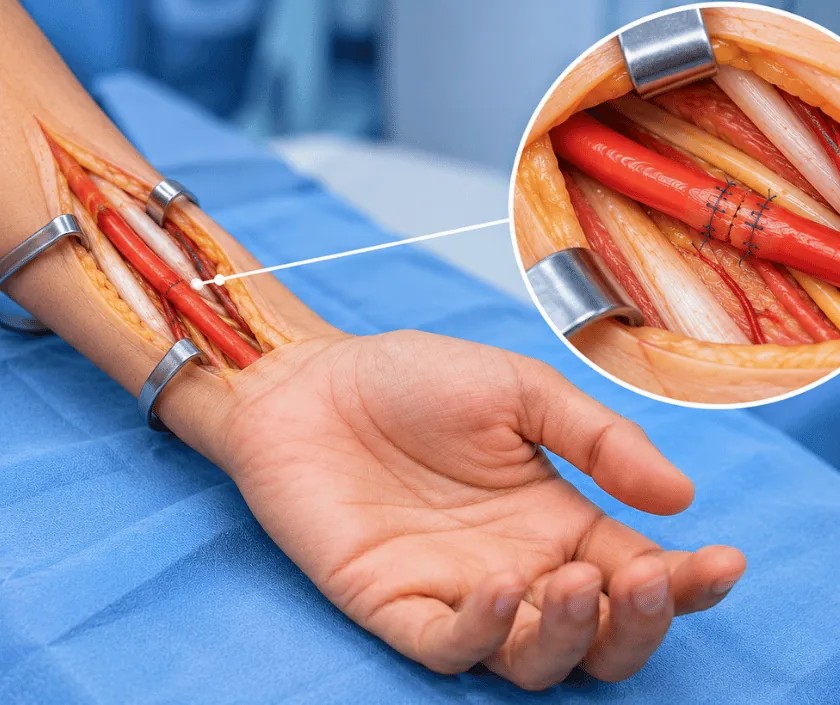
Radial artery repair joins the cut ends of the vessel at the wrist under a microscope so that blood flows through it again. Many hands survive on the ulnar artery alone, yet repair is still preferred because it restores reserve, supports healing of the other injured tissues and reduces cold intolerance. Nerve and tendon repairs are done at the same sitting.
Blood reaches the hand through the radial artery on the thumb side of the wrist and the ulnar artery on the little finger side. They join in loops across the palm, which is why a hand can often stay alive when only one of them is working. That safety net explains why a bleeding wrist wound is survivable, though it does not mean the injury can be shrugged off.
Repair is carried out under magnification. Cut ends are trimmed back to healthy vessel wall, clamped gently, and joined with sutures finer than a hair. Where a segment has been lost or badly bruised, a short vein graft taken from the forearm bridges the gap. Flow is then released and the join is watched to confirm that it fills and stays open.
Because a blade or glass edge cuts in a straight line, the median or ulnar nerve and several tendons are frequently divided at the same level. Those repairs are usually completed in the same operation, and they often decide the eventual result more than the artery does.
Repair is advised whenever the artery is divided and the patient is stable enough for surgery. Priorities are set by how much of the hand is short of blood.
Bleeding is controlled with direct pressure and elevation, never with a blind clamp. Circulation, nerve function and tendon movement are all tested and recorded before anaesthesia is given.
A regional block or general anaesthesia is used and a tourniquet applied. The wound is extended along a planned line so the cut ends of the artery, and any injured nerves and tendons, can be seen properly.
Damaged wall is trimmed until both ends look healthy. If the gap is too wide to join without tension, a short vein graft is harvested from the forearm to bridge it.
Under the microscope the ends are stitched together with very fine sutures. Clamps come off and the surgeon waits to confirm that the repair fills, pulses and remains open.
Divided nerves are joined and tendons repaired at the same sitting. A splint is then applied that holds each repair in a safe position.
The hand is elevated while colour, warmth and refill are checked frequently. Keeping the room warm helps the repair stay open. Tobacco and cold exposure are avoided entirely.
Wounds are reviewed and dressings reduced. Protected therapy begins according to which tendons and nerves were repaired, since those repairs set the pace rather than the artery.
Splints usually come off and strengthening starts. Sensation is mapped to follow nerve recovery. Many people notice the hand still feels colder than the other one.
Grip and feeling continue to improve. Cold intolerance often eases slowly, and any remaining tendon or nerve problem is reassessed for further surgery.
The artery repair itself usually succeeds, and most people never think about it again. How the hand actually functions afterwards depends far more on the nerves and tendons cut alongside it. Feeling returns slowly and may stay altered in patches. Cold intolerance is common and settles gradually rather than suddenly. Scars across the front of the wrist remain visible and often sit close to the surface.
Vessel repair is delicate work, and a small number of joins do not stay open. Each of these points is explained before consent.
The first weeks are about protecting a delicate join and giving the nerve and tendon repairs the conditions they need.
Bleeding often stops as the vessel goes into spasm and clots. The artery is still divided, and a swelling or poor circulation can appear later.
Many hands do manage on one. Repair still gives reserve, better healing and less trouble with cold, which is why it is preferred when conditions allow.
Improvised tourniquets can cause extra damage. Reaching an emergency department quickly, with the arm raised, is the far more useful priority.
The artery is often the least of it. Nerve and tendon repairs at the same level usually decide how well the hand ends up working.
Elegance Clinic in Surat approaches wrist injuries as a package, exploring the wound properly so that vessel, nerve and tendon are all addressed rather than the bleeding alone.

Repairing a wrist artery is usually part of a larger operation that also addresses nerves and tendons, so the estimate is built around the whole exploration rather than the vessel alone. It covers theatre time, microsurgical instruments, anaesthesia, the hospital stay for observation and the therapy that follows.
Where a vein graft is needed or several structures require repair, theatre time rises and the estimate reflects that. Injuries at work or in road accidents may be covered by insurance or an employer scheme, so bring the relevant documents to your consultation.
These are the questions that come up most often in consultation. If yours is not here, send it on WhatsApp and the team will reply, usually the same day.
Ask your question →The estimate usually covers the whole wrist exploration, since nerves and tendons are repaired at the same time. It sets out theatre and microsurgery charges, anaesthesia, the observation stay and expected therapy, and is given in writing after assessment.
Microsurgical repair is well established and carried out under anaesthesia with monitoring. Concerns are that the join blocks, or that bleeding or infection follows. Warmth, elevation and avoiding tobacco during the first days all help it stay open.
The vessel repair settles within weeks, but nerves and tendons repaired alongside it dictate the real timetable. Splints come off after several weeks, then strengthening begins. Feeling in the fingers keeps improving for many months afterwards.
Grip usually recovers well. Sensation returns in patches and can stay altered, and many people report the hand feeling colder than the other one. That cold sensitivity generally eases with time, although it may not disappear completely.
Sometimes, when the other vessel supplies the hand well and the patient has other serious injuries. Repair is preferred where circumstances allow, because reserve flow supports healing and reduces problems with cold.
Treat it as an emergency. Go straight to hospital if bleeding is heavy or the hand turns cold and pale. Even once bleeding settles, the wound needs exploring promptly so divided nerves and tendons are found early.
Circulation is checked in both arteries, sensation is tested in each finger, and tendon function is examined individually. Imaging may be taken if glass or metal could still be inside. The plan for exploration is then explained to you.
Each technique below has its own page explaining how it works and when it is chosen.
Seeing patients from across the city and beyond: read about the practice on the plastic surgeon in Surat page, or check what a written estimate covers on the costs and insurance page.
