The median nerve gives feeling to the thumb, index and middle fingers and powers the muscles that pinch and grip. When it is cut or crushed, early assessment and repair give the nerve its best chance to recover.
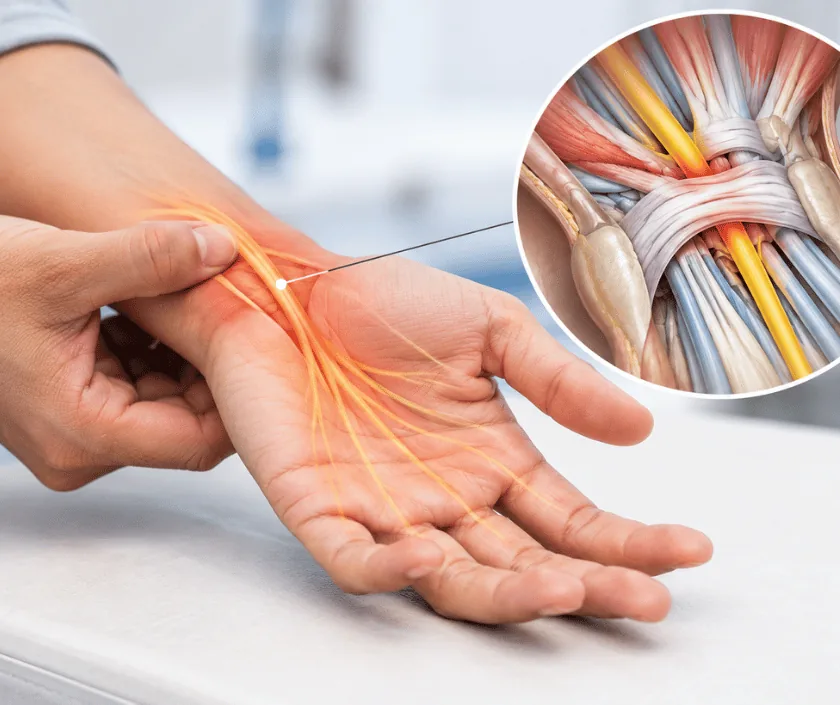
A median nerve injury means the nerve running down the front of the forearm into the palm has been damaged. Feeling fades in the thumb, index and middle fingers, and pinch grip weakens. Surgery joins the cut ends or bridges the gap with a graft. Recovery is slow, because the nerve regrows down the limb over months.
Every nerve works a little like a bundle of fine electrical cables wrapped in a protective sheath. The median nerve travels from the shoulder, down the inner side of the arm, through the front of the forearm and into the palm through a tunnel at the wrist. Along the way it carries messages in both directions. Some fibres bring feeling back from the skin of the thumb, index and middle fingers, while others carry commands out to the small muscles at the base of the thumb.
Damage can happen in several ways. A glass cut or blade injury at the wrist may divide the nerve cleanly. Crushing from machinery, a fracture or a road traffic injury may bruise or stretch it without cutting it. Pressure that builds slowly inside the tunnel at the wrist is a different problem again, and it is treated differently.
What the injury feels like depends on where it sits. An injury at the wrist mostly affects the hand. Damage higher in the forearm or at the elbow also weakens the muscles that bend the thumb and index finger, so patients notice they cannot press the two fingertips into a rounded circle.
Nerve repair suits people whose loss of feeling or thumb power can be traced to a clear injury, and whose wound is clean enough for the nerve to be handled safely.
You are examined to map exactly which areas have lost feeling and which muscles have weakened. Scans or nerve tests may be added. The likely level of injury is marked before theatre.
A regional block numbs the whole arm, with sedation if you prefer. The wound or scar is opened under a tourniquet so the surgeon can see the nerve clearly in a bloodless field.
Damaged tissue is trimmed back until healthy nerve bundles are visible under the microscope. Trimming matters, because joining unhealthy ends gives the regrowing fibres nowhere useful to travel.
If the ends meet without pulling, they are stitched with very fine sutures under magnification. Should a gap remain, a segment of a spare sensory nerve is used to bridge it.
The wound is closed and the wrist rested in a splint that keeps tension off the repair. Therapy begins early with gentle guided movement rather than free use.
The arm is elevated and kept in the splint. Pain is usually manageable with simple medication. As the block wears off the hand may feel heavy at first.
Stitches are checked and the dressing changed. A hand therapist starts protected movement of the fingers so joints do not stiffen while the repair is still fragile.
The splint is usually discarded and light use resumes. Feeling is often still absent, which is expected, since regrowing fibres have travelled only a short distance.
Tingling that moves further down the fingers is a sign of progress. Sensation and strength keep improving slowly, and the final picture can take well over a year.
Honest expectations matter here. A repaired nerve rarely returns to exactly how it felt before the injury, and protective sensation, meaning the ability to feel heat, cold and pressure, is a more realistic goal than fine touch. Younger patients with clean, early repairs tend to regain more. Muscle power often returns before delicate sensation does. Recovery can vary widely between people, and patience through many months of therapy is part of the treatment.
Nerve surgery is generally well tolerated, yet every operation carries risk, and these are discussed openly before you decide.
Most of the work after a nerve repair happens outside hospital, in the weeks of careful use and therapy that follow.
Skin healing and nerve healing are separate processes. A divided nerve needs its ends aligned surgically before fibres can find their way across.
Some movements use muscles supplied by other nerves. Loss of feeling in the thumb side of the hand can be the only early clue.
Late repair is harder and results are less predictable, yet options such as grafting or tendon transfer may still restore useful function.
Nerve fibres regrow slowly along the limb, so meaningful change is measured in months rather than weeks.
Elegance Clinic in Surat treats hand and nerve injuries as reconstructive work, where the examination, the surgery and the therapy plan are all parts of one process.

The cost of median nerve surgery depends on where the nerve is damaged, whether a graft is needed and how much theatre and therapy time the plan involves. For that reason a figure is shared only once you have been examined. You then receive a written estimate covering surgeon, anaesthesia, theatre and the expected follow up visits, so there are no surprises later. Many injury cases attract insurance or employer cover, and the clinic team helps you check what applies in your situation.
These are the questions that come up most often in consultation. If yours is not here, send it on WhatsApp and the team will reply, usually the same day.
Ask your question →Cost varies with the level of injury, whether a nerve graft is needed and how long theatre time runs. A written estimate is given after you are examined, covering surgery, anaesthesia and expected review visits, so you can plan before admission.
Nerve repair is a routine part of hand surgery and is usually well tolerated under a regional block. Risks such as infection, stiffness or an incomplete result are real and are explained beforehand, along with what is done to reduce them.
Regrowing fibres travel slowly down the limb, so change is gradual. Tingling that moves further towards the fingertips over months is the usual first sign. Useful sensation may take a year or longer, and it can vary a great deal between people.
Many patients regain protective feeling and useful grip, though touch rarely returns exactly as before. Early repair in a younger patient with a clean wound tends to do better. Therapy shapes how much of the returning function you can actually use.
A bruised or stretched nerve that is still in one piece may recover with splinting, therapy and time. A nerve that has been cut will not join by itself, so surgical repair is the only route back to a working pathway.
Sooner is better. A clean cut is ideally repaired within days, while the ends are still healthy and the gap is small. Delay allows muscle wasting and scarring, which make the repair harder and the result less predictable.
Your hand is examined area by area to map lost feeling and weak muscles, and the injury is matched to a level on the nerve. Tests may be arranged. You then receive an explanation of the options and a written estimate.
Each technique below has its own page explaining how it works and when it is chosen.
Seeing patients from across the city and beyond: read about the practice on the plastic surgeon in Surat page, or check what a written estimate covers on the costs and insurance page.
