Two fine nerves run along either side of each finger and carry all its feeling. A clean cut across one of them leaves part of the finger numb, and repairing it under magnification gives sensation a route back.
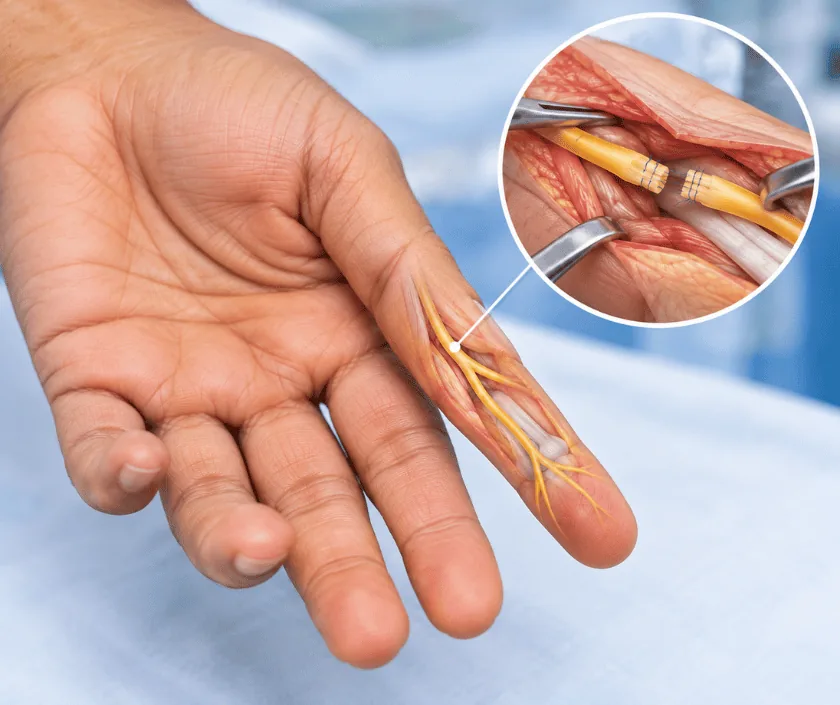
Digital nerve repair joins the cut ends of one of the small nerves that supply feeling to a finger. Surgeons work under a microscope with sutures finer than a hair. The operation restores a pathway, not the sensation itself, so numbness fades slowly over months as fibres regrow towards the fingertip.
Feeling in a finger arrives through two slender nerves that travel along either side, just beneath the skin, alongside the small arteries. Because they sit so close to the surface, a kitchen knife, a shard of glass or a sheet of metal can divide one in an instant. Patients often describe the strange sensation of a finger that looks normal but feels like it belongs to someone else.
The nerve does not knit itself back together across a gap. Fibres above the cut do try to grow, yet without guidance they wander into scar and form a tender lump instead. Bringing the two ends face to face gives those fibres a tube to follow, which is the whole purpose of the operation.
Work at this scale needs a microscope or high magnification loupes, a tourniquet to keep the field bloodless and sutures thinner than a hair. When the two ends cannot meet without pulling, a short graft or a small conduit may be used to bridge the distance instead.
Repair suits anyone with a clearly divided finger nerve, especially when the numb area lies on a working surface of the hand.
Each side of the finger is tested separately for feeling, and the level of the cut is matched to the course of the nerve. That tells the surgeon which nerve is divided and where.
A block numbs the arm or hand, and a cuff briefly stops blood flow. Working in a bloodless field is essential, because these nerves are barely thicker than thread.
The wound is opened along its length and the retracted ends traced through healthy tissue. Any bruised or ragged portion is trimmed back until the inner bundles look healthy.
Under the microscope the ends are aligned and joined with a few extremely fine stitches placed in the outer sheath. Where a gap remains, a graft or conduit bridges it.
Skin is closed and the finger rested in a splint that stops the joint straightening fully. That position protects the join from stretch during early healing.
The hand is kept raised and the splint stays on. Discomfort is usually mild and settles with simple medication. Neighbouring fingers can be moved gently.
Dressings are changed and sutures reviewed. A therapist begins guided movement so the finger joints do not stiffen while the repair is still delicate.
Splinting is usually stopped and normal light use returns. Feeling is generally still absent, because fibres have travelled only a short way past the join.
Tingling that creeps towards the fingertip shows fibres are advancing. Sensation continues improving for a year or more, and the tip is always the last part to change.
Most people regain some feeling after digital nerve repair, though it is rarely identical to the other side. Protective sensation, meaning you notice heat, cold and pressure, returns more reliably than the fine discrimination used to identify a coin by touch. Younger patients and early, clean repairs tend to do better. Cold sensitivity in the finger is common for a long while, and recovery can vary from person to person.
This is small, careful surgery, but you should still know what can go wrong.
Once the dressing is on, the outcome depends largely on how carefully the finger is used at home.
Digital nerves lie just under the skin, so even a short cut in the wrong place can divide one completely.
A divided nerve cannot bridge a gap on its own. Without repair, the numb area usually stays numb.
Skin heals in about a fortnight, whereas nerve fibres take months to travel along the finger to the tip.
Feeling along the sides of the finger guides grip and warns of injury, so numbness anywhere on the digit affects use.
Finger nerve work at Elegance Clinic in Surat is carried out with the magnification and instruments the tissue requires, and with therapy planned from the outset.

Charges for digital nerve repair depend on how many nerves are divided, whether a graft or conduit is needed, and how much theatre time the repair takes. Other injured structures such as tendons or arteries often need attention in the same sitting, which also affects the total. You receive a written estimate after examination, covering surgery, anaesthesia, day care charges and the review visits planned. Work related injuries may attract employer or insurance cover, and the team helps you check.
These are the questions that come up most often in consultation. If yours is not here, send it on WhatsApp and the team will reply, usually the same day.
Ask your question →Cost reflects how many nerves are cut, whether a graft is needed and what else in the finger requires repair at the same time. A written estimate follows your examination, listing surgery, anaesthesia and review visits so you can plan.
Repairing a finger nerve is routine microsurgery, usually done under a block with the hand numb. Infection, stiffness and incomplete return of feeling remain possible, and each of these is explained to you before consent is taken.
Wound healing takes roughly a fortnight, while sensation takes far longer. Fibres travel slowly along the finger, so tingling reaches the tip last. Meaningful feeling often develops over many months and can keep improving for a year.
Many patients regain protective feeling, meaning they notice heat, cold and pressure again. Fine touch discrimination often stays reduced compared with the other hand. Early repair of a clean cut in a younger patient tends to give the better return.
A bruised nerve that remains in one piece may recover with time. Once the nerve has been divided, the ends pull apart and cannot rejoin themselves, so repair is the only way to give fibres a path.
Early is better. Repair within days, while the ends are healthy and close together, is more straightforward than later surgery through scar. Delay tends to mean a graft is required and the result becomes less predictable.
Feeling is tested along each side of the injured finger and compared with the others, and the wound is examined for tendon or artery damage. Options are then explained in plain language along with a written estimate.
Each technique below has its own page explaining how it works and when it is chosen.
Seeing patients from across the city and beyond: read about the practice on the plastic surgeon in Surat page, or check what a written estimate covers on the costs and insurance page.
