When a tendon or its nerve is beyond repair, another working tendon can be rerouted to do the missing job. Tendon transfer surgery borrows that spare power and gives the hand back a movement it had lost.
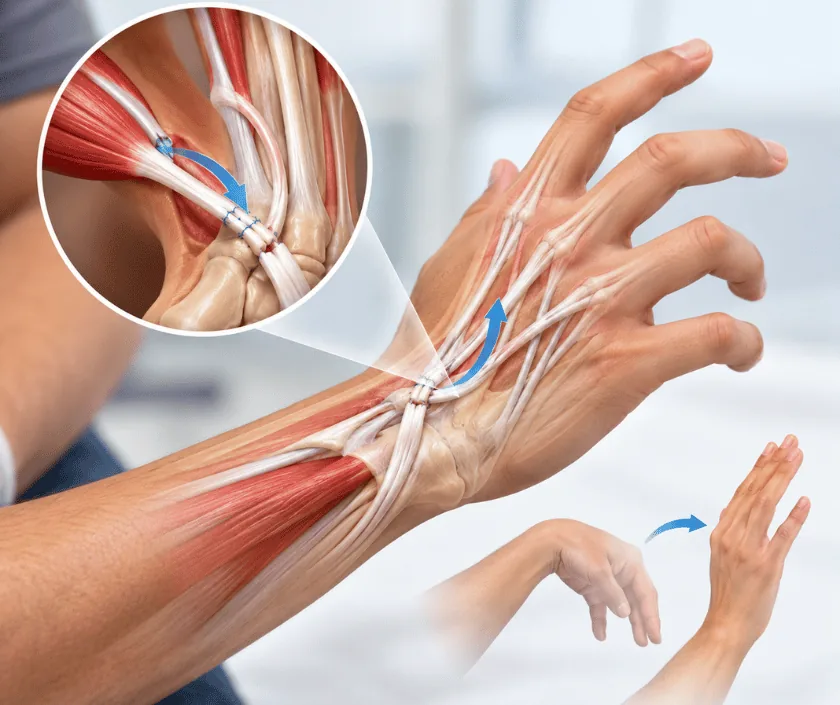
Tendon transfer surgery moves a healthy, working tendon to a new attachment so it can take over a movement the hand has lost. It is used when a tendon cannot be repaired directly, or when nerve damage has left certain muscles paralysed. The transferred tendon works, yet retraining it with hand therapy is what makes the new movement feel natural.
Each muscle in the forearm pulls on a tendon that crosses the wrist or finger and produces one movement. When a nerve is damaged or a tendon is destroyed, that movement disappears even though the rest of the hand still works. A transfer solves this by taking a muscle whose job other muscles can cover, cutting its tendon free and fixing it where the lost movement is needed.
Planning is the heart of this operation. The surgeon checks which muscles still contract, tests the strength of possible donors, and confirms that the joints move freely when helped by hand. Nerve recovery is also considered, because waiting a while is sometimes wiser than transferring too early. Old scar, poor skin cover or fixed joints are dealt with first.
During surgery the donor tendon is rerouted along a smooth path and stitched to its new attachment at a tension the surgeon judges carefully. Too loose and the movement is weak, too tight and the finger rests in an awkward position. A splint then protects the join before therapy begins.
A transfer works best when the rest of the hand is in good condition, because the operation redistributes power rather than creating it. Two things are checked first: supple joints and a strong donor muscle.
Every muscle group is tested for power, and the joints are moved passively to confirm they are supple. Nerve studies may be arranged. The surgeon then chooses a donor whose loss you will barely notice in daily life.
Surgery is usually done under a regional block that numbs the whole arm, with sedation if you prefer. Your arm rests on a side table and a tourniquet keeps the field clear for fine work.
Through a small incision the donor tendon is detached from its old attachment and freed gently, so its muscle keeps a straight line of pull. Its own blood supply and nerve are left untouched.
The tendon is passed through a smooth tunnel under the skin to its new site and stitched there. Tension is set with care, because it decides whether the new movement feels strong or awkward.
A splint holds the wrist and fingers in a resting position that keeps the join relaxed. Your therapist explains what to expect and books the retraining sessions before you go home.
Swelling is normal and the hand stays raised as much as possible. The splint remains on, dressings are kept dry, and pain relief is taken as prescribed.
Stitches are usually removed at the wound check. Therapy starts with the mind more than the muscle, learning to fire the donor while the splint still protects the join.
Active movement out of the splint usually begins around now, guided by your therapist. Strength builds slowly, and heavy lifting is still avoided so the join is not stressed.
The new movement usually feels more automatic by this stage and grip keeps improving. Recovery can vary, and some people gain smoothness for many months yet.
Most people gain a useful, dependable movement rather than the exact strength they had before the injury. A transferred muscle usually works at slightly less power than the original, and fine control returns gradually as retraining takes hold. Results depend on donor strength, joint suppleness and how consistently therapy is done. Recovery can vary, and a smaller second procedure is sometimes needed to adjust tension.
Transfers are well established operations, though it helps to know what can go differently.
Your splint and the daily practice sessions carry most of the weight in these first weeks.
Nothing about the nerve changes. A different working muscle is redirected to do the missing job, which is why the hand has to learn a new pattern afterwards.
A borrowed muscle usually delivers less power than the original. Our aim is a reliable, useful movement rather than the strength the hand had before the injury.
Some nerves recover on their own over months. Transferring too early may sacrifice a donor that was never needed, so timing is judged case by case.
Your brain still fires the donor muscle for its old job. Retraining with a therapist is what turns that signal into the new movement.
Elegance Clinic in Surat plans tendon transfers around what your hand actually needs for work and daily life. Dr. Ashutosh Shah discusses donor choices and their trade offs before anything is booked.

The price of a tendon transfer depends on how many movements are being restored, whether joints need release first, the anaesthesia used and the length of the therapy programme. A single transfer to restore wrist lift costs less than a staged reconstruction for a clawed hand. At Elegance Clinic the estimate is written down after examination, so there are no surprises later.
Cover varies between policies. Transfers after injury or documented nerve palsy are often accepted under mediclaim, while some insurers treat them differently. Share your policy papers early and the office will help you check.
These are the questions that come up most often in consultation. If yours is not here, send it on WhatsApp and the team will reply, usually the same day.
Ask your question →Cost depends on how many movements are restored, whether joints need release beforehand, and how long the therapy programme runs. You receive a written estimate after the hand is examined. Many transfers following injury or nerve palsy are accepted under mediclaim, subject to policy terms.
This is a planned operation done under a block that numbs the arm, and serious problems are uncommon. Wound infection, stretching of the transfer and stiffness remain possible. Each risk is explained beforehand and watched for at the follow up visits.
Your splint stays on for the first several weeks while the join heals, then guided movement begins. Useful strength usually builds over the following months. Manual work takes longer to resume than desk work, and recovery can vary from person to person.
Movement usually feels deliberate at first, because you are firing a muscle that used to do something else. With practice it becomes automatic for most people. Fine control and speed often keep improving well after the wound has healed.
Anyone with stiff, fixed joints needs those treated first, since a tendon cannot move a locked joint. Active infection, unhealed skin and a nerve injury still recovering are also reasons to wait. Smoking and poorly controlled diabetes make healing harder.
Often yes. Many nerve injuries improve over months, and transferring too soon can sacrifice a donor muscle you did not need to give up. Examination and nerve studies help judge whether recovery has genuinely stopped.
Muscle power is tested group by group and the joints are moved to see how supple they are. Nerve studies may be requested. The likely donor, the expected gain and the therapy schedule are explained, and a written estimate follows.
Seeing patients from across the city and beyond: read about the practice on the plastic surgeon in Surat page, or check what a written estimate covers on the costs and insurance page.
