A finger that clicks, catches or locks in the palm is not wearing out, it is snagging at a tight pulley. Trigger finger surgery opens that pulley through a small cut so the tendon glides freely again.
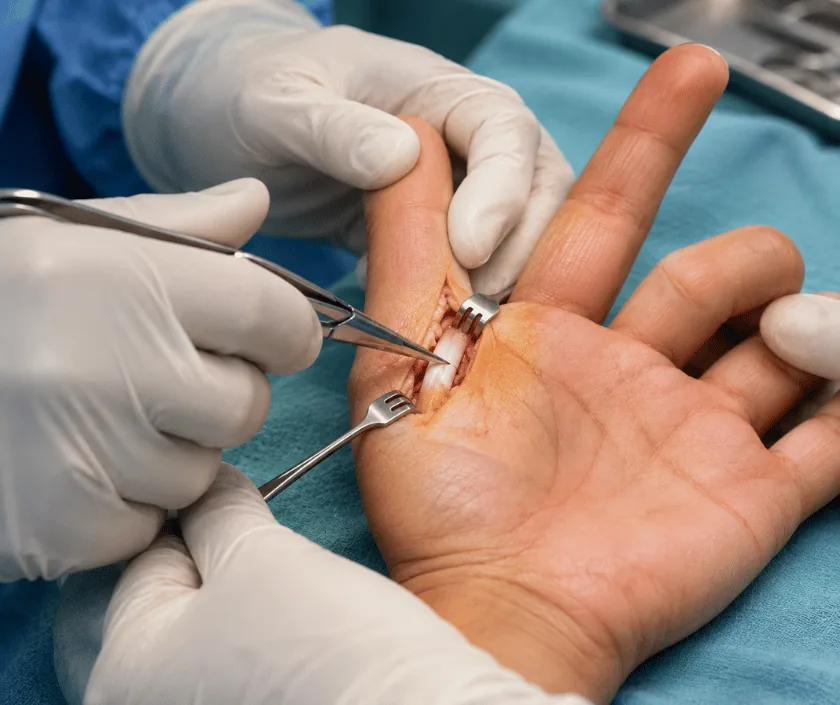
Trigger finger surgery, also called pulley release, opens a tight band in the palm that is catching the flexor tendon as the finger bends. The procedure is short, done under local anaesthetic in most cases, and the catching usually stops straight away. Some soreness or tenderness in the palm can linger for a few weeks afterwards.
Flexor tendons run along the palm side of each finger inside a sheath, held down by a series of pulleys that keep them close to the bone. When a tendon swells slightly, or the first pulley thickens, that tendon has to squeeze through a passage which is now too narrow. The finger bends, then snaps or sticks on the way back, and in stubborn cases it locks in the palm until the other hand pulls it out.
Steroid injected around the sheath calms the swelling and settles many fingers. Surgery is considered when symptoms return, when the digit locks repeatedly, or when several fingers are affected together. The operation itself is brief. Through a small incision in a palm crease, the tight pulley is divided under direct vision, and you are asked to bend the finger to confirm the catching has gone.
Because the remaining pulleys still hold the tendon against the bone, dividing this one band does not weaken the finger. The wound is closed with fine stitches and covered with a light dressing, and you go home the same day.
Release suits people whose catching keeps coming back or whose finger has begun to lock. A first mild episode is usually worth treating without surgery to begin with.
The surgeon feels for the tender nodule at the base of the finger and watches the digit catch as you bend it. Your incision site is marked in a palm crease so the scar settles discreetly.
Numbing medicine is injected into the palm and given a few minutes to work. You stay awake and comfortable, and being able to move the finger during surgery helps confirm the release is complete.
A short incision opens the skin, then the tight pulley is divided along its length under direct view while the nearby digital nerves are kept protected. The tendon is then seen to glide without snagging.
You are asked to bend and straighten the finger fully. Any remaining catch is dealt with there and then, before the wound is closed with fine stitches and a light dressing.
Your hand can be used gently for light tasks straight away, although the palm feels sore. Keep the dressing dry and raise the hand when resting so swelling stays down.
Stitches are usually removed at the wound check. Gentle bending and straightening several times a day keeps the tendon gliding, and most people manage everyday tasks by now.
The scar in the palm often stays a little firm or tender when pressed. Grip strength continues to improve, and heavier tools or gym work can usually be resumed.
Scar sensitivity settles for most people and the finger moves freely. Recovery can vary, and stiffness is more likely if movement was avoided in the early weeks.
Most people find the triggering has gone as soon as they bend the finger after release, and it seldom returns in that same digit. What takes longer is the soreness in the palm and the firmness of the scar, which usually ease over weeks. Fingers that had been locked for a long time may not regain full bending, and people with diabetes can develop triggering in another digit later.
This is a small operation, yet it is still worth knowing what can happen.
Movement is the main treatment after this operation, and the sooner it starts the better the finger behaves.
The joint is not the problem here. A thickened tendon or narrowed pulley is catching, which is why releasing that band settles the symptom.
Forcing a locked digit irritates the sheath further and can leave the joint stiff. Assessment is safer, and a finger that keeps locking needs proper treatment.
Most people use the hand for light tasks within days. Heavier gripping waits a few weeks, although the palm wound is small and heals quickly for many patients.
Injection helps many fingers, sometimes lastingly. Symptoms do return for some people, especially with diabetes or when several digits are involved, and release is then discussed.
At Elegance Clinic in Surat, trigger finger is treated as a small problem that still deserves proper assessment. Dr. Ashutosh Shah explains when injection is worth trying before any surgery is booked.

Trigger finger release is a short day care procedure, so the cost is modest compared with larger hand operations. What changes the figure is the number of digits treated in one sitting, the choice between local anaesthetic and sedation, and whether dressings and the wound check are included. At Elegance Clinic you receive a written estimate after examination.
Insurers vary in how they treat this procedure, and some day care policies exclude it. Bring your papers to the consultation so the office can check the position before you decide.
These are the questions that come up most often in consultation. If yours is not here, send it on WhatsApp and the team will reply, usually the same day.
Ask your question →The figure depends on how many digits are released together, whether local anaesthetic or sedation is used, and what the package includes. A written estimate follows your examination. Some insurance policies cover day care hand procedures and others exclude them, so check your terms.
Release is a short, well established operation done through a small palm incision, usually with the hand awake. Infection, a tender scar and temporary stiffness are the usual concerns. Serious nerve injury is uncommon, because the nerves are protected under direct vision.
Light use starts the same day, and gentle bending is actively encouraged because it keeps the tendon gliding. Writing, cooking and desk work are usually manageable within a few days. Heavy gripping and power tools wait until the wound has settled.
In the released digit it seldom returns, since the tight band has been opened. A different finger can start catching later, and that is more likely in people with diabetes. Any new clicking is worth reporting at a review visit.
Often that is the sensible first step, especially for a recent problem. Steroid around the sheath settles the swelling for many people. Surgery is discussed when symptoms return, when the finger locks repeatedly, or when several digits are involved.
Overnight the tendon and its sheath swell slightly while the finger rests bent for hours. That narrowed pulley then grips harder, so the first movements of the day catch most. Gentle use usually eases it as the hours pass.
Your palm is examined for the tender nodule, and you are asked to bend the finger so the catching can be seen. Treatment options are compared, injection included. If release is chosen, the day care plan and a written estimate are given.
Seeing patients from across the city and beyond: read about the practice on the plastic surgeon in Surat page, or check what a written estimate covers on the costs and insurance page.
