The ulnar artery runs on the little finger side of the wrist and is usually the main feed into the palm. When it is cut or damaged, repair restores that supply and is generally carried out together with repair of the ulnar nerve lying right beside it.
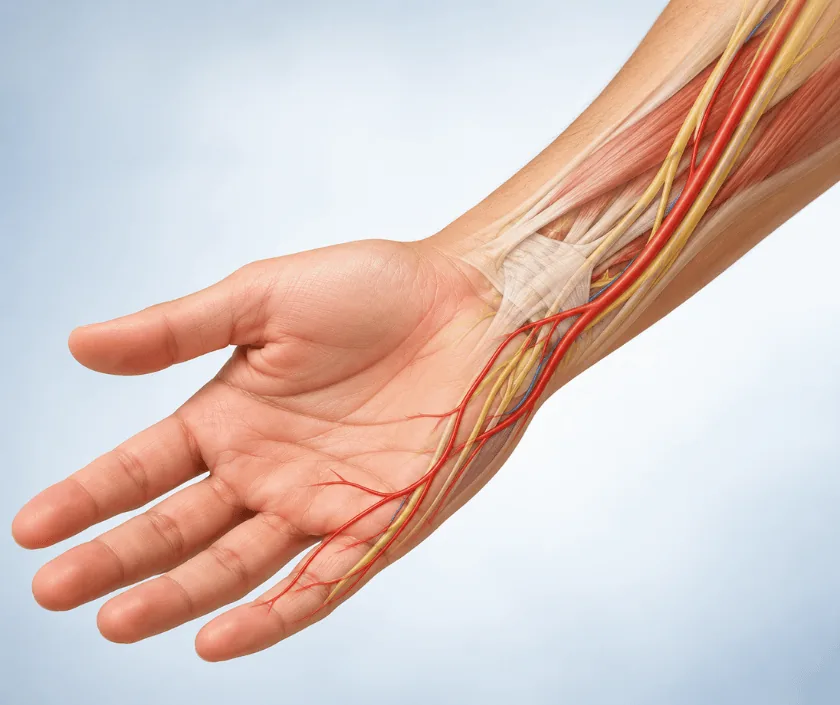
Ulnar artery repair rejoins the divided vessel on the little finger side of the wrist using microsurgical technique. Since the ulnar artery is usually the dominant supply to the palm, restoring it matters. The ulnar nerve sits immediately alongside, so it is examined and repaired in the same operation whenever it has been cut as well.
Two arteries supply the hand, and in most people the ulnar one carries the larger share into the palm. It enters through a narrow tunnel on the little finger side of the wrist, with the ulnar nerve packed in beside it. A cut in that area therefore tends to injure both, and often the flexor tendons as well.
During surgery the wound is opened along a planned line so vessel and nerve can be traced above and below the injury. Damaged artery wall is trimmed away until healthy tissue remains, then the ends are joined under a microscope with extremely fine sutures. Where a length has been lost, a vein graft from the forearm bridges the gap. The ulnar nerve is repaired at the same sitting.
Not every ulnar artery problem comes from a cut. Repeated hammering with the base of the palm can damage the vessel wall over months or years, causing clot or a swelling that sends fragments out into the fingers. Such cases usually need the damaged segment removed and replaced with a graft.
Repair is recommended in most divided ulnar arteries, and urgency depends on how much of the hand is short of blood. The choice is made once the wound has been examined properly.
Bleeding is managed with direct pressure and elevation. Circulation to each finger, ulnar nerve function and tendon movement are all recorded before any anaesthetic is given.
Under regional or general anaesthesia with a tourniquet, the wound is extended so artery and nerve can be traced through the tunnel at the wrist and beyond the zone of injury.
The artery is trimmed to healthy wall on both sides. Where a damaged segment has been removed, a vein graft is taken from the forearm to bridge the resulting gap without tension.
Fine sutures are placed under the microscope to unite the ends. Clamps are released and the surgeon watches to confirm the repair fills, pulses and stays open.
The ulnar nerve is repaired and any divided tendons reconstructed. Skin is closed loosely and a splint holds the wrist in a position that protects every repair.
Colour, warmth and refill in the fingers are checked regularly. The hand is kept warm and elevated. Tobacco and cold exposure are avoided completely during this stage.
Dressings are reduced and wounds inspected. Therapy starts within the limits set by the nerve and tendon repairs, with gentle movement of joints that were not involved.
The splint usually comes off and strengthening begins. Sensation across the little and ring fingers is charted so that ulnar nerve recovery can be followed.
Grip and pinch improve as the ulnar nerve recovers, which is slow work. Cold intolerance often persists for a while, and any secondary procedure is considered now.
Blood flow is usually restored without difficulty, and the artery itself causes few ongoing symptoms. Ulnar nerve recovery is the harder problem, since that nerve powers the small muscles behind grip and pinch, and its return is slow and often incomplete in adults. Numbness along the little finger may persist. Cold intolerance is frequent and eases gradually. Scars at the wrist stay visible.
Vessel work is delicate and the nerve alongside it is unforgiving, so both are discussed carefully before you consent.
Warmth, elevation and patience protect a microsurgical repair through its most vulnerable weeks.
In most hands the ulnar artery is the larger supply to the palm, so repair is preferred whenever conditions allow it.
Repeated pounding with the base of the palm can damage the ulnar artery without breaking the skin, showing up later as cold, discoloured fingers.
Sensation depends on the ulnar nerve, which regenerates slowly. Numbness in the little finger commonly lingers for many months.
A pulsating swelling there may be a false aneurysm, which can enlarge or throw clot into the fingers, so it deserves assessment.
Elegance Clinic in Surat treats a cut at the ulnar side of the wrist as a combined vessel and nerve problem, exploring the wound fully so nothing is left to be discovered later.

Because the ulnar artery is rarely injured on its own, the estimate is written for the full wrist exploration. It includes theatre and microsurgery charges, anaesthesia, any vein graft, the short observation stay and the therapy that follows the nerve and tendon repairs.
If the injury happened at work or on the road, insurance or employer cover may be available. Bringing your policy papers and the accident report to the consultation lets the team begin the approval process early.
These are the questions that come up most often in consultation. If yours is not here, send it on WhatsApp and the team will reply, usually the same day.
Ask your question →The written estimate covers the whole exploration, since nerve and tendon repairs are almost always needed too. It lists theatre and microsurgery charges, anaesthesia, any vein graft, the observation stay and the therapy sessions expected afterwards.
It is standard practice, performed under anaesthesia with continuous monitoring. Concerns include the join blocking, bleeding into the wound and infection. Keeping the hand warm and elevated, and avoiding tobacco, all improve the odds in the first days.
Wounds settle within a couple of weeks, but the ulnar nerve dictates the real timetable. Splints are worn for several weeks, then strengthening begins. Feeling and grip carry on improving slowly across many months.
Grip depends heavily on small hand muscles supplied by the ulnar nerve, so recovery is gradual and sometimes partial. Therapy helps considerably. Most people regain useful function, though fine pinch may remain weaker than on the other side.
That is done when bleeding must be controlled quickly, or the patient has other serious injuries. Repair is preferred otherwise, because the ulnar artery usually carries the greater share of blood into the palm.
Immediately if bleeding is heavy or the fingers look pale and feel cold. Even a wound that has stopped bleeding needs prompt exploration, since a divided nerve found late is much harder to repair well.
Circulation to each finger is tested, along with sensation in the little and ring fingers and the strength of the small hand muscles. Tendon movement is checked individually, and imaging is taken if glass may be retained.
Each technique below has its own page explaining how it works and when it is chosen.
Seeing patients from across the city and beyond: read about the practice on the plastic surgeon in Surat page, or check what a written estimate covers on the costs and insurance page.
