The ulnar nerve controls most of the small muscles inside the hand and carries feeling from the little finger side. When it is damaged, grip fades, fingers begin to claw and everyday tasks lose their precision.
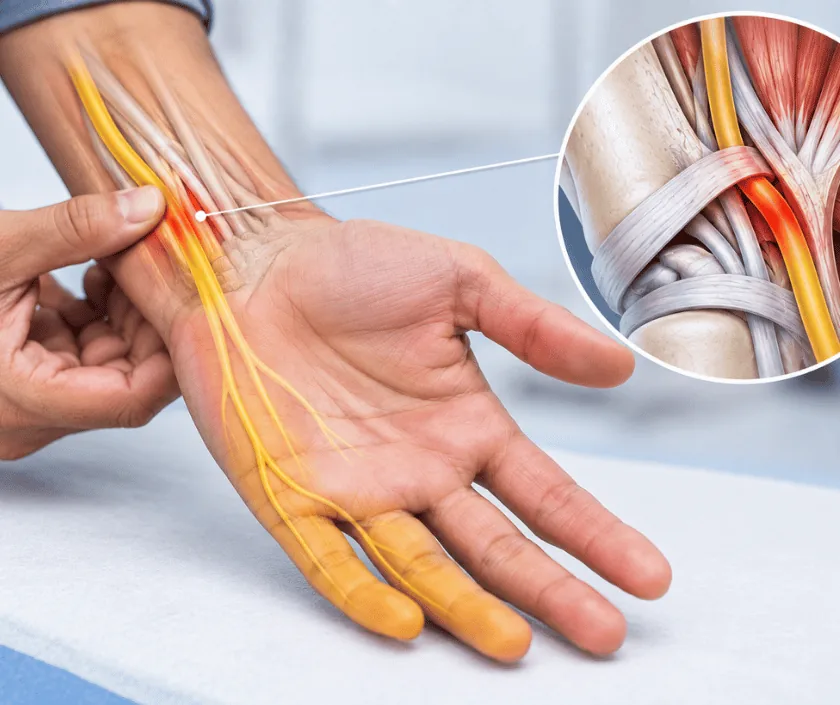
An ulnar nerve injury damages the nerve that runs behind the elbow and along the little finger side of the forearm. Feeling is lost in the little and ring fingers, and the small muscles inside the hand weaken. Surgery repairs or grafts the nerve. Because those muscles sit far from the elbow, recovery after a high injury is limited and slow.
Most people have met the ulnar nerve without realising it. That tingling shock felt when the elbow strikes a hard edge comes from this nerve, which passes through a shallow groove behind the bony point of the elbow with very little padding over it. From there it runs down the forearm and enters the hand beside the wrist bone on the little finger side.
Two jobs matter. The nerve carries feeling from the little finger and half the ring finger, front and back. It also drives most of the small muscles that sit inside the palm and between the bones. Those muscles do the fine work, spreading the fingers, holding a card between them and keeping the knuckles aligned while the fingers straighten.
Injury can follow a cut at the wrist, a fracture or dislocation at the elbow, a crush at work or steady pressure over years in the elbow groove. Where the damage sits changes the picture. An injury at wrist level spares some forearm tendons, which paradoxically makes the clawing look worse than damage higher up the arm.
Ulnar nerve surgery suits people whose weakness and numbness follow a clear injury or a clear point of pressure, and whose hand still has supple joints to work with.
The hand is tested muscle by muscle and area by area to place the injury at wrist, forearm or elbow level. Nerve conduction studies are often added before a plan is fixed.
A block numbs the arm and sedation is offered. The incision follows the course of the nerve, and a tourniquet keeps the field clear so fine structures stay visible.
Scar and damaged tissue are cleared until healthy nerve is seen under magnification. At the elbow the nerve may also be moved forward into softer tissue so it is no longer stretched.
Clean ends are stitched together with very fine sutures. When a gap remains, a spare sensory nerve bridges it, or a working nearby branch is redirected to power the hand muscles sooner.
The wound is closed and the limb rested in a position that keeps tension off the repair. Therapy begins with protected movement rather than free use of the hand.
The arm stays elevated in a splint and discomfort is usually controlled with simple medication. Fingers are moved gently within the limits your surgeon sets.
Sutures and dressings are reviewed. A hand therapist guides early movement so joints stay supple while the repair is still delicate.
Splinting eases and light activity resumes. Numbness usually persists at this stage, which is expected, because fibres have covered only a short distance.
Tingling that shifts towards the fingertips signals progress. Small muscles recover last, and the final result may take a year or more to judge.
Results depend heavily on where the nerve was damaged. Repairs near the wrist have a shorter distance to travel and often regain more useful hand muscle function than repairs at the elbow. Protective feeling, meaning awareness of heat, cold and pressure, is a fair goal, while fine discrimination may not fully return. Wasted small muscles sometimes recover only partly, and a tendon transfer can be considered later if power stays limited.
Every operation carries some risk, and with nerve surgery it is important that you know these before deciding.
How you use the hand in the first weeks matters as much as the surgery itself.
A trapped nerve in the neck can cause it, yet damage at the elbow or wrist is a common cause and is checked by examining the hand.
Clawing usually reflects loss of the small muscles inside the hand, not tendon rupture. The tendons remain intact but pull without balance.
Nerve fibres must regrow before muscles can respond, so grip returns over many months, and therapy carries much of that work.
If nerve recovery is unlikely, transferring a working tendon can restore useful movement, which is a different operation with a different aim.
At Elegance Clinic in Surat, ulnar nerve problems are assessed as a whole, from the level of the injury to the hand therapy that follows, rather than as a single procedure.

What ulnar nerve surgery costs depends on the level of the injury, whether a graft or nerve transfer is required, the length of theatre time and the therapy that follows. A price is therefore quoted only after you have been examined. You are then given a written estimate covering surgery, anaesthesia, hospital charges and planned review visits. Injuries at work or on the road often attract insurance or employer cover, and the team will help you check the paperwork.
These are the questions that come up most often in consultation. If yours is not here, send it on WhatsApp and the team will reply, usually the same day.
Ask your question →The figure depends on the level of injury, whether a graft or transfer is needed and how much hospital and therapy time is involved. After examination you receive a written estimate covering surgery, anaesthesia and follow up, so nothing comes as a surprise.
It is a well established part of hand surgery, usually performed under a regional block that numbs the arm. Risks such as infection, stiffness and incomplete recovery do exist, and each is explained clearly before you agree to proceed.
Wound healing takes a couple of weeks, but nerve recovery runs far longer. Fibres regrow slowly along the arm, so useful change is measured in months. Many patients continue improving for a year or more with steady therapy.
Clawing may lessen if the small hand muscles regain their nerve supply. When the injury is high or late, recovery of those muscles is limited, and a tendon transfer can then be considered to improve finger position and function.
Mild pressure at the elbow often improves with splinting, avoiding leaning on the elbow and doing therapy. A nerve that has been cut cannot rejoin on its own, so surgery is needed to give the fibres a path to follow.
Timing matters a great deal. Early repair of a clean cut gives healthy ends and a short gap, while delay brings scarring and muscle wasting. Once muscles have wasted badly, nerve repair alone may no longer restore movement.
Your hand and elbow are examined in detail, testing feeling and each muscle group to locate the injury. Nerve studies may be arranged. Options are then explained in plain language, along with a written estimate before any date is fixed.
Seeing patients from across the city and beyond: read about the practice on the plastic surgeon in Surat page, or check what a written estimate covers on the costs and insurance page.
