Limb salvage means working to keep a severely injured leg rather than removing it. That decision rests on blood supply, nerve function, bone loss and what the limb will realistically do afterwards.
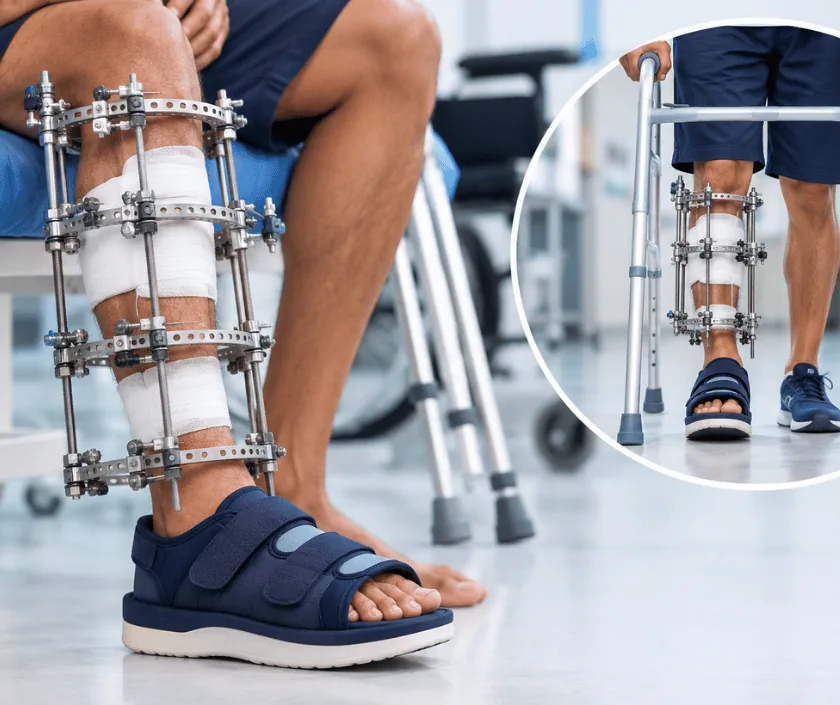
Post traumatic limb salvage is the combined effort to save a badly injured leg. Orthopaedic surgeons stabilise and rebuild the bone while plastic surgeons provide living cover over it, and therapists work on movement throughout. Salvage is offered when circulation, nerve supply and bone stock give the limb a realistic chance of useful function.
Severe leg injuries damage several systems at once. Bone breaks and pieces may be lost, muscle is crushed, skin is torn away, and vessels or nerves can be divided. Treating any one of these alone rarely helps. Salvage means addressing them together, usually across a series of operations planned over weeks and months.
The sequence generally starts with saving life and controlling contamination. Dead tissue is removed, the fracture is stabilised and circulation is restored if a vessel has been damaged. Soft tissue cover follows, often with a flap, because bone cannot heal while exposed. Once the wound is closed and settled, attention turns to any bone gap, joint stiffness or nerve problem that remains.
Honest discussion belongs at the start. Salvage takes longer than amputation, needs more operations and does not always give a better result. Where the foot has no sensation, no circulation and no prospect of taking weight, keeping the limb may leave someone less mobile than a well fitted prosthesis would.
Salvage is offered where the limb has a realistic prospect of useful function and the patient can commit to a long programme.
Bleeding is controlled, contamination is washed out, dead tissue is removed and the fracture is held in a frame. Circulation to the foot is restored if a vessel has been cut.
Once the patient is stable, imaging, nerve function and circulation are reviewed. Salvage and amputation are both explained honestly, with their timelines and likely outcomes.
A flap is used to cover exposed bone and metalwork. This stage is planned jointly, because cover has to fit the eventual bone reconstruction plan.
Any gap in the bone is addressed with grafting, transport or staged techniques once the soft tissue envelope is healed and free of infection.
Physiotherapy, splinting and gait training run throughout, and footwear or braces are prescribed as the leg becomes able to take weight.
The leg is elevated and immobilised, flaps are monitored and antibiotics are given. Pain relief is regular, and the immediate goal is stability rather than progress.
Dressings are reviewed and further theatre visits may be planned. Sitting out of bed begins, and the longer term plan is discussed with the family.
Bone healing and wound status are reviewed on imaging. Weight bearing may start partially, guided by the orthopaedic team, alongside daily exercises.
Walking usually improves steadily. Further procedures for bone, contour or stiffness are considered, and normal footwear becomes possible for many people.
A salvaged leg is rarely the leg it was. Expect scarring, altered shape, some stiffness and often a limp. Many people walk independently again, though some need a brace or modified footwear. The process usually spans months and several operations. Recovery can vary greatly, and a frank conversation about time and effort is part of the decision.
Salvage is a long road with real risks, and these are discussed openly alongside the alternative of amputation.
Between admissions, steady habits protect the work already done and keep the programme moving forward.
Not always. A leg that cannot feel or bear weight may leave someone less mobile than a well fitted prosthesis would.
Salvage is a sequence. Cleaning, cover, bone work and therapy each take their own time and follow in order.
Closure is a milestone rather than an end. Bone healing and movement work usually continue for many months.
Age helps, yet the pattern of injury, circulation and nerve damage matter more than years alone.
Salvage decisions are made with the orthopaedic team and shared honestly with the family, including when amputation may serve the patient better. Elegance Clinic sets out the timeline before treatment begins.

Limb salvage is staged, so cost builds across admissions. The estimate covers the planned operations, the flap cover, hospital stay, implants or frames and the physiotherapy programme. Where further bone surgery is likely, that is flagged at the outset rather than added later.
Most injuries of this kind involve accident cover or an employer scheme. The office will explain which documents insurers usually request and where approval commonly takes time.
These are the questions that come up most often in consultation. If yours is not here, send it on WhatsApp and the team will reply, usually the same day.
Ask your question →Circulation, nerve function, bone loss and the general condition of the patient are all weighed together. Both options are explained with their timelines. The family is part of that conversation, and the decision is never rushed unless the injury itself demands it.
Flap cover after an open fracture falls in the band Rs 1.8L to Rs 4.5L, and the final figure is case based. Because salvage is staged, the estimate is prepared to cover the planned operations, stay and therapy so families can plan properly.
Usually several. Cleaning, fixation, flap cover and later bone work each take their own sitting, and some stages are repeated. A realistic plan is discussed early so the number does not come as a shock later.
Many people do walk again, sometimes with a brace or modified footwear. Outcome depends on nerve function, bone healing and how consistently therapy is done. Recovery can vary, and progress is measured over months rather than weeks.
No. For some injuries a prosthesis restores mobility sooner and more reliably than a salvaged limb would. Choosing it after honest discussion is a sound decision, not a defeat, and support is provided either way.
Months in most cases, and the exact period depends on your job and the leg itself. Desk based work often resumes earlier than physically demanding work. The team will advise as bone healing and walking progress.
Bring all imaging, operation notes, discharge summaries, a list of medicines and details of any accident claim or insurance. Photographs of the wound taken earlier help when dressings are already in place.
Seeing patients from across the city and beyond: read about the practice on the plastic surgeon in Surat page, or check what a written estimate covers on the costs and insurance page.
