Arm swelling after breast cancer treatment is common enough that it deserves a plan rather than a shrug. Caught early, while the tissue is still soft, it usually responds well and stays under control for years.
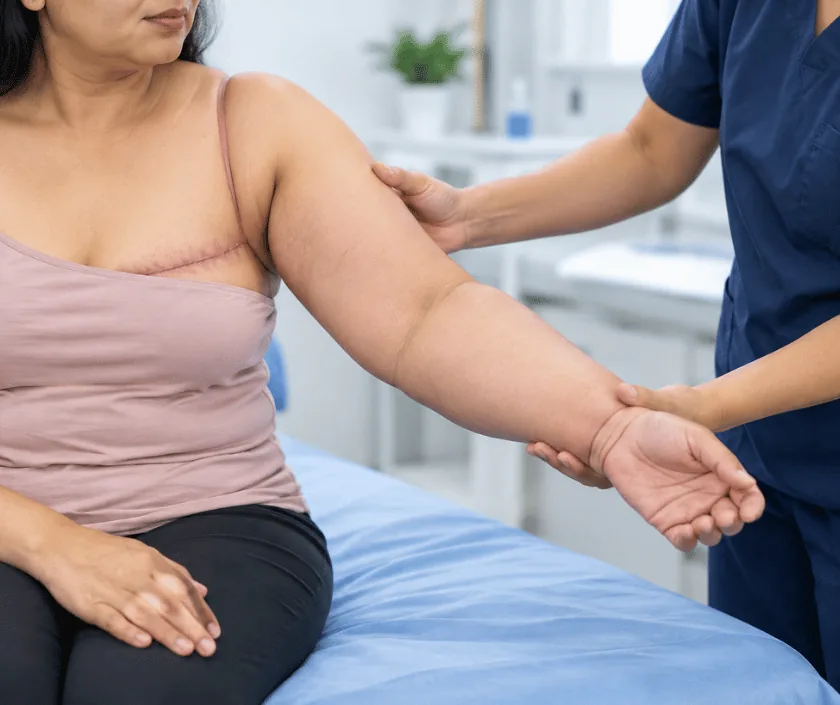
Lymphedema after mastectomy develops when lymph node surgery or radiotherapy interrupts drainage from the arm. Swelling may begin within months or appear years later, often starting with tightness in a sleeve or ring. Treatment starts with skin care, compression and exercise, and microsurgery is considered for limbs that remain fluid predominant.
Lymph from the arm drains through nodes in the armpit before returning to the chest. When those nodes are removed during cancer surgery, or scarred by radiotherapy, the route narrows. For a while the body compensates by using alternative channels. If demand later outstrips that capacity, fluid begins to collect and the arm swells.
First signs are usually subtle. A ring feels tighter, a sleeve pinches, or the arm aches by evening and looks normal again by morning. At this point the swelling is soft and pits when pressed, and it responds quickly to treatment. Left alone for months or years, tissue thickens as fat and fibrous tissue are laid down, and the arm becomes firmer and harder to reduce.
Timing varies more than most people expect. Some women notice swelling within weeks of surgery, others years after finishing treatment, sometimes triggered by an infection or a period of inactivity. Any new heaviness or tightness in the arm deserves review, both to start treatment and to confirm that the cancer itself has not returned.
Every woman with arm swelling after breast cancer treatment benefits from assessment. What differs is which part of the pathway is offered first.
Both arms are measured at fixed points, skin is examined and your surgery and radiotherapy details are reviewed. Cancer follow up status is confirmed before any drainage treatment begins.
Any fungal infection, cracked skin or minor wound is treated first, and daily skin care is taught. Reducing cellulitis attacks protects whatever drainage remains.
Manual lymphatic drainage with bandaging brings soft swelling down, followed by a fitted sleeve and glove where the hand is involved. Exercise is taught alongside.
Fresh measurements show what therapy has achieved and what is left. Fluid that persists in a soft arm suggests microsurgery may help, while a firm fatty arm points elsewhere.
If surgery is considered, imaging maps remaining channels and options are explained with their limits. Compression continues afterwards in almost every case.
Therapy begins and the arm feels tight under fresh bandaging. Many women notice the sleeve of a shirt fitting differently within the first few days.
Most of the early volume reduction happens here. A sleeve and glove are usually fitted once the arm has settled at a smaller size.
A review compares measurements against the baseline and checks sleeve fit, shoulder movement and skin condition.
Routine becomes part of ordinary life. Reviews cover garment replacement, infection episodes and whether surgery deserves discussion.
Treatment controls the swelling rather than restoring a normal lymphatic system. Many women achieve an arm close in size to the other side and hold it there with a sleeve, exercise and skin care. Arms treated early do best. Where the limb has been swollen for years and feels firm, reduction is smaller and the focus shifts to comfort, infection control and preventing further increase.
Treatments used here are gentle, but there are genuine difficulties and it is fair to know them in advance.
These habits make a real difference to how the arm behaves over the coming years.
Most arm swelling after treatment is lymphedema rather than recurrence, though any new swelling should still be reviewed so recurrence can be excluded properly.
Lymphedema can appear years after treatment. Reporting early tightness remains worthwhile whatever the interval since surgery.
Graded exercise helps drainage. Sensible use of the arm, built up gradually, is part of treatment rather than something to avoid.
Firm arms respond less to compression but are not beyond help. Options shift towards operations that reduce bulk, with compression continuing afterwards.
Elegance Clinic in Surat works alongside your cancer team rather than separately from it. Dr. Ashutosh Shah reviews the arm in the context of the surgery and radiotherapy you have already had.

Costs depend on which parts of the pathway you need. An assessment with measurement sits at one end, a course of decongestive therapy with sleeve and glove in the middle, and surgery at the other end. Many women need only the first two.
Insurance cover varies, and documentation from your breast cancer treatment often matters to the claim. After assessment we provide a written estimate covering the recommended stage of treatment, and the team can guide you on the paperwork usually requested.
These are the questions that come up most often in consultation. If yours is not here, send it on WhatsApp and the team will reply, usually the same day.
Ask your question →It depends on what you need. Assessment with measurement is the smallest cost, a course of decongestive therapy with a sleeve and glove sits in the middle, and surgery costs considerably more. A written estimate is given after assessment for the stage recommended.
Yes, and it should run alongside that follow up. We confirm your oncology status first, because any suspicion of recurrence must be reviewed before drainage treatment. Once that is clear, therapy and compression are safe to continue during long term follow up.
Many women notice the arm feeling lighter within the first days of bandaging, with most of the volume reduction over the first weeks. Progress then slows as the arm reaches a stable size. Longstanding firm arms improve more gradually.
Sometimes it comes close, particularly when treatment starts early while the tissue is still soft. More often the aim is a comfortable arm held at a stable size with a sleeve. Arms swollen for years reduce less, whatever treatment is used.
That depends on what the arm is made of. Soft, fluid filled arms with working lymph channels may suit microsurgery, while arms thickened with fat respond better to reduction operations. Imaging and measurement after therapy usually settle the question.
It can begin within weeks or appear many years later, sometimes after an infection or a spell of inactivity. There is no point at which swelling stops being worth reporting, so tell your team about new tightness whenever it occurs.
Bring operation notes, radiotherapy details, recent scans, a list of medicines and any sleeve you already wear. Note roughly how many infections the arm has had. That history often shapes the plan more than any single measurement.
Seeing patients from across the city and beyond: read about the practice on the plastic surgeon in Surat page, or check what a written estimate covers on the costs and insurance page.
