Sometimes a fall does not break the jaw itself but shifts a block of teeth along with the bone that holds them. Treatment is about repositioning that segment quickly and splinting it while the socket bone heals.
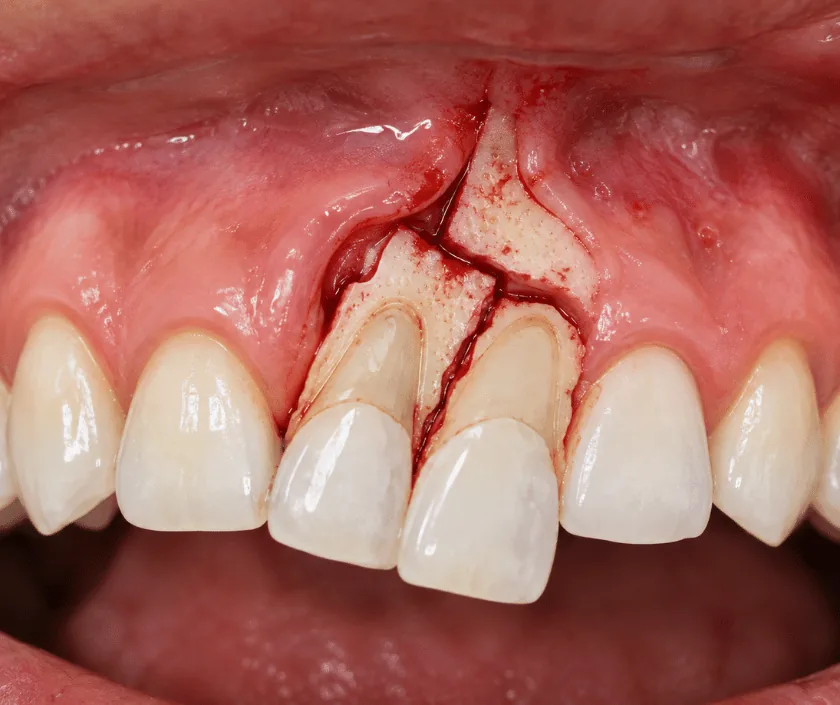
A dentoalveolar fracture is a break involving teeth together with the block of bone that forms their sockets, without a full fracture of the jaw. The loosened segment is eased back into its correct position and held with a splint bonded to the neighbouring teeth. Speed matters, because a segment repositioned early has a far better chance of keeping its teeth alive.
Teeth do not sit directly in the main body of the jaw. They sit in a shelf of bone shaped into sockets, and that shelf is thinner and more fragile than the bone beneath it. A blow to the mouth, from a fall, a cricket ball or a dashboard, can crack this shelf and push a group of teeth backwards or sideways while the rest of the jaw stays intact.
What people notice is that several teeth move together when touched, the bite no longer meets on that side, and the gum has torn or bruised. Front teeth of the upper jaw are involved most often, since they take the impact first. Children and teenagers make up a large share of these injuries, and in them the roots of the teeth may still be developing.
Because bone starts to set quickly, this is one of the few facial injuries where a delay of days genuinely changes the outcome. The segment is eased back into position and held with a splint bonded across it and the healthy teeth on either side. Bone usually knits within weeks, yet the teeth inside it need watching for far longer, because the blood supply to a tooth can fail long after the gum has healed.
Almost anyone with a displaced block of teeth benefits from repositioning and splinting. What varies is the anaesthetic used and how much dental work is needed afterwards.
The mouth is examined for loose segments, missing teeth and gum tears. Scans of the teeth and jaw show how far the block has moved and whether any root is broken.
The area is numbed and then gently cleaned. Grit and debris are washed out of the socket and the torn gum, since anything left behind invites infection later and can tattoo the healing tissue.
The block of teeth is eased back into its correct position using steady finger pressure, guided by how the upper and lower teeth meet when the mouth closes.
A splint is bonded across the affected teeth and onto healthy teeth on either side. It holds the segment still while allowing the mouth to be kept clean.
The splint is removed at the planned time, then the teeth are checked repeatedly over months. Root canal treatment is carried out if a tooth loses its blood supply.
The lip and gum are swollen and sore, and the splint feels bulky. Cool soft food, prescribed pain relief and gentle mouth rinses cover this period.
Soreness fades and eating soft food becomes easy. Most people are back at work or school, brushing carefully around the splint.
The splint has usually been removed after review, and the segment feels firm. Teeth are tested for vitality and the bite is checked.
Dental review continues, since a tooth may darken or need root canal treatment months later even when everything looked settled.
Treated early, most segments heal firmly and the teeth stay in place. Honesty about the teeth themselves is important. Some lose their nerve supply and need root canal treatment, a few darken over time, and occasionally a tooth is lost despite everything being done correctly. Roots may also shorten slowly over the years. Outcome depends heavily on how quickly treatment started and on how much force the injury carried.
These points are discussed at the first visit, since expectations about the teeth matter as much as the bone healing.
While the splint is on, cleaning is awkward but essential, and the diet needs real discipline.
When the supporting bone has broken, the segment sets in whatever position it is left in, so early repositioning changes the whole outcome.
An adult tooth handled by the crown, kept moist and brought in quickly can sometimes be replaced, so it should never be left behind at the site.
A tooth that has lost its nerve supply often stops hurting altogether, which is exactly why review visits and vitality testing matter.
They still need assessment, because injury to a baby tooth can affect the adult tooth developing in the bone above it.
Elegance Clinic in Surat treats these injuries as urgent, and the plan covers not only the bone and the splint but the dental follow up that decides how the teeth fare.

Cost here depends almost entirely on what the injury has done. Repositioning and splinting a small segment under local anaesthesia sits at one end of the range, while a child needing general anaesthesia along with treatment of several teeth sits at the other. Insurance behaves differently too, since the surgical treatment of an injury may be covered while dental work such as root canal treatment, crowns or replacement of a lost tooth is often excluded. For that reason a written estimate is prepared after assessment, with the dental part listed separately so nothing comes as a surprise.
These are the questions that come up most often in consultation. If yours is not here, send it on WhatsApp and the team will reply, usually the same day.
Ask your question →As soon as possible, ideally the same day. Bone and gum begin to heal in whatever position they are left in, so a segment repositioned early sits correctly, while one left for days becomes far harder to move back.
Because the injuries vary so widely. The number of teeth involved, the anaesthetic needed, whether roots are broken and how much dental work follows all change the figure. A written estimate is prepared once the mouth has been examined and imaged.
The surgical part of treatment after an injury is often covered, while dental treatment such as root canal work, crowns or replacing a lost tooth is commonly excluded from health policies. Estimates separate the two so the position is clear.
Usually a few weeks, with the exact period set by how firm the segment feels at review. Removing it too early risks the teeth loosening again, so the timing is judged case by case rather than by the calendar alone.
Many do, especially when treatment started quickly. Some lose their nerve supply and need root canal treatment, a few darken, and occasionally a tooth is lost despite everything being done correctly. Regular review is what catches these changes early.
School usually within a few days, once soreness settles. Contact sport waits until the splint is off and the segment is firm, and a fitted mouthguard is strongly advised before returning to play.
Pick it up by the crown, never the root, rinse it briefly if dirty, keep it moist in milk or in the mouth of the injured person if they are alert, and reach a clinic immediately. Minutes matter here.
Seeing patients from across the city and beyond: read about the practice on the plastic surgeon in Surat page, or check what a written estimate covers on the costs and insurance page.
