A missing section of skull leaves the brain covered by skin alone and changes the shape of the head. Cranioplasty closes that gap with saved bone or with an implant made to fit.
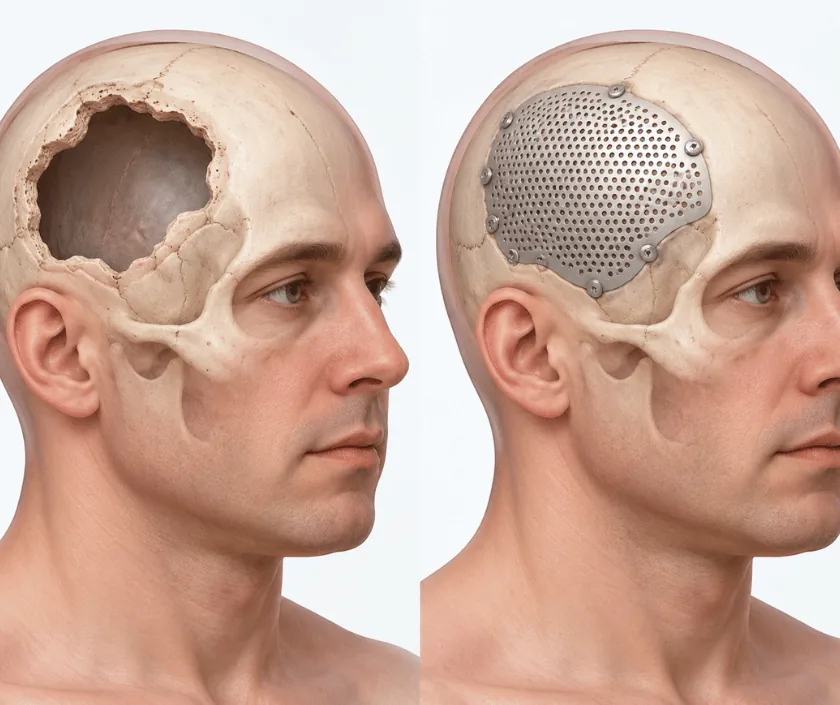
Cranioplasty is the operation that closes a defect in the skull, most often where a piece of bone was removed earlier to relieve pressure on a swollen brain, or lost through injury. The gap is filled with the bone saved at that first operation or with an implant shaped from a scan. Protection of the brain and the shape of the head both improve.
Sometimes a piece of skull has to be removed. After a serious head injury or a stroke the brain may swell, and taking away a section of bone gives it room, which can be lifesaving. Bone is also removed when it has been shattered beyond repair, when infection has destroyed it or when a tumour has grown into it. Whatever the reason, the person is left with a soft area where the skull should be, and often with a dip that changes the shape of the head.
Cranioplasty closes that gap. The bone taken at the first operation is frequently stored and can be replaced once things have settled. Where it is unusable, an implant is made instead, from titanium, from a firm plastic such as porous polyethylene or from acrylic. Modern practice is to design that implant from the CT scan, mirroring the opposite side of the skull so the contour matches.
Timing matters as much as the material. Surgery waits until the scalp has healed properly, any infection has cleared and the brain is no longer swollen. Rushing the operation raises the chance of infection, which is the main complication of this procedure.
Cranioplasty suits people whose brain and scalp have settled after the original problem, and for whom protection, head shape or comfort would improve with the gap closed.
The scalp, the defect and general health are assessed, and a CT scan maps the gap. Old operation notes matter here, especially whether the original bone was stored and in what condition.
Stored bone is used when it is sound. Otherwise an implant is chosen and, for larger defects, designed from the scan so that it matches the curve of the opposite side.
The previous scalp incision is usually reopened, which avoids a second scar. Tissue over the defect is lifted carefully, since it lies directly on the covering of the brain.
The bone or implant is set into the gap and held with small plates and screws so it cannot shift. Edges are checked so the surface sits flush with the surrounding skull.
The scalp is closed in layers, often over a drain. Alertness, pain and the wound are watched closely in the first days, as infection is the complication that matters most.
Headache and scalp swelling are expected, and any drain is usually removed within this period. Nursing staff monitor alertness, temperature and the wound at regular intervals.
Stitches or clips come out and swelling settles. Gentle walking is encouraged, while bending, straining and lifting are avoided to keep pressure off the healing scalp.
The implant is firmly held by now and the head shape is clear. Many people resume light work and driving after review, and rehabilitation continues if it was already under way.
Scalp sensation and scar appearance keep improving. Long term review checks that the implant remains stable and that the skin over it stays healthy.
Head shape usually improves a great deal, and a custom implant follows the curve of the opposite side closely. Slight differences can still be felt or seen at the edges, particularly where the scalp is thin. Protection is restored, which many people describe as the biggest change in daily confidence. Where headache or tiredness had been linked to the defect, improvement is possible but cannot be promised beforehand.
This is a rebuilding operation on tissue that has already been through surgery, so the risks deserve a frank hearing.
Most of what helps at home is about protecting the scalp and spotting infection early.
A helmet protects only while it is worn. Closing the defect restores cover through the whole day and returns the natural shape of the head at the same time.
Titanium and plastic implants are light and sit under the scalp. Most people stop noticing them, although the edges may be felt where the skin is thin.
Timing is chosen deliberately. Operating before the scalp has healed or while infection lingers raises the chance of losing the implant, so waiting is often the safer path.
Sometimes it is, and that is the preferred option. Stored bone can also be reabsorbed or contaminated, in which case an implant shaped from the scan is the better choice.
Skull defect surgery at Elegance Clinic in Surat is planned with neurosurgical colleagues and with attention to the scalp itself, since healthy skin cover is what protects the implant over the years.

What cranioplasty costs depends mainly on the material used, since a custom implant designed from the scan is priced differently from stored bone. Defect size, the state of the scalp, whether a neurosurgical team shares the operation and the length of stay all matter too. For that reason an estimate is prepared in writing after assessment. Most health insurance policies cover this surgery, and the team helps with the paperwork.
These are the questions that come up most often in consultation. If yours is not here, send it on WhatsApp and the team will reply, usually the same day.
Ask your question →Material is the largest factor, because a custom implant designed from a scan costs differently from replacing stored bone. Defect size and length of stay also count. A written estimate is prepared after assessment, once the plan and the material are settled.
Closing a skull defect after injury, stroke surgery, infection or tumour removal is medical treatment, so most policies cover it. Approval usually needs operation notes from the first surgery, imaging and photographs. Policy limits and waiting periods still apply as written.
It is a well established operation carried out under general anaesthesia. Infection around the implant is the main concern and is the reason timing and scalp quality are judged so carefully. Fluid collection and seizures are also discussed before consent.
Most people stay in hospital for a few days and see swelling settle over a fortnight. Light activity often resumes within four to six weeks. Recovery can vary a great deal, since it also depends on the original injury or illness.
A custom implant follows the curve of the opposite side, so head shape usually improves markedly. Slight steps at the edges can be felt where the scalp is thin. Hair generally hides the incision once it has healed.
Surgery waits until the scalp has healed fully, infection has cleared and brain swelling has settled. That may be several months after the first operation. Operating too early raises the risk of losing the implant.
Bring operation notes from the surgery that created the defect, all scans and reports, discharge papers, insurance documents and your medicine list. Mention any seizures, diabetes, smoking or blood thinning tablets, since each affects planning.
Each technique below has its own page explaining how it works and when it is chosen.
Seeing patients from across the city and beyond: read about the practice on the plastic surgeon in Surat page, or check what a written estimate covers on the costs and insurance page.
