This level takes a pyramid of bone with it. The break crosses the bridge of the nose, dips through the floor and rim of each eye socket, then runs back through the side walls of the upper jaw, freeing nose and jaw together.
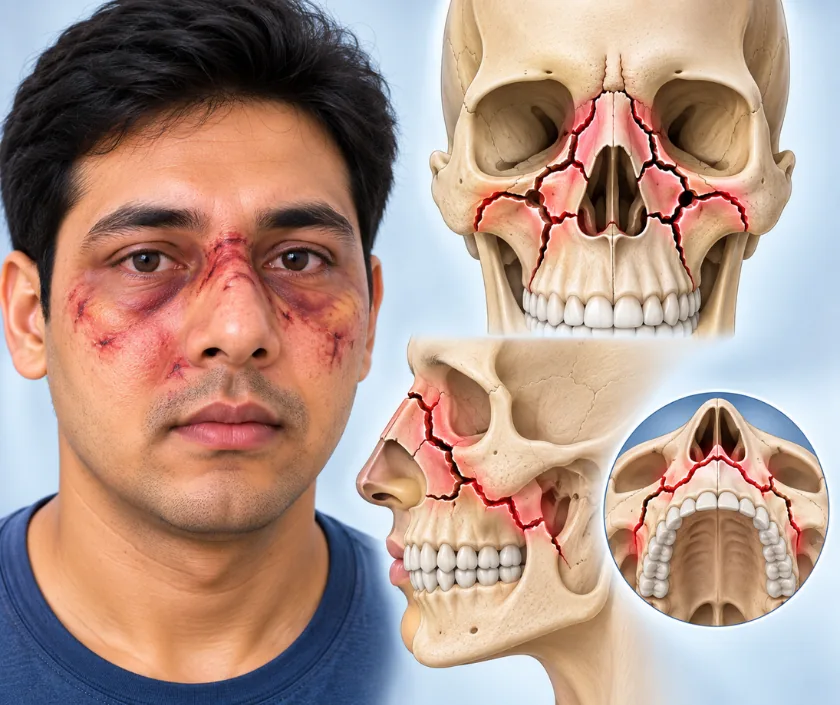
A Le Fort II fracture separates a pyramid of bone made up of the nose and the upper jaw, with the lines passing through the rims and floors of both eye sockets. The cheekbones stay attached to the skull, so the face narrows in the middle and flattens. Repair restores the bite, then rebuilds the rims under the eyes and the pillars of the upper jaw.
Picture a pyramid with its apex at the root of the nose and its base at the palate. That is the shape of bone which comes free in this pattern. From the nasal root the fracture runs sideways into each eye socket, along the floor, out through the rim beneath the eye, then down and backwards through the side wall of the upper jaw to the back of the palate.
Because the nose travels with the jaw, the middle of the face loses support and settles backwards. Patients often have swollen bruised eyelids, a broadened nasal root and numbness across the cheek and upper lip. Grasping the front teeth moves the nose as well as the palate, which is the finding that separates this level from the lower one. Double vision can occur where the socket floor has dropped.
The bite suffers as it does in the lower pattern, usually with the back teeth meeting early and a gap at the front. Nose bleeds are frequent, and a clear watery discharge raises the question of a tear at the skull base, which is looked for carefully on the scan.
Almost all displaced injuries at this level need fixation, because the freed pyramid affects the bite, the nose and the eye sockets at the same time.
Airway, bleeding and other injuries are dealt with before facial repair is considered. A computed tomography scan then maps the fracture lines through the eye socket rims and floors.
Under anaesthesia the upper and lower teeth are brought together as they met before the injury and held with arch bars. Everything above is then rebuilt on top of that foundation.
The rims under the eyes are reached through the eyelid crease or inside the lower lid, and the upper jaw pillars through a cut inside the upper lip. A small cut in the brow region gives access to the nasal root when needed.
The rims and the nasal root are aligned first, since they set the height and projection of the midface. Plates are placed there and along the pillars of the upper jaw.
Eye movement and the level of both eyes are checked before closure, and the socket floor is repaired when the scan and examination call for it.
Facial and eyelid swelling peaks and the nose feels completely blocked. Care focuses on pain relief, head elevation, mouth rinses and a liquid diet.
Swelling drops away and eyelid stitches are removed. Vision is rechecked, elastics may guide the bite and food moves towards a soft diet.
The framework has united. Chewing restarts gradually, work becomes possible again and the shape of the midface is now visible.
Cheek and lip sensation keep improving slowly. Nasal shape, eye level and any residual bite issue can be reviewed and planned properly at this stage.
Careful reconstruction usually returns the face close to its earlier proportions and gives a bite that works. Even so, this is a large injury, and slight flattening of the midface, a broader nasal root or a small difference in eye level can remain. Cheek numbness improves over months and may stay incomplete. Some patients need a later procedure on the nose or the eye socket to refine the result.
The operation is major surgery on a badly injured face, and these risks are discussed openly before you consent.
The framework needs six weeks of protection, and simple habits at home make a real difference to how it heals.
The nose and jaw come free as one pyramid, and the fracture crosses both eye sockets. Treating the nose alone would leave the midface unsupported.
Heavy facial and eyelid swelling is expected after this repair and peaks in the first days. Steady improvement over two weeks is the normal pattern.
Sensation usually improves over months, though not always completely. The nerve is bruised by the injury itself, before any operation is performed.
The main repair restores the framework and the bite. Refinements to the nose, the eye socket or the teeth are sometimes planned later once everything has settled.
Complex midface injuries at Elegance Clinic in Surat are planned as a whole, with the bite, the eye sockets and the nose considered in one sitting rather than treated piece by piece.

What you pay reflects the number of sites plated, the hardware used, whether the eye socket floor is repaired, theatre and anaesthesia time and the length of your stay. Jaw fracture fixation gives the nearest guide to the range involved, and the band shown below is a fair reference point. A written estimate follows the scan and the agreed plan. Such treatment is usually covered by mediclaim, and the team assists with the claim.
These are the questions that come up most often in consultation. If yours is not here, send it on WhatsApp and the team will reply, usually the same day.
Ask your question →Facial fracture fixation of this kind usually sits in a band of Rs 55,000 to Rs 1.2L, moving with the number of plates, any eye socket repair, theatre time and length of stay. A written estimate is prepared once the scan has been reviewed with you.
Yes, in most cases, since fixation after an accident is reconstructive treatment rather than cosmetic. Claims usually need the accident record, the scan report and operative notes. Room rent limits and waiting periods in your policy still apply and should be checked early.
It is major surgery performed with the airway protected and the eyes assessed before and after. Bleeding, infection, numbness and double vision are the main risks. They are explained fully, and the alternative of leaving a mobile midface carries its own problems.
Swelling settles over two to three weeks and liquids give way to soft food. Bone unites by about six weeks, when chewing gradually returns. Light work often restarts at four to six weeks, depending on the job and on other injuries.
Careful repair usually restores the proportions closely and gives a working bite. Slight flattening of the midface, a broader nasal root or small differences in eye level can remain, and a later refining procedure is sometimes planned.
Once other injuries are stable, usually within the first one to two weeks. Waiting longer allows the fragments to begin fusing, which makes restoring the bite and the facial height considerably harder.
The bite, jaw mobility, cheek sensation and eyes are examined, and the scan is gone through with you. Options, likely recovery and the risks are explained, and an estimate follows once the plan is agreed.
Seeing patients from across the city and beyond: read about the practice on the plastic surgeon in Surat page, or check what a written estimate covers on the costs and insurance page.
