The angle is the corner where the lower jaw turns up towards the ear, and the wisdom tooth sits right in that corner. Bone is thin here, so this is one of the places a jaw breaks most often.
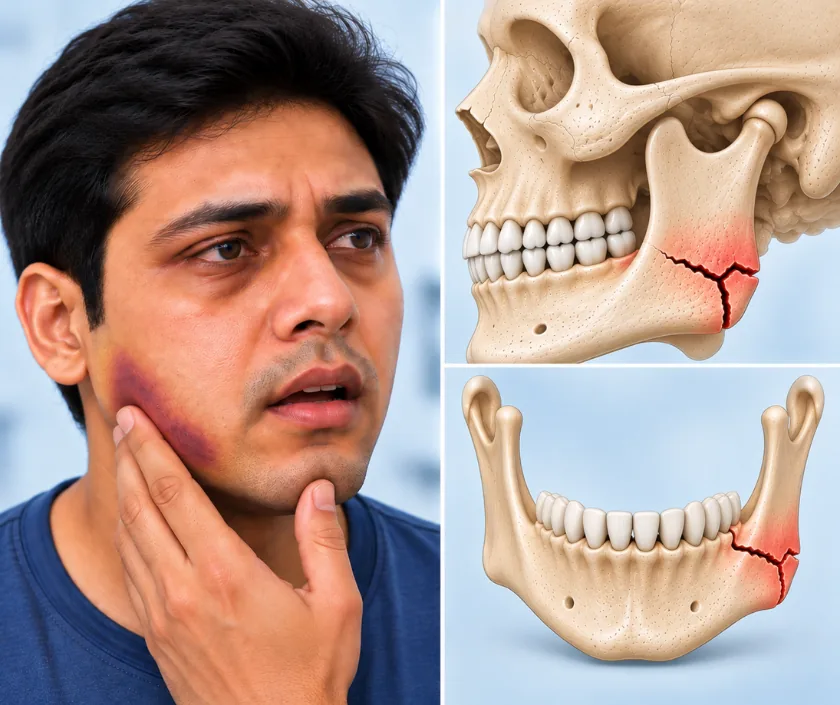
A mandibular angle fracture is a break at the corner where the horizontal jaw turns upward towards the joint. The bone is naturally thin there and the wisdom tooth socket weakens it further, so this corner gives way easily. Most angle fractures are fixed through the mouth with a plate placed along the ridge above the fracture.
Run a finger along the lower edge of your jaw and you will reach a corner just below the earlobe. That corner is the angle. It marks the point where the jaw stops running forward and starts climbing towards the joint, and it is thinner than the bone on either side of it. When a wisdom tooth is buried there, as it is in many young adults, even less solid bone remains.
The result is predictable. A punch or a fall that would bruise another part of the face often snaps the jaw at this corner, and the fracture frequently runs down into the wisdom tooth socket. Because that socket opens behind the last standing tooth, saliva and bacteria reach the fracture immediately, which is why infection is a bigger worry here than elsewhere in the jaw.
Muscle behaves differently at this site too. Powerful chewing muscles wrap the outer and inner faces of the bone just behind the angle, and they hold the back fragment while the front of the jaw sags. That combination gives the typical picture of a jaw that will not open, a gum that has torn behind the last tooth and back teeth that meet before the front ones do.
Plate fixation suits most adults with a displaced or mobile angle fracture. A few settle well with conservative care, and the choice is made once scans and the bite have been reviewed.
Jaw opening, bite and the state of the wisdom tooth are examined, then scans define the fracture line and show whether a second break sits at the opposite condyle, which is a common pairing.
General anaesthesia is given with the breathing tube usually passed through the nose. That keeps the mouth free so the teeth can be brought together and the bite checked during surgery.
The upper and lower teeth are wired or screwed into their original bite. Getting this right first matters more than the appearance of the bone on a scan.
A cut inside the mouth behind the last tooth exposes the angle. The wisdom tooth is removed if it is damaged or infected, and a plate is screwed along the strong ridge above the fracture line.
The gum is closed carefully, because a wound that opens later is the usual route to infection here. Before the patient wakes, the bite is checked once more.
Swelling around the angle is at its worst and jaw opening is limited. Cool liquids, regular pain relief and gentle mouth rinses make up most of the routine.
Swelling settles and opening improves. Most people return to light work while staying on soft food and rinsing after everything they eat.
The bone is usually united enough for the diet to widen after review. Jaw opening exercises continue if the mouth is still not opening fully.
Chewing on that side generally feels normal again. Late problems such as a loose plate or a grumbling infection show up in this window and are dealt with then.
Most angle fractures unite well and the bite returns to normal. Even so, this site has the highest rate of wound trouble in the jaw, so a small number of people develop infection around the plate and need a further short procedure. Jaw opening may take several weeks to come back fully, especially when the chewing muscles were bruised. Healing varies with age, tobacco use and mouth hygiene.
These risks are explained before consent so that expectations match what actually happens at this particular site.
Since the wound sits at the back of the mouth where a toothbrush struggles to reach, hygiene needs extra attention here.
Partial opening is normal after an angle fracture, because muscle spasm limits movement long before the bone itself blocks it.
It depends. A sound wisdom tooth may be left alone, while a broken, decayed or infected one is taken out during the same operation.
At the angle a single plate along a specific strong ridge is a recognised technique, chosen because it suits the way force travels through this corner.
Antibiotics help control infection, but they cannot hold bone still. Movement across a fracture is what keeps it from healing.
Elegance Clinic in Surat treats angle fractures with the infection risk of this site kept firmly in mind, from how the wound is closed to how review visits are scheduled.

Fixing an angle fracture is medically necessary, so mediclaim policies generally cover the admission, the operation and the implants, often as a cashless claim. The estimate depends on whether a wisdom tooth also has to be removed, how many fracture sites there are, the plates chosen, the room category and the length of stay. A written estimate is given once the scans have been studied, and anything that would change it is discussed with the family first.
These are the questions that come up most often in consultation. If yours is not here, send it on WhatsApp and the team will reply, usually the same day.
Ask your question →Bone is naturally thinner at that corner, and in many young adults a wisdom tooth occupies part of it. Less solid bone means the corner gives way under force that other parts of the jaw would absorb.
Not always. An undisplaced fracture with a normal bite can sometimes be managed with a soft diet, mouth care and close review. Once the bite has changed or the segment moves, fixation gives a much more dependable result.
Usually not, since most angle fractures are reached through a cut inside the mouth behind the last tooth. A small skin incision is occasionally needed to pass a screw, and that is discussed beforehand.
Fracture fixation is generally covered by mediclaim because it restores function after injury. Cover depends on the policy terms and the insurer approval. Any dental work that follows, such as replacing a lost tooth, is normally billed separately.
The chewing muscles wrapped around the angle go into spasm after injury and after surgery. Opening usually improves over a few weeks with gentle exercises. Movement that stays very limited is reviewed, since scarring can also restrict it.
Wound trouble is more common at the angle than at other jaw sites, because the fracture opens into the mouth behind the last tooth. Careful closure, antibiotics, mouth rinses and stopping tobacco all reduce that risk.
Light walking can restart within days. Weights, contact sport and anything that risks a knock to the face are usually kept aside for six to eight weeks, and the timing is confirmed at review once healing has been checked.
Seeing patients from across the city and beyond: read about the practice on the plastic surgeon in Surat page, or check what a written estimate covers on the costs and insurance page.
