Upper jaw bone carries the top teeth and keeps the mouth separate from the nose and sinus above it. When part of it is removed or damaged, maxillary reconstruction restores that barrier and gives the teeth something to sit on again.
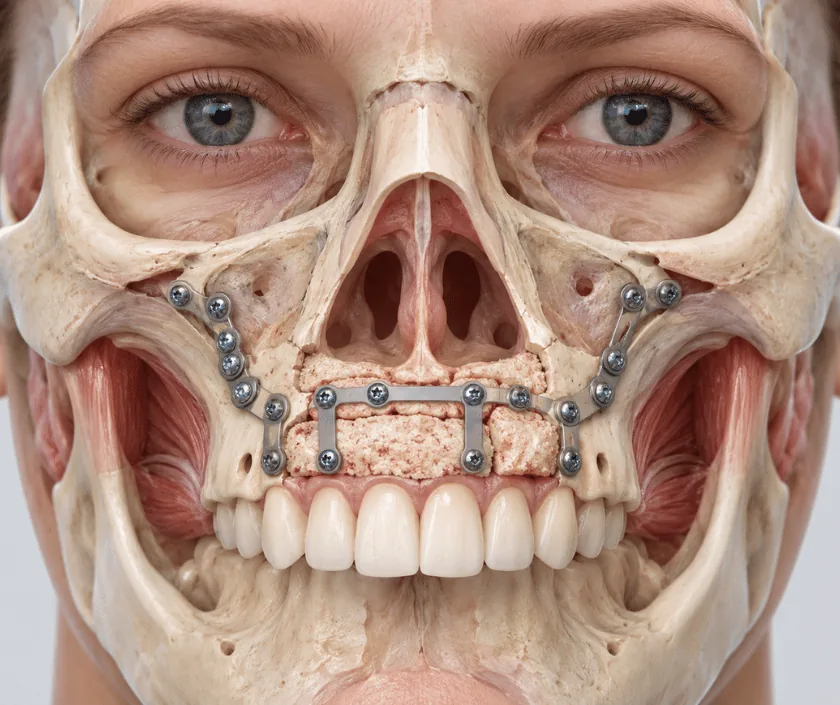
Maxillary reconstruction rebuilds the upper jaw after tumour removal, injury or severe infection. Its purpose is to close the opening between mouth and sinus, restore the shape of the cheek and palate, and provide bone for teeth. Choices run from a removable obturator plate through soft tissue flaps to bone carrying free flaps, decided by the size of the defect.
Losing part of the upper jaw creates a very specific set of problems. Food and fluid pass up into the nose, speech takes on a nasal quality, the cheek loses support and the upper teeth on that side no longer have a base. Anyone planning reconstruction has to answer each of those, and the answers differ according to how much bone and lining were taken.
Options sit on a ladder. The simplest is an obturator, a plate made by a prosthodontist that fills the gap and can be taken out and cleaned. It needs no further surgery, works well for many people and can be adjusted as things change. Next comes a soft tissue flap, which closes the opening for good but gives no bone, so teeth must sit on a denture. Higher still is a bone carrying free flap, usually taken from the lower leg or the hip, which restores height and width and can later hold implants.
Deciding between them involves the surgeon, a prosthodontist and the patient together. Age, general health, planned radiotherapy and how well someone manages a removable appliance all weigh on the choice.
Not every upper jaw defect needs an operation, and the discussion begins by asking what the patient actually needs day to day.
A surgeon and prosthodontist examine the defect together, take impressions and review the CT scan. Remaining teeth are assessed, since they anchor an obturator and influence every later decision.
The simplest workable option is offered first. Where an obturator will serve well, that is said plainly, and surgery is reserved for defects an appliance cannot manage comfortably.
If surgery is chosen, lining is restored so that mouth and sinus are separated. Soft tissue flaps achieve this reliably where bone height is not the main issue.
For larger defects, bone with its own blood supply is shaped to rebuild the jaw and fixed with plates. Position is planned around where teeth will eventually need to sit.
After healing, a denture, an obturator or implant supported teeth are fitted. This stage is often what patients notice most, so it is planned from the very beginning.
Swelling of the face and palate is marked, and feeding often runs through a fine tube. A temporary plate may be in place to protect the area.
Swelling eases and soft diet usually begins. Mouth rinses and nasal care become routine, and most people are discharged during this stretch.
Healing of the lining is normally complete and impressions for a definitive appliance can be considered. Speech is noticeably clearer by this stage.
Bone has consolidated where a graft or flap was used, and implants may be discussed. Contour continues to settle for several more months.
Speech and swallowing usually improve markedly once the opening is closed, and most patients notice this within weeks. Appearance improves as cheek support returns, though the treated side seldom matches the other exactly. Implants are not always possible, particularly after radiotherapy, and a denture may remain the practical answer. Healing and function can vary widely between patients, so the plan is reviewed honestly at each visit rather than fixed in advance.
Because this area connects the mouth, nose and sinus, infection and leakage are the risks that come up most often.
Keeping the area clean is the single most useful thing you can do while the reconstruction settles.
For many people a well made obturator is a lasting solution. It restores speech and eating, allows the area to be inspected easily and avoids a second major operation.
Dental implants need bone to sit in. Where the jaw itself is missing, bone has to be rebuilt first, otherwise the implant has nothing to hold it.
A defect through the palate that involves bone does not close spontaneously. Waiting usually makes the edges scarred and stiff, which complicates later repair.
Dental care is central to upper jaw reconstruction from beginning to end. Impressions, appliances and long term maintenance decide much of the final comfort.
Upper jaw work at Elegance Clinic in Surat is planned jointly with dental colleagues from the first visit, so the reconstruction is built around where teeth will eventually go.

Cost is driven by the option chosen. A prosthetic obturator is the least expensive route, a soft tissue flap sits in the middle, and bone carrying free tissue transfer with plates and later implants is the most involved. Hospital stay, monitoring and dental work all contribute. A written estimate is prepared once the scan and dental assessment are complete, and reconstruction after tumour or injury is usually insurable.
These are the questions that come up most often in consultation. If yours is not here, send it on WhatsApp and the team will reply, usually the same day.
Ask your question →It depends on the route taken. An obturator is the least expensive, while bone carrying tissue transfer with implants costs considerably more. A written estimate is prepared after the scan and dental assessment, with surgical and dental stages listed separately.
Reconstruction after a tumour, injury or serious infection is medically necessary and generally covered by mediclaim policies and government schemes. Purely dental items such as implants are often excluded, so check that part of the policy carefully before admission.
These operations are well established, though the larger ones are lengthy and need good general fitness. Infection, flap problems and a persistent opening between mouth and sinus are the main risks. Blood tests, scans and a physician review are done before any anaesthetic.
Most people are home within a few days to about two weeks depending on the operation. Soft diet continues for some weeks, and lining is usually healed by around six weeks. Bone consolidation and dental work extend over several months.
Closing the opening between mouth and sinus usually removes the nasal quality from speech, and many people notice a clear difference quickly. Some sounds may still need practice, and a speech therapist helps considerably where difficulty continues.
Sometimes. Implants need enough healthy bone and are more difficult after radiotherapy. Where they are not advisable, a well made denture or obturator gives good function. The dental team will set out what is realistic in your case.
Bring scan films and reports, any biopsy result, previous operation notes and any appliance you currently wear. A list of medicines is useful, and noting which problem troubles you most helps direct the discussion.
Each technique below has its own page explaining how it works and when it is chosen.
Seeing patients from across the city and beyond: read about the practice on the plastic surgeon in Surat page, or check what a written estimate covers on the costs and insurance page.
