When the jaw joint has been destroyed by disease, injury or repeated operations, it can be replaced with an artificial joint fixed to the skull and the jaw. It is a considered step, taken after simpler options have been weighed.
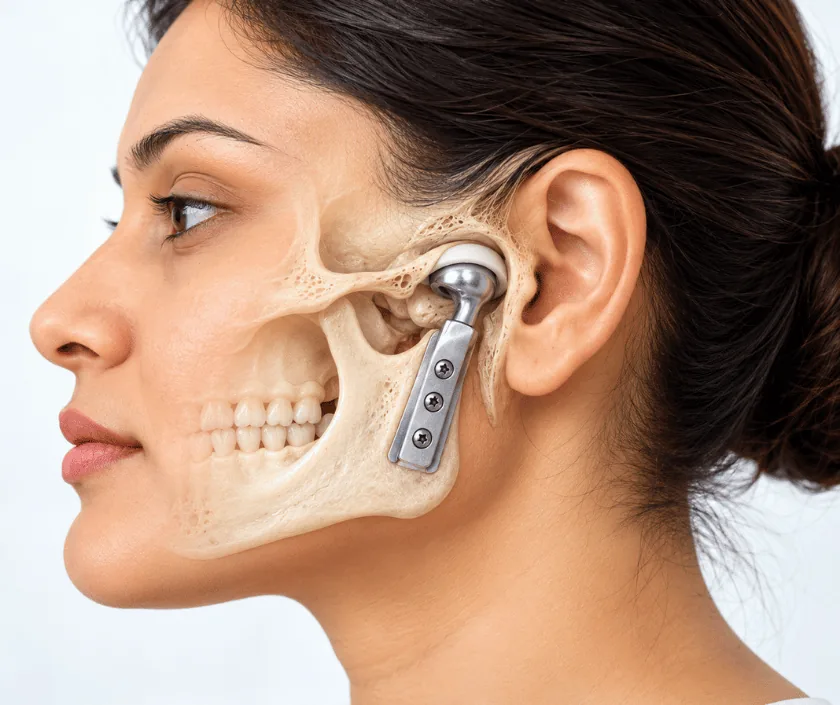
Jaw joint replacement means removing a destroyed joint and fitting an artificial one, with a socket component fixed to the skull and a jaw component screwed to the ramus. It is considered when the joint has been ruined by disease, severe injury or repeated failed operations. The aim is comfortable opening and a stable bite rather than the full range of a natural joint.
The jaw joint is small but heavily used, moving every time you speak, eat or yawn. When it is destroyed, the jaw loses height on that side, the bite collapses at the back and pain becomes constant. Replacement is one answer to that problem. A metal and plastic socket is fixed to the skull where the natural socket sat, and a matching component is screwed to the side of the lower jaw, so the two surfaces move against each other.
Reaching this point usually takes time. Most people offered a replacement have already tried medication, splints, physiotherapy and often surgery on their own joint. Others come with a joint destroyed by inflammatory disease, or with a jaw that has fused repeatedly despite release. In these situations rebuilding with bone from elsewhere in the body may be less dependable than an artificial joint, particularly in adults.
Two routes exist for the implant itself. Ready made components come in several sizes and are matched during surgery, while custom components are manufactured from a detailed scan so that they sit against the individual shape of the skull and jaw. The choice depends on how distorted the anatomy has become, on cost and on how much planning time is available before surgery.
Replacement suits adults with a joint that cannot be salvaged, who understand what an artificial joint can and cannot do. It is not a first step, and it is not for growing children.
Opening, bite and facial symmetry are recorded, and a fine cut scan shows the joint and the surrounding bone. Previous operation notes are reviewed, since scarring changes the approach.
The team decides between ready made and custom components. Custom implants are designed on a model of the individual skull and jaw, which adds planning time before surgery.
Under general anaesthesia the breathing tube passes through the nose. Two incisions are used, one hidden near the ear and one under the jawline, giving access to both parts of the joint.
The destroyed joint is removed, the skull component is fixed where the natural socket sat, and the jaw component is screwed to the ramus. Bite position is checked before the components are finally tightened.
Gentle opening exercises begin within the first days, since the muscles around the joint stiffen quickly. Physiotherapy is taught before discharge and continued at home.
Swelling around the ear and jawline is at its height. Pain relief, soft diet and supervised gentle opening exercises make up the routine in hospital.
Wounds settle and stitches are removed. Exercises increase steadily, and eating soft food by mouth becomes comfortable again.
Opening is measured against the range achieved during surgery. The diet widens carefully, and heavy chewing is still avoided to protect the implant.
Function usually reaches its settled level. Yearly review continues with scans, since an implant needs monitoring for many years.
Most people gain useful opening, a steadier bite and considerably less pain. An artificial joint is still not the same as a natural one. Side to side and forward movement usually remain limited, chewing very hard food is discouraged for the life of the implant, and hard grinding foods are best avoided. Implants can loosen or wear over many years, so review continues indefinitely. Results vary with how scarred the joint area already was.
An implanted joint carries the risks of major surgery and the separate risks that come with any device placed in the body.
An implanted joint changes some habits for good, and knowing this beforehand makes the adjustment much easier.
Opening usually improves a great deal, but side to side and forward movement stay limited, and that is expected rather than a complication.
It sits at the end of a long path. Medication, splints, physiotherapy and joint preserving surgery come first for almost everyone.
Components can loosen or wear over the years, so yearly review with scans is part of living with an artificial joint.
An artificial joint does not grow, so children are managed with release and reconstruction, and replacement is considered only after growth is complete.
At Elegance Clinic in Surat, joint replacement is discussed only after simpler options have been considered, and the planning, costs and long term commitments are set out in full beforehand.

The implant is the single largest item in this operation, and its price varies with whether ready made components are used or a custom set is manufactured from a scan of the individual patient. Beyond that, cost depends on whether one joint or both are replaced, on the length of the anaesthetic, on the days spent in hospital and on the physiotherapy that follows. Insurance treatment varies as well, since some policies handle implants differently from surgery. For all these reasons a written estimate is prepared after assessment, with the implant listed as a separate line so the family can see exactly what it contributes.
These are the questions that come up most often in consultation. If yours is not here, send it on WhatsApp and the team will reply, usually the same day.
Ask your question →Usually after other treatments have been tried and the joint itself is destroyed on scans. Repeated fusion, severe injury and inflammatory joint disease are the common reasons. It is considered a later step rather than an early one.
Many implants function well for a long time, but no device is beyond wear or loosening, and honest figures for any individual cannot be promised. Yearly review with scans is how problems are caught before they become urgent.
Opening usually improves considerably, which is the main goal. Side to side and forward movement generally stay limited, since an artificial joint cannot reproduce the sliding motion of a natural one.
An artificial joint does not grow, so it would fall behind as the rest of the face develops. Children are managed with release and reconstruction instead, and replacement is only considered once growth is complete.
Often partly. Surgery to restore jaw function after destruction of the joint is generally covered, while implant cost may be handled differently by different policies. This is checked with the insurer during assessment and shown separately in the estimate.
Very hard items such as ice, bones, hard nuts and tough dried snacks are discouraged for as long as the implant is in place, since they load the components heavily. Most everyday food becomes comfortable again after recovery.
Regular visits with measurement of opening and bite, and scans at planned intervals to check the position of the components. Review continues for years, and any new pain, swelling or change in the bite is a reason to return sooner.
Seeing patients from across the city and beyond: read about the practice on the plastic surgeon in Surat page, or check what a written estimate covers on the costs and insurance page.
