An amputation above the elbow is the most urgent replantation of all, because the arm carries a large mass of muscle that suffers quickly without blood supply. Every minute on the road counts.
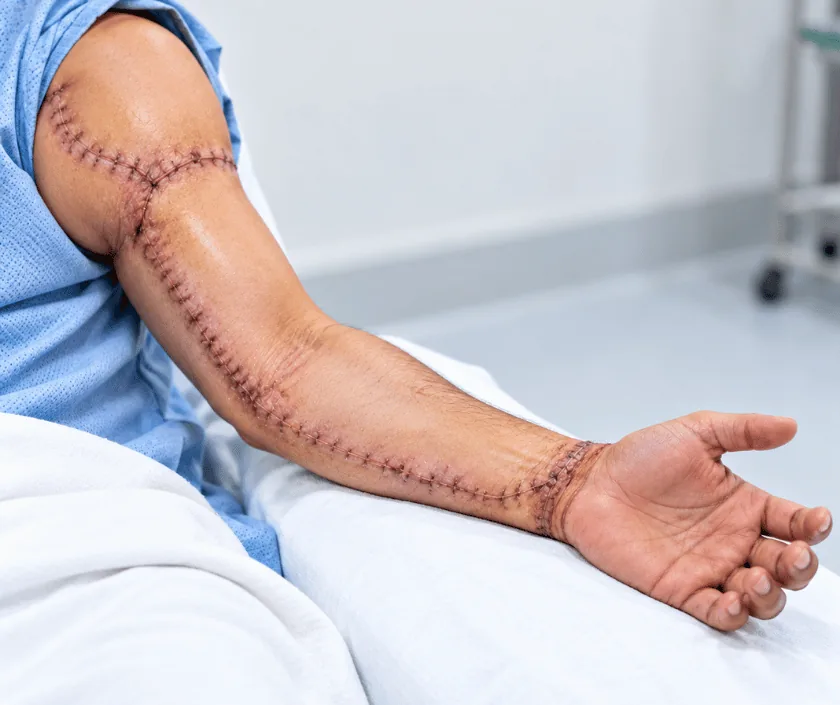
Arm replantation reattaches a limb severed above the elbow. Surgeons control bleeding, shorten and fix the bone, restore arterial flow quickly, then repair veins, muscle and the major nerves. This is the most time critical level of replantation, because the upper arm holds a large volume of muscle and muscle tolerates loss of blood supply poorly.
An amputation through the upper arm divides the humerus, the large muscles that move the elbow and the nerve bundle that supplies the entire forearm and hand. Blood loss is significant, so resuscitation and reattachment run side by side. Two surgical teams often work at once, one preparing the stump while the other prepares the amputated limb.
Priorities change at this level. Getting blood back into the muscle comes before elegant repair, so a temporary shunt may be used to restore flow within the first part of the operation. Bone is then shortened and fixed, muscles are repaired in layers, veins are joined and the nerves are aligned and stitched under magnification.
Realistic conversation matters here more than anywhere. Nerve fibres regrow slowly, and the distance from the upper arm to the hand is long, so hand movement and sensation after an arm level replantation are limited. Many patients gain a limb they can reach and steady with, while fine hand work remains difficult. Our team explains this before consent rather than afterwards.
At this level the decision balances saving a limb against keeping the patient safe. Both sides are weighed openly with the family before surgery starts.
Blood loss is replaced, antibiotics and tetanus cover are given, and imaging is arranged. The amputated limb is cooled and inspected while consent and anaesthetic checks proceed in parallel.
Where delay has been significant, a temporary shunt carries blood into the limb early. Getting oxygen back to muscle takes priority over completing every repair first.
Dead tissue is removed and the humerus is shortened enough for a tension free repair, then fixed with a plate or an external frame so the limb becomes mechanically stable.
The artery is repaired formally, sometimes with a vein graft, and veins are joined so blood can drain. Muscle bellies are then stitched in layers to rebuild elbow movement.
Major nerves are aligned and repaired under magnification. Skin is closed loosely and release incisions may be left open, since swelling in a large limb needs somewhere to go.
Care usually happens in a high dependency setting, with attention to circulation, swelling, urine output, blood counts and kidney function. The limb is kept elevated and warm.
Wounds are reviewed, open areas are closed or grafted and the splint is adjusted. Therapy begins with gentle shoulder and finger movement to keep joints supple.
Imaging checks bone union. Elbow and shoulder work becomes more active, and a plan is made for the long wait while nerves regrow towards the forearm.
Nerve recovery continues over a long period. Secondary surgery such as a tendon transfer, free functioning muscle transfer or joint release is often considered at this stage.
At arm level the honest expectation is reach and elbow function rather than a working hand. Nerve fibres travel a long distance to reach the forearm, so grip and sensation return slowly and incompletely, if at all. Many patients use the replanted arm as a stabilising limb and rely on the other hand for detail. Improvement continues for a long time and often needs further surgery.
This is among the largest operations in reconstructive surgery, and the risks affect both the limb and the rest of the body.
Discharge from an arm level replantation comes with a detailed plan. Ask a family member to sit in, so the instructions are heard twice.
The opposite is true. A large muscle mass suffers faster without blood supply, so arm level injuries are the most urgent replantations of all.
Nerve fibres regrow slowly across a long distance, so hand function after arm level replantation is limited. Elbow and reach usually improve far more than grip.
Planned shortening lets vessels, nerves and muscle be repaired without tension, which protects the whole reconstruction.
Arm level reconstruction is usually staged. Secondary procedures to improve movement are part of the plan rather than a sign that something failed.
Elegance Clinic in Surat manages major limb emergencies with a microsurgery trained team and monitoring geared to this level of injury. Dr. Ashutosh Shah discusses the limits of arm level replantation before consent, not after surgery.

Cost at arm level reflects a long operation, possible transfusion, implants or grafts, a longer hospital stay and high dependency care after circulation is restored. The band below helps you plan rather than fixing a price.
Our team provides a written estimate once the limb has been examined, covering theatre, implants, stay, medicines and rehabilitation. Insurance and government scheme paperwork is started by the front desk while the operation is being organised.
These are the questions that come up most often in consultation. If yours is not here, send it on WhatsApp and the team will reply, usually the same day.
Ask your question →Replantation work sits within a band of Rs 1.2L to Rs 3.5L, and the figure rises with theatre time, transfusion, implants and days in hospital. Emergency admission is often covered by insurance or a government scheme, and a written estimate follows assessment.
Because the upper arm carries a large mass of muscle, and muscle tolerates loss of blood supply poorly. The higher the amputation, the shorter the window. Travel straight to a microsurgery centre with the amputated part cooled correctly.
It carries substantial risk, including heavy blood loss, clotting of the repaired vessels, infection and strain on the kidneys when blood returns to the muscle. Monitoring in a high dependency area during the first days is planned for exactly these reasons.
Two weeks or more in hospital is common, followed by months of therapy. Nerve regrowth towards the hand takes far longer, so changes continue well beyond a year, and staged secondary surgery is often part of the plan. Recovery can vary greatly.
Realistically, elbow bending and reach improve much more than grip. Nerve fibres must travel a long way to reach the hand, so sensation and finger movement return slowly and incompletely. Later procedures can add specific movements once healing settles.
If the arm was crushed, burnt or torn over a long segment, if the muscle has been without circulation too long, or if other injuries make a lengthy anaesthetic unsafe, then a well shaped stump and a prosthesis may serve you better.
The findings, the imaging, the likely level of function, the alternative of stump formation and the chance of needing further surgery are all discussed with you and your family. Anaesthetic fitness is assessed and a written estimate is provided.
Each technique below has its own page explaining how it works and when it is chosen.
Seeing patients from across the city and beyond: read about the practice on the plastic surgeon in Surat page, or check what a written estimate covers on the costs and insurance page.
