When a finger, hand or limb is cut off, the first hour shapes what surgeons can offer. Two things matter most, which are stopping the bleeding safely and carrying the amputated part the right way.
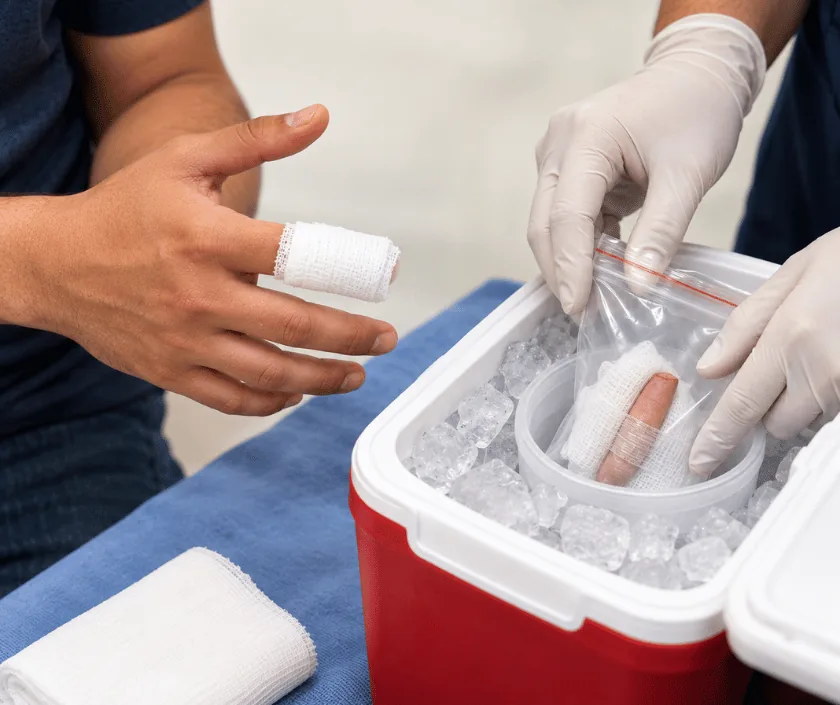
Control bleeding with firm pressure through a clean cloth and raise the injured limb. Wrap the amputated part in clean moist gauze, seal it inside a plastic bag, then rest that sealed bag on ice. Never put the part directly against ice and never soak it in water. Travel at once to a hospital that performs microsurgery, taking the part with you.
Stay with the injured person and keep them calm. Press firmly over the wound with a clean cloth or pad and raise the limb above the level of the heart, since pressure and elevation together slow most bleeding. If blood soaks through, add another pad on top rather than lifting the first one away. Arrange transport while you keep the pressure on.
Now deal with the part itself. Pick it up gently, wrap it in clean moist gauze or a clean damp cloth, and place it inside a clean plastic bag. Seal the bag, then rest that sealed bag on ice or in a box of ice and water. The barrier is the whole point, because tissue that touches ice directly is frozen and cannot be used, and tissue left soaking in water swells and breaks down.
Avoid a few common mistakes. Do not scrub the part, do not pour antiseptic or spirit over it, and do not tie a tight band around the limb unless a trained responder tells you to. Take the part with you even if it looks badly damaged, and go straight to a hospital with a microsurgery team.
These steps are for the people at the scene in the minutes before an ambulance arrives or before you reach hospital. They do not replace medical assessment.
Switch off the machine, disconnect power and move away from moving parts before you help. Helping from within a dangerous space risks a second injury and delays everyone.
Press firmly over the wound with a clean cloth and raise the limb. Add extra pads on top if blood soaks through, and keep steady pressure until medical help takes over.
Pick it up gently without scrubbing or rinsing it with antiseptic. Handle it as little as possible, because rough handling damages the very vessels the surgeon needs to join.
Wrap the part in clean moist gauze, seal it inside a clean plastic bag, then rest that bag on ice. Keep ice away from direct contact and never leave the part soaking in water.
Go straight to a hospital that performs replantation, taking the sealed bag with you. Do not stop at a small clinic first, and do not give food or drink on the way.
Bleeding is controlled, the part is wrapped and cooled correctly, and transport is arranged. Keeping calm and organised here saves more time than rushing without a plan.
You reach the hospital, the injury and the part are examined together, blood tests and imaging are done and the surgical team is mobilised.
Options are explained to you and your family, consent is taken and surgery is arranged. Antibiotics and tetanus cover are given while theatre is prepared.
Circulation in the repaired part is monitored closely, and therapy is planned. The team explains what to watch for before you go home.
Good first aid improves the odds, but it does not decide them. Whether a part can be reattached depends on how it was injured, how much muscle it contains and how long it was without blood supply. Some parts arrive in excellent condition and still cannot be repaired, because the crush is too extensive. Handling the part correctly simply makes sure the choice is a surgical one.
Most damage done outside hospital comes from well meant handling. Knowing these traps helps you avoid them.
While one person cares for the injured, another can prepare everything the hospital will ask for.
Direct contact with ice freezes tissue and destroys it. The part must be wrapped and sealed in a bag first, with the bag resting on ice.
Appearances mislead. Bring it anyway, because the surgical team may still use skin, bone or a vein from it even if full reattachment is impossible.
Antiseptics and spirit damage the delicate vessels and nerves. Wash out is done properly in theatre, so leave the cleaning to the hospital.
Reattachment needs a microsurgery team and a microscope. Stopping somewhere without them usually costs the very time the tissue cannot spare.
Elegance Clinic in Surat is geared for hand and limb emergencies, with a microsurgery trained team and instruments ready at short notice. Dr. Ashutosh Shah assesses the injury and the amputated part together before any plan is made.

First aid itself costs nothing, and the treatment that follows depends entirely on what the injury turns out to need. A washout and closure is a very different operation from a full replantation with bone fixation and vessel repair.
Once you arrive and the injury has been assessed, our team gives you a written estimate covering theatre, implants, hospital stay, medicines and therapy. If you carry insurance or a government scheme card, the front desk starts the approval while surgery is being arranged.
These are the questions that come up most often in consultation. If yours is not here, send it on WhatsApp and the team will reply, usually the same day.
Ask your question →A written estimate is prepared once the injury has been assessed, because the operation needed can range from a washout and closure to a full replantation. The estimate covers theatre, implants, stay, medicines and therapy, and emergency admission is often covered by insurance.
Wrap it in clean moist gauze or a clean damp cloth, seal it inside a plastic bag, then rest that sealed bag on ice. Keep the part away from direct contact with ice and never leave it soaking in water.
Only a trained responder should apply one. For most injuries, firm pressure through a clean pad with the limb raised controls bleeding safely. A tight band applied without training can damage nerves and vessels and worsen the injury.
Immediately. Parts containing muscle, such as a hand, forearm or foot, deteriorate fastest, so those journeys are the most urgent of all. A fingertip tolerates a little longer, though delay always reduces what surgery can achieve.
No. Correct handling protects the tissue so that reattachment remains possible, but the decision depends on how the injury happened and how badly the vessels were crushed. Some parts arrive well preserved and still cannot be repaired.
Travel to hospital straight away with the injured person and ask someone else to keep searching. The wound still needs urgent care, and the part can be brought separately if it is found soon afterwards.
Say exactly when the injury happened, how it happened, how the part was stored and whether any tight band was applied. Bring identity documents, insurance details and a list of current medicines, and avoid giving food or water.
Seeing patients from across the city and beyond: read about the practice on the plastic surgeon in Surat page, or check what a written estimate covers on the costs and insurance page.
