A cut through the eyelid needs more care than a cut anywhere else on the face, because the lid shields the eye and must still close properly afterwards. Repair puts every layer back in its own place.
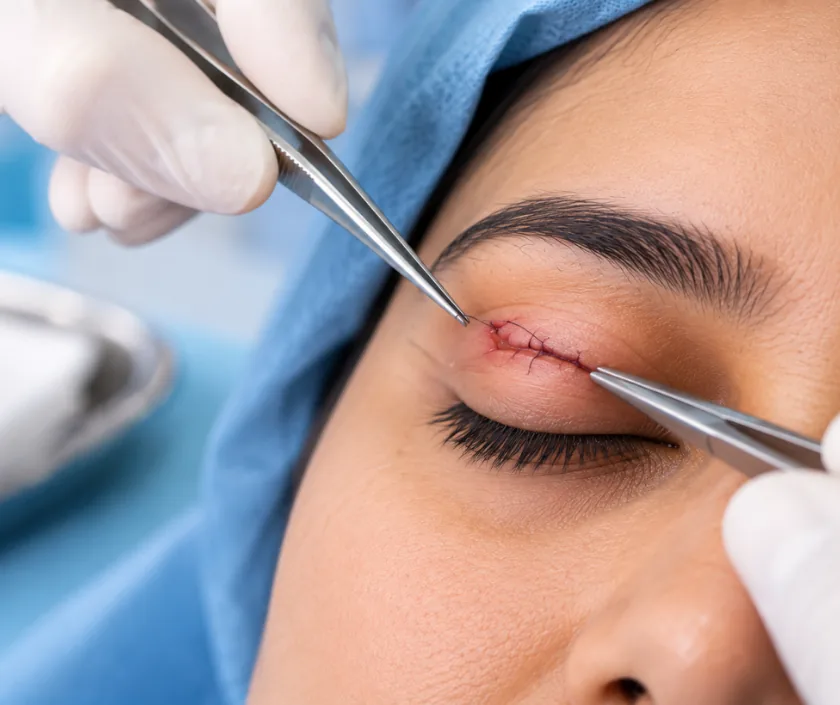
Eyelid laceration repair is surgery to close a cut through the eyelid so the lid still shields the eye and blinks normally. Your surgeon checks whether the tear duct, the lifting muscle or the eye itself is involved, then rebuilds the wound layer by layer with fine stitches. Most repairs are done under local anaesthesia on the same day.
The eyelid is thinner than almost any other tissue on the body, yet it does constant work. Beneath the skin lies a sheet of muscle that closes the eye, and behind that a firm plate that gives the lid its shape and holds the lashes in line. A cut crossing these layers cannot be treated as an ordinary skin wound, because each layer has to be identified and returned to its own position.
Assessment therefore comes before any stitching. Vision is checked, the surface of the eye is examined and the wound is explored to see how deep it runs. Particular attention goes to the inner corner near the nose, where the tear drainage channel sits, and to the upper lid, where the muscle that lifts the lid can be divided without any obvious sign from outside.
Repair then moves from the inside outwards. The firm plate is closed first, then the muscle, then the skin, with the lash line aligned so the lid edge stays flat. Most adults are treated under local anaesthesia, while children and deeper injuries are usually done under general anaesthesia so the work can be unhurried.
Almost any eyelid cut that goes beyond the skin surface needs formal repair. What varies is the setting, the anaesthesia and how much rebuilding is required.
Vision is tested and the eye is examined before anything else. Your surgeon then explores the wound to see how deep it runs, whether the lid margin is cut and whether the tear duct is involved.
The area is washed and any grit, glass or dirt is lifted out. Tetanus cover and antibiotics are given when the injury is dirty or caused by a bite.
Most adults are treated under local anaesthesia with the eye area numbed. Children, deep wounds and injuries needing tear duct work are usually done under general anaesthesia.
The firm inner plate is closed first, then muscle, then skin. Where the margin is cut, it is aligned along the lash line so the lid edge sits flat rather than notched.
Ointment is applied and a light pad may be used overnight. A review follows within a few days, and stitches near the lash line are removed early on purpose.
Swelling and bruising peak, and the eye may look alarming. Cold compresses over the closed lid and the drops or ointment advised help settle it.
Most bruising fades and stitches are taken out. Many people go back to desk work in this period, using dark glasses outdoors.
The lid usually moves and closes normally. Your scar looks pink and slightly firm, which is expected at this stage.
Scars keep softening and fading. Any small notch or tightness is reviewed then, and a minor adjustment can be planned if needed.
Most eyelid repairs heal well, with a lid that closes properly and a scar that fades into the natural lines of the area. A faint line usually stays visible on close inspection. If the injury tore away tissue or crushed the lid edge, a small notch or a slight difference in lid height can remain. Such changes are reviewed once the scar has matured, and a small adjustment often improves them.
Eyelid repair is common work, though every wound near the eye carries some risk. Knowing what can happen makes the early signs easier to spot.
Care at home is simple, and it matters most during the first two weeks while the stitches are still in place.
Even a short cut can pass through the lid margin or the tear duct. Those layers have to be identified and stitched separately, which tape cannot do.
The lid has several layers and a working edge. Closing skin alone leaves gaps underneath that show up later as a notch or a droop.
Vision can be normal while the drainage duct or the lifting muscle is torn. That is why the whole lid is examined and not only the eyesight.
Fresh wound edges line up far more easily. After a delay, tissue swells and pulls back, and the repair becomes harder and less tidy.
Eyelid injuries are handled at Elegance Clinic in Surat as reconstructive work rather than routine stitching, with the tear duct, the lid margin and the movement of the lid all checked before the wound is closed.

Cost depends on what the injury actually involves. A simple cut closed under local anaesthesia sits at one end of the range, while a wound crossing the lid margin or reaching the tear duct needs theatre time, general anaesthesia and finer material. Because the extent is only clear after examination, a written estimate is shared once the injury has been assessed. Repair after trauma is reconstructive work, so most mediclaim policies cover it, and the team helps with the paperwork.
These are the questions that come up most often in consultation. If yours is not here, send it on WhatsApp and the team will reply, usually the same day.
Ask your question →Cost varies with the depth of the wound, whether the lid margin or tear duct is involved and the type of anaesthesia used. For that reason a written estimate is shared after the injury has been examined rather than quoted over the phone. Most trauma repairs are covered by mediclaim.
Repair is carried out with the eye shielded and the field magnified, so the surface of the eye stays protected throughout. Risks such as infection or a small notch in the lid edge do exist, as with any wound. Each is looked for at review and treated early.
Swelling and bruising are worst in the first three days, then fade over a week or two. Stitches near the lash line come out early. Many people return to desk work within a week, while dusty or heavy jobs usually wait until the wound has healed fully.
A fine line usually remains, although it often settles into the natural creases around the eye and becomes hard to notice in ordinary light. Scars keep fading for several months. Should a notch or tightness persist once healing has matured, a small adjustment can be discussed.
Not always. A shallow graze that stops at the skin surface can heal with dressings. Formal repair is advised when the cut goes deeper, crosses the lash line, sits at the inner corner near the nose, or when tissue has been lost and the edges will not meet.
Sooner is better. Wound edges line up most easily within about a day of the injury, and a torn tear duct is far simpler to repair early. Later repair remains possible, though swelling and tissue retraction make the work harder and the result less tidy.
Vision is checked first, then the wound is examined to see which layers are torn and whether the drainage duct is involved. Photographs are usually taken for the record. You will be told what the repair needs, which anaesthesia suits and what the written estimate covers.
Seeing patients from across the city and beyond: read about the practice on the plastic surgeon in Surat page, or check what a written estimate covers on the costs and insurance page.
