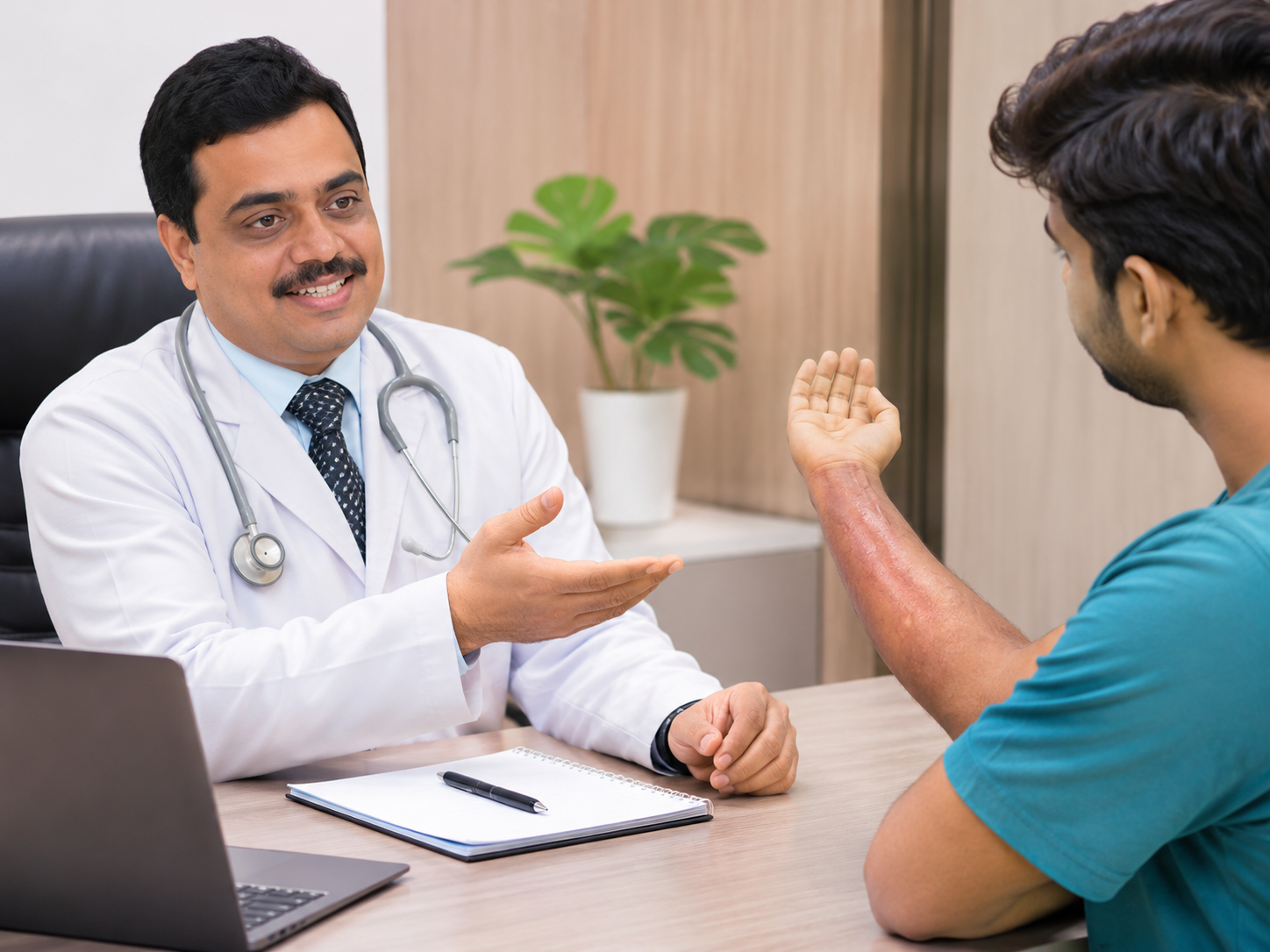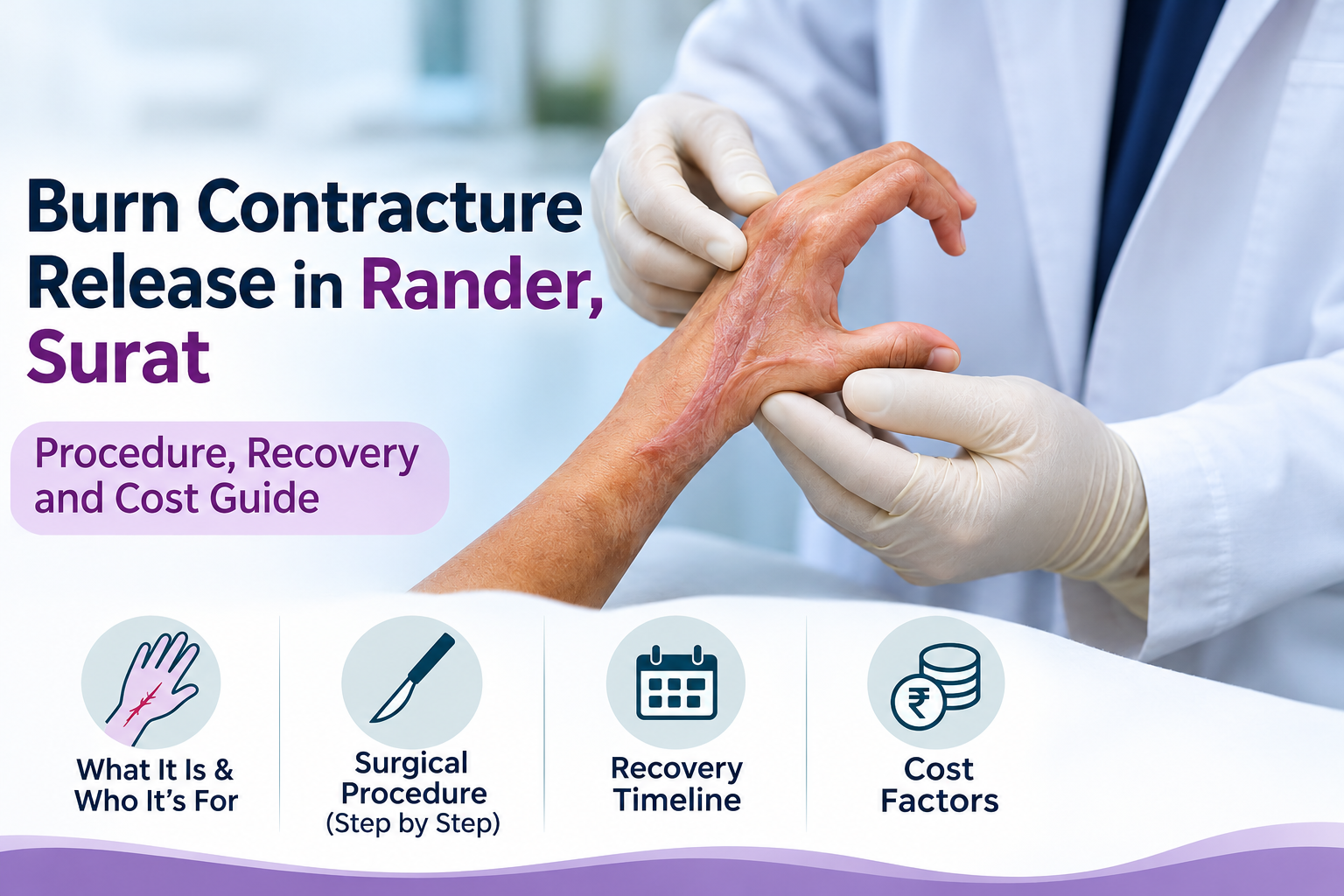
Burn contracture release is a reconstructive procedure that loosens tight scar tissue after a burn to improve movement, comfort, and daily function. People considering burn contracture release in Rander Surat should understand the surgical options, recovery timeline, cost factors, and importance of rehabilitation before deciding on treatment.
Burn contractures commonly affect the hands, fingers, neck, elbows, and other joints. Depending on the severity, treatment may involve scar release, Z-plasty, skin grafting, or flap reconstruction.
What Is Burn Contracture Release and Who Is It For?
A burn contracture develops when scar tissue tightens after a burn injury, restricting the movement of nearby skin and joints.
Deep burns can damage the skin's elasticity. As healing progresses, the scar may shorten and pull surrounding tissues into an abnormal position.
This can interfere with walking, writing, dressing, eating, or performing routine activities.
Common signs of burn contracture
-
Difficulty straightening or bending fingers.
-
Tightness around the neck, elbow, or shoulder.
-
Restricted movement after a healed burn.
-
Pain or pulling sensations when stretching.
-
Difficulty performing everyday activities.
-
Changes in posture caused by tight scars.
-
Repeated irritation or skin breakdown over the affected area.
Who may need burn contracture release?
Patients may benefit from reconstructive evaluation when scar tightness significantly restricts movement, causes discomfort, or affects daily activities.
However, not every burn scar requires an operation.
Mild contractures may improve with physiotherapy, splinting and other scar-management treatments.
For more information about reconstructive treatment, explore burn surgery and reconstruction.
How Burn Contracture Release Is Done, Step by Step
The surgical approach depends on the location, size and severity of the contracture, along with the condition of surrounding tissues.
During a consultation, Dr. Ashutosh Shah at Elegance Clinic can assess the affected area and discuss suitable treatment options.
Step 1: Clinical examination
The surgeon examines the scar, measures joint movement and assesses the condition of the surrounding skin.
The evaluation may include:
-
Scar thickness and tightness.
-
Joint range of motion.
-
Skin elasticity.
-
Circulation and sensation.
-
Previous burn treatments.
-
Functional difficulties.
-
Existing medical conditions.
Step 2: Selecting the surgical technique
Several reconstructive techniques may be considered.
Z-plasty
Z-plasty rearranges nearby skin to lengthen a tight scar. It may be suitable for selected linear contractures when sufficient healthy surrounding skin is available.
Skin grafting
After releasing the contracture, a skin graft may be used to cover the resulting defect.
The graft usually comes from another area of the patient's body.
Local or regional flap reconstruction
Flap reconstruction uses nearby tissue with its own blood supply to cover the released area.
It may be useful when deeper tissues require durable coverage.
Complex reconstructive surgery
Severe or recurrent contractures may require multiple procedures or staged reconstruction.
Patients with finger contractures can also explore finger contracture release for more information about hand-related reconstruction.
Step 3: Anaesthesia and surgery
The surgeon selects local, regional or general anaesthesia according to the procedure and the patient's medical condition.
During surgery, the tight scar is released and the resulting defect is reconstructed using the selected technique.
Step 4: Dressing and protection
The surgical area is covered with appropriate dressings.
A splint may be recommended to maintain the corrected position during healing.
Step 5: Rehabilitation
Physiotherapy and occupational therapy help maintain movement and reduce the risk of recurrent contracture.
The rehabilitation programme depends on the reconstruction technique, healing progress and affected joint.
Recovery Timeline: Day 1 to Week 6
Recovery after burn contracture release in Rander Surat varies according to the size of the contracture, surgical technique and individual healing response.
Some patients recover from smaller procedures within a few weeks, while complex reconstruction may require several months of rehabilitation.
| Recovery period | Expected recovery and care |
|---|---|
| Day 1–3 | Pain management, dressings, swelling control and surgical-site protection. |
| Day 4–7 | Wound checks and assessment of graft or flap healing when applicable. |
| Week 2 | Continued wound healing and review of dressings or stitches. |
| Week 3–4 | Gradual movement and rehabilitation when approved by the surgeon. |
| Week 5–6 | Ongoing improvement in movement and scar management. |
| After 6 weeks | Continued physiotherapy, splinting and long-term scar care when needed. |
How long does complete healing take?
Smaller surgical wounds may heal within a few weeks.
Larger grafts, flaps and complex reconstructions can require longer recovery.
Scar maturation may continue for 12–18 months or longer.
Why is physiotherapy important?
Surgery releases the tight scar, but rehabilitation helps maintain the improvement.
Treatment may include:
-
Range-of-motion exercises.
-
Custom splints.
-
Scar massage after wound healing.
-
Silicone-based scar management when recommended.
-
Pressure therapy in selected cases.
-
Supervised strengthening and stretching.
Patients should not force movement across a newly operated graft or flap without medical clearance.
For additional information, read about burn rehabilitation and treatment options.
What Affects the Cost of Burn Contracture Release in Surat?
The cost of burn contracture release depends on the extent of scarring, the reconstruction technique, anaesthesia, hospital facilities and postoperative requirements.
An accurate price cannot be determined without a clinical examination.
1. Size and location of the contracture
A small finger contracture may require a less extensive procedure than a severe contracture involving the neck, shoulder or several joints.
2. Surgical technique
Z-plasty, skin grafting and flap reconstruction have different operating requirements.
Complex procedures may involve additional surgical time and resources.
3. Anaesthesia and hospital stay
The need for general anaesthesia, inpatient admission or postoperative monitoring can affect the total cost.
4. Dressing and rehabilitation
Some patients need repeated dressings, splints, physiotherapy and follow-up appointments.
5. Additional procedures
Severe contractures may require staged reconstruction or further corrective procedures.
What should the cost estimate include?
| Expense | What to confirm |
|---|---|
| Surgeon fees | Whether all planned surgical work is included |
| Anaesthesia | Type of anaesthesia and related charges |
| Hospital charges | Operating theatre, room and monitoring fees |
| Skin graft or flap | Whether reconstruction is included |
| Medicines | Postoperative medicines and dressings |
| Rehabilitation | Physiotherapy and splinting expenses |
| Follow-ups | Number of included appointments |
| Additional surgery | Possible costs of future procedures |
Some insurance policies may cover medically necessary reconstructive surgery. Coverage depends on policy conditions, eligibility and approval.
Patients should request a written estimate and confirm insurance benefits before proceeding.
Risks and How They Are Kept Low
Burn contracture release is a reconstructive procedure, and complications are possible.
Potential risks
-
Infection.
-
Bleeding or swelling.
-
Delayed wound healing.
-
Skin graft or flap failure.
-
Persistent stiffness.
-
Changes in skin sensation.
-
Visible scarring.
-
Recurrence of the contracture.
How can patients reduce complications?
Before surgery: Follow medical advice, maintain adequate nutrition, manage existing health conditions and avoid smoking.
After surgery: Follow dressing instructions, attend appointments, use prescribed splints and participate in rehabilitation.
Seek prompt medical attention if you experience increasing pain, fever, spreading redness, unusual discharge or sudden colour changes in reconstructed tissue.
Can a burn contracture return?
Yes. Scar tightening may recur, particularly after severe burns or complex reconstruction.
Regular rehabilitation and scar management can help reduce the risk, although recurrence cannot always be prevented.
Getting to Elegance Clinic From Rander
Patients searching for burn contracture release in Rander Surat can consider a reconstructive surgery consultation at Elegance Clinic.
Dr. Ashutosh Shah is a plastic and reconstructive surgeon with more than 22 years of surgical experience.
During consultation, the assessment may include:
-
Reviewing the original burn injury.
-
Examining the scar and affected joint.
-
Evaluating previous treatment.
-
Discussing non-surgical and surgical options.
-
Explaining the expected functional improvement.
-
Planning postoperative care and rehabilitation.
Patients travelling from Rander should confirm the clinic's current address and appointment availability before visiting.
If surgery is recommended, arrange appropriate transportation and postoperative assistance, particularly when a limb is immobilised, or general anaesthesia is required.
Questions to Ask Before You Decide
Before choosing burn contracture release, patients should understand the expected benefits, limitations and rehabilitation requirements.
Consider asking:
-
Is surgery necessary for my contracture?
-
Can physiotherapy improve my movement without surgery?
-
Which reconstructive technique is suitable?
-
Will I need a skin graft or flap?
-
How much movement can realistically improve?
-
What type of anaesthesia will be used?
-
How long will I need to avoid work?
-
Will I require physiotherapy or splinting?
-
What is the possibility of recurrence?
-
What is included in the treatment estimate?
You can also explore burn care and recovery articles for related information.
Conclusion
Burn contracture release can improve movement, comfort and daily function in appropriately selected patients with restrictive burn scars.
However, long-term improvement depends on suitable surgical planning, wound care, rehabilitation and follow-up.
For patients considering burn contracture release in Rander Surat, a consultation can help determine whether surgery is appropriate and which reconstructive approach may provide meaningful functional improvement.
Have questions about your situation? Book a consultation with Dr. Ashutosh Shah at Elegance Clinic (Monday to Saturday), or send your medical reports through the clinic's official WhatsApp channel. Contact Elegance Clinic.