A tight burn scar in the armpit slowly pulls the arm down against the chest, until reaching overhead becomes impossible. Axilla contracture release opens that band with new skin, so the shoulder can lift, reach and move freely again.
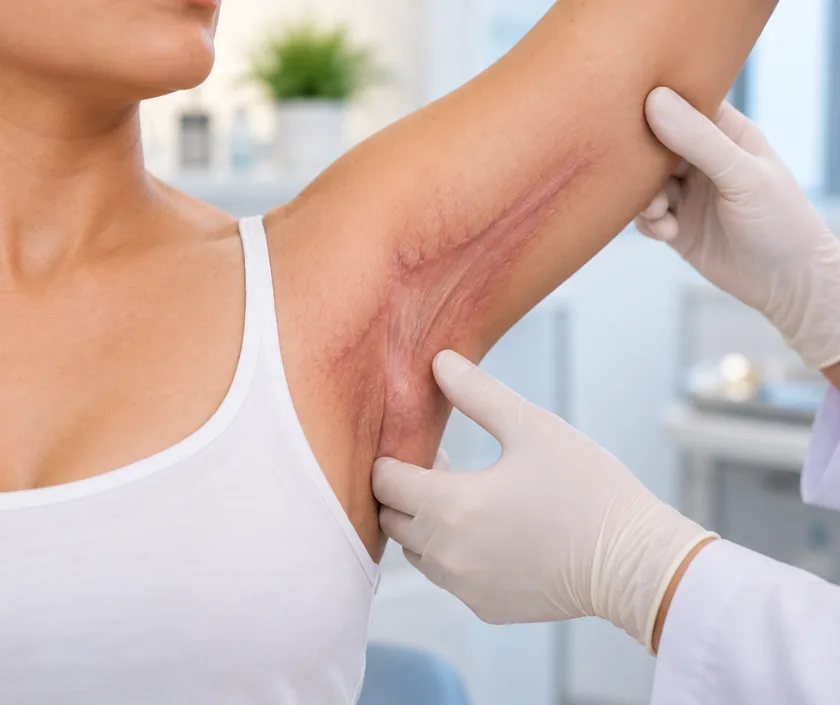
Axilla contracture release is surgery that divides the tight burn scar band in the armpit and resurfaces the gap with healthy tissue, so the arm can be raised again. Most people need a skin graft or a local flap, followed by splinting that holds the shoulder open and by daily therapy. Without that after care, the band tends to tighten once more.
Burns around the armpit heal into scar that shrinks as it matures. Because the shoulder moves in every direction, even a narrow band of tight scar can hold the arm down against the chest. Many people notice the loss slowly. At first the arm simply feels stiff in the morning, then reaching a high shelf becomes awkward, and eventually the elbow cannot be lifted past shoulder level at all.
Daily life narrows quickly. Wearing a shirt, combing hair, hanging washing on a line and carrying a bag on that side all turn into a struggle. Skin inside the fold often stays damp and can break down or itch, while the shoulder joint itself grows stiff from being held still for so long.
Surgery aims to give the armpit back its length. Once the band is divided, the raw area is covered with a skin graft or a flap of healthy tissue, and the shoulder is held open while that new cover settles. Therapy then trains the joint to use the range that has been restored.
Release works best when the burn wound has fully healed and the scar has settled into a firm band that limits movement.
The surgeon measures how far the arm lifts, feels where the band is tightest and marks it with the arm stretched. Photographs and a therapy review help decide whether a graft or a flap will cover the gap.
Under general anaesthesia the tight cord is cut across, so the arm swings up freely. Deeper structures such as nerves and vessels are protected, and the true size of the gap only becomes clear once the shoulder opens.
Small gaps are closed by rearranging local skin as Z shaped flaps. Wider raw areas need a thick skin graft, and a deep armpit may be lined with a flap of skin lifted from the chest wall or back.
Before waking, the arm is settled in an open position and supported with a bulky dressing or a splint. That position protects the new cover while it takes and stops the scar from folding back on itself.
Once the graft has settled, a therapist begins gentle shoulder movement and teaches a home routine. Splint wear at night usually continues for months, because a healing scar will pull inward if it is left alone.
The arm stays supported and slightly raised, pain is controlled with medicine, and the first dressing is usually left undisturbed unless there is a concern.
Dressings are changed, graft take is checked and gentle assisted movement begins. Most people go home with a splint and clear instructions on wearing it.
Therapy becomes more active, stretching is added and everyday tasks on that side are practised. Scar care with massage and pressure often starts around this time.
Scar softens slowly and range is reviewed at follow up. Night splinting may continue for a long while, and growing children are watched closely for tightening.
Movement usually improves a great deal, yet the armpit will not look or feel like skin that was never burned. Grafted areas often stay a different colour and texture, and a fine scar line remains at the edges. How much range is kept depends heavily on splinting and therapy carried out at home. Some tightening over time is common, and a second smaller release is occasionally needed, particularly while a child is still growing.
Every operation carries risk, and burn scar surgery has a few of its own that are worth discussing before you agree to a date.
Work done at home decides how much of the new movement is kept, so plan for it before you leave hospital.
Scar can be released and resurfaced years after the original injury, and movement often improves even in old contractures.
Release opens the armpit, although splinting and therapy are what hold the gain. Skipping them is the commonest reason movement is lost again.
Therapy helps mild tightness and keeps joints supple, though a mature band of scar will not lengthen enough on its own.
Growth usually makes a burn contracture worse, because scar does not lengthen with the limb, so children need review as they get taller.
Burn reconstruction at Elegance Clinic in Surat is planned as a course of care rather than a single operation, with therapy and splinting built into the plan from the first consultation.

In India a burn contracture release counts as reconstructive surgery, so most health insurance policies and many government schemes cover it once the need is documented. The final figure depends on how large the raw area is, whether a graft or a flap is used, the length of stay and the therapy that follows. You will be given a written estimate before admission.
These are the questions that come up most often in consultation. If yours is not here, send it on WhatsApp and the team will reply, usually the same day.
Ask your question →Cost usually falls in a band of Rs 45,000 to Rs 1.6L, depending on the size of the raw area, whether a graft or a flap is needed and how long you stay in hospital. A written estimate is given before admission.
Burn contracture release restores function rather than changing appearance, so mediclaim policies and government schemes generally allow it. Approval needs photographs, a note on the movement lost and the treating team paperwork. Waiting periods and room limits in your policy still apply.
Release is a common reconstructive procedure and is usually well tolerated under general anaesthesia. Risks include graft loss, bleeding, infection and rarely injury to a nerve near the released band. Your fitness is checked beforehand, and problems are far easier to manage when reported early.
Most people go home within a few days, once the dressing has settled. Assisted movement starts in the first weeks, and stronger stretching follows as the graft matures. Night splinting and home exercises often carry on for many months, which is what protects the movement gained.
Reaching overhead usually becomes far easier, though the shoulder may not regain the full range it had before the burn. Skin over the armpit will still look grafted. How much movement is kept depends largely on splinting and therapy done at home.
Surgery is usually planned once the burn has healed and the scar has matured, so tissue handles better. Children are treated sooner when tightening starts to limit growth, posture or school activity. An open or infected wound must settle before any release is booked.
Shoulder movement is measured, the scar band is examined with the arm stretched and photographs are taken for records and insurance. Options such as a graft or a flap are explained, along with splinting and therapy. You leave with a written plan and estimate.
Each technique below has its own page explaining how it works and when it is chosen.
Seeing patients from across the city and beyond: read about the practice on the plastic surgeon in Surat page, or check what a written estimate covers on the costs and insurance page.
