The groove between cheek and gum is where chewed tobacco and areca nut are often held, and it is a common site for oral cancer in India. Reconstruction rebuilds that groove so the mouth still opens and works.
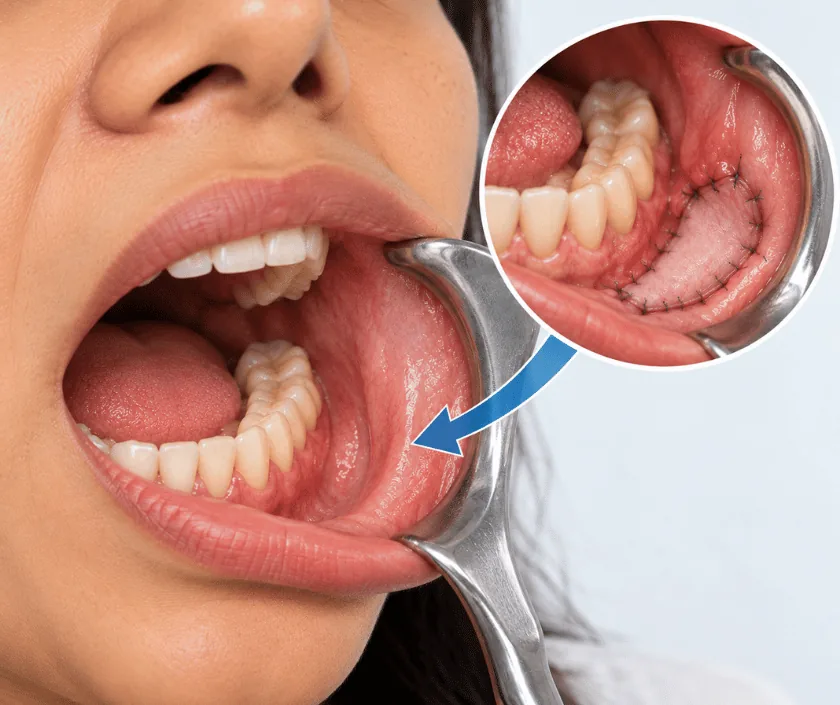
Gingivobuccal sulcus reconstruction restores the groove where the inner cheek meets the gum after a cancer has been removed. Because this area scars and contracts easily, fresh tissue is brought in as a flap rather than pulling the edges together. Keeping the groove deep protects mouth opening, makes cleaning possible and allows dentures to be fitted later.
Fold your cheek away from your teeth and you find a shallow trench. That trench, the gingivobuccal sulcus, is where a quid of tobacco or areca nut is usually parked, and it is a common site for cancer in this part of the world. When a tumour is removed from here, the surgeon takes the lining of the cheek, the lining of the gum and sometimes a thin layer of the jaw bone.
The problem afterwards is contraction. This groove scars enthusiastically, and a wound left to heal on its own, or closed under tension, pulls the cheek tight against the gum. Mouth opening narrows, brushing becomes impossible, and future dentures have nowhere to sit. Reconstruction resurfaces both walls of the groove with tissue that will not shrink in the same way.
What is used depends on the defect. A skin graft held with a bolster may suffice for a shallow area. A flap of tissue from the cheek, neck or forearm is used when the removal is deeper, involves the jaw, or reaches through to the skin. When the jaw has been cut through, bone reconstruction is planned in the same operation.
The reconstruction is decided along with the cancer removal. Both the extent of disease and your ability to do exercises afterwards influence the plan.
Mouth opening is measured, the extent of any fibrosis is noted, and scans are reviewed with the cancer surgeon. Dental treatment that will be difficult after radiotherapy is completed first wherever possible.
The tumour is taken out with a margin, along with the involved gum lining and, when needed, the outer plate or a segment of the jaw. Neck glands are usually cleared in the same sitting.
A skin graft, a local flap from nearby tissue, or a free flap from the forearm or thigh is selected. The decision rests on how deep the defect is and whether the jaw was cut.
Tissue is inset so that both the cheek wall and the gum wall are resurfaced, and a groove is deliberately maintained between them rather than allowing the two surfaces to meet.
A splint or bolster may hold the new groove open while healing begins. Mouth opening exercises are started as soon as the surgeon considers the repair secure.
The face is swollen and feeding goes through a tube. Any splint or bolster stays in place. Nurses check the flap and keep the mouth clean with gentle rinses.
Swelling settles, the bolster or splint usually comes off, and soft feeds by mouth begin once swallowing is checked. Mouth opening exercises start under supervision.
Healing is mostly complete and exercises are the main task. Radiotherapy, if advised, tends to begin around this stage and can make the mouth sore for several weeks.
The groove has settled to its final depth. Continued exercises hold the gains made. Dental rehabilitation, when planned, is usually considered from this point onwards.
Mouth opening usually improves compared with a scarred or fibrotic starting point, yet it rarely reaches a normal range, especially when fibrosis was already present or radiotherapy follows. The groove tends to shallow a little over the first year, which is why daily exercises are stressed so heavily. Chewing on that side often stays weaker. Most people gain a mouth they can clean, examine and feed themselves with comfortably.
Scarring is the main long term adversary in this area, and the other risks are those of any major oral operation.
Success here is decided at home over many months, mostly through exercises and hygiene.
Left alone, this groove heals by scarring and pulls the cheek onto the gum. That is exactly what reconstruction is designed to prevent.
Scar keeps tightening for many months. Exercises are what hold the opening you gained, particularly through and after radiotherapy.
Continued use keeps the whole lining at risk and raises the chance of a second cancer in another part of the mouth.
Dental rehabilitation is often possible later, which is a large part of why the groove is deliberately kept deep.
Elegance Clinic in Surat treats mouth opening as an outcome that is measured and followed, not simply hoped for. The plan, the likely stay and the estimate are explained to the family before admission.

Costs vary with the type of cover used, whether jaw bone is removed and rebuilt, the duration of surgery and the length of stay. A simple graft sits well below a free flap in cost, while jaw reconstruction sits at the upper end.
You receive a written estimate after the joint plan is finalised. Cancer surgery is covered by many insurance policies and government schemes, so bring your documents when you come.
These are the questions that come up most often in consultation. If yours is not here, send it on WhatsApp and the team will reply, usually the same day.
Ask your question →Free flap reconstruction usually falls between Rs 1.8L and Rs 4.5L. Simpler cover with a graft costs less, while jaw reconstruction sits higher. The final estimate is written down once the extent of the removal is planned with the cancer team.
Opening often improves compared with a fibrotic or scarred mouth, though it rarely returns to normal. Exercises are the deciding factor. Radiotherapy can tighten tissue again, so the exercise routine continues right through that treatment.
It can be done, but healing is slower because fibrotic tissue has a poorer blood supply. Flaps that bring in their own circulation are often preferred. Blood sugar, nutrition and any infection are corrected before the date is fixed.
Most stays run from about five to ten days, depending on the flap and how quickly swallowing recovers. Where a splint holds the new groove open, its removal is usually the point at which soft feeds by mouth begin.
No. Continued tobacco or areca nut use keeps the entire lining at risk, delays healing and raises the chance of a second cancer elsewhere in the mouth. Stopping completely is part of the treatment.
It typically begins once wounds have healed, often around four to six weeks after surgery, with the exact timing set by the oncology team. Mouth opening exercises should carry on before, during and after those sessions.
Mouth opening is measured, the mouth is examined, and reports and scans are reviewed. The likely removal, the choice of cover, the expected stay and the estimate are all discussed with you and your family together.
Each technique below has its own page explaining how it works and when it is chosen.
Seeing patients from across the city and beyond: read about the practice on the plastic surgeon in Surat page, or check what a written estimate covers on the costs and insurance page.
