The lips seal the mouth, shape speech and carry a great deal of expression. Reconstruction after lip cancer aims first at a lip that closes properly, then at a shape and a scar that sit comfortably on the face.
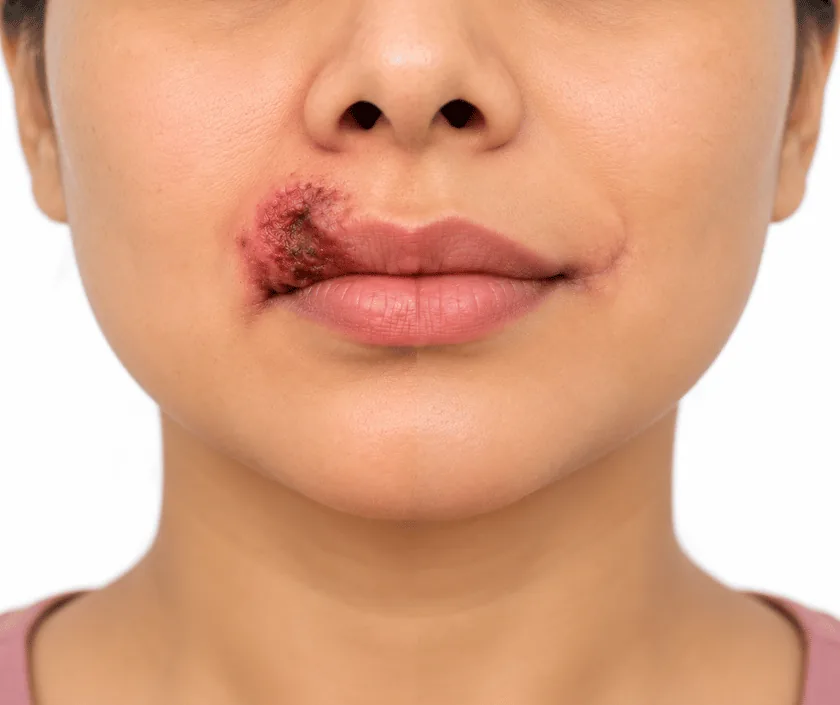
Lip cancer reconstruction restores the lip after a tumour and a margin of healthy tissue have been removed. Small defects can be closed directly. Larger ones are rebuilt with flaps that borrow tissue from the remaining lip, the cheek or the chin, and very large ones may need a free flap. The first goal is a lip that seals the mouth.
A lip is more complicated than it looks. It has skin on the outside, moist lining on the inside, a ring of muscle in between that squeezes the mouth shut, and a sharp red border where the two surfaces meet. Cancer surgery removes all four layers together with a margin, so the repair has to put all four back in the right order.
How that is done depends on how much lip has gone. A small removal can be closed directly, and the muscle is stitched as its own layer so the lip still purses. When roughly a third or more is missing, tissue is borrowed from the remaining lip, the cheek or the region beside the nose, and moved in while keeping its own blood supply. Very large removals, or those that also take the chin or the jaw, may need a free flap brought from the arm or the thigh.
Whatever the method, scars are placed along the natural lines of the lip and chin wherever possible, and the red border is aligned carefully, since even a small step there is visible in ordinary conversation.
Almost everyone having a lip cancer removed needs some form of repair. The question is which method fits the size of the defect and your general health.
The tumour is measured and the likely defect is marked on the lip. Photographs are taken for planning. Neck glands are examined, and scans are arranged when the tumour is large or thick.
The tumour is removed with a margin of healthy tissue, taken through all layers of the lip. Where required, the specimen is checked during surgery before the repair begins.
Small defects are closed directly in layers. Larger ones are rebuilt with a flap borrowed from the remaining lip, the cheek or beside the nose. Very large defects may need a free flap.
Lining, muscle and skin are repaired as separate layers so the lip can still purse and seal. The red border is aligned precisely before the outer stitches go in.
If glands in the neck are involved or the tumour is thick, neck clearance is carried out in the same sitting. The pathology report then guides any further treatment.
The lip is swollen and stiff, and speech feels awkward. A soft or liquid diet is used and the wound is cleaned as instructed. Most people go home during this period.
Stitches are usually removed and swelling begins to fall. Gentle lip exercises start. Eating becomes easier, though a straw may still be simpler than a cup at first.
Scars are settling and mouth opening exercises continue. Most people are back at work. Radiotherapy, where advised, often starts around this stage.
Scars soften and pale, and lip movement continues to improve. Any small adjustment of the red border or the mouth corner is usually considered from this point onwards.
A rebuilt lip is usually competent and functional, yet it is rarely identical to the original. The mouth may look slightly smaller or a little asymmetrical, particularly after a large removal. Scars fade over months but do not disappear. Sensation and fine movement return partially, so precise sounds and pursing may not fully recover. Most people eat, drink and speak comfortably and find the appearance settles well by around six months.
The lip heals well as a rule, but there are specific problems worth knowing about before you consent.
The lip is used constantly, so the home routine is mostly about protecting the repair while it settles.
It is a cancer that can spread to the neck glands. Removal with a clear margin comes first, and the repair is planned around that.
Shaving the surface leaves disease behind. The removal must go through the full thickness of the lip with a margin around it.
Closing a lip is easy. Keeping the mouth wide enough to eat, and the red border aligned, is what the planning is for.
Scars keep softening and paling for many months, and lip movement improves in parallel, so early appearance is not the final one.
Elegance Clinic in Surat plans lip repair around function first and appearance close behind, with the reconstruction discussed before the removal rather than afterwards. The estimate and the expected stay are shared in advance.

Cost varies widely here, because a small direct closure and a large flap repair are very different operations. Neck gland clearance, the type of anaesthesia and the length of stay all change the figure.
A written estimate is given once the removal has been planned. Many policies and government schemes cover cancer surgery, so please bring your documents to the consultation.
These are the questions that come up most often in consultation. If yours is not here, send it on WhatsApp and the team will reply, usually the same day.
Ask your question →Free flap reconstruction sits in the band of Rs 1.8L to Rs 4.5L, while smaller repairs using local tissue cost considerably less. Neck gland clearance, theatre time and hospital stay all affect the total, and a written estimate is given beforehand.
Scars are placed along the natural lines of the lip and chin wherever the defect allows. They look red and firm at first, then soften and pale over several months. Sun protection during that period genuinely helps them settle.
Most people go home within a few days and return to routine within two to four weeks, depending on the repair. Swelling and stiffness ease over the first fortnight, while scar softening and lip movement continue improving for months.
A soft diet is used at first, and many people find a straw easier than a cup during the early days. Eating usually becomes comfortable within a few weeks. After a very large removal, the mouth opening may stay smaller than before.
Yes, and in that situation the neck is cleared during the same operation. The pathology report then guides whether radiotherapy is advised. Reconstruction is planned so that further treatment is not delayed.
Lip cancers are best removed soon after diagnosis, since delay allows growth and involvement of the neck glands. The date depends on completing any scans and on controlling diabetes or other health problems first.
The lip and neck are examined, the size of the likely removal is marked, and repair options are drawn out for you. Photographs are taken for planning, questions are answered, and a written estimate follows.
Each technique below has its own page explaining how it works and when it is chosen.
Seeing patients from across the city and beyond: read about the practice on the plastic surgeon in Surat page, or check what a written estimate covers on the costs and insurance page.
